
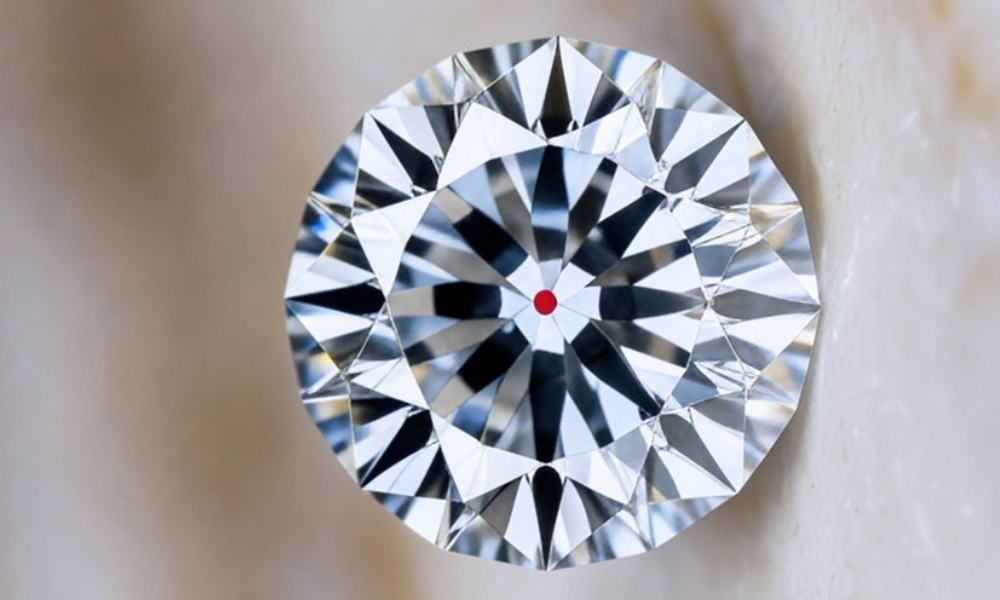
It’s time for the natural diamond industry to reassert itself as one of the foremost personal luxuries. Diamond has for centuries been associated with royalty, wealth and more recently, the most special moments of modern life.
However, over the years a diamond’s legacy, allure and value has been clouded by an influx of non-gem-quality goods, colour and clarity treated stones, and most consequentially, the mainstream introduction of ubiquitous machine-made diamonds.
In order to reframe the perception of diamond as ‘one of the most valuable things you can own’ it could serve the industry well to uniquely identify natural goods with a distinguishing marker of sorts to more easily differentiate, at least top-quality goods, from the (much less valuable) rest.
Ideally, the “mark” would be simple and easily identifiable without distracting from the diamond’s eye clarity – perhaps only visible with a 10x loupe. But it’s important that consumers can relativity easily identify the authenticity of a diamond on their own.
Ideally, the key would be for every natural diamond to have the same, consistent mark – including all branded jewellery that includes natural diamonds. For example, an embedded red pinpoint or star visible from the table – think Christian Louboutin’s signature coloured sole. Ultimately, the standard practice of shopping for a diamond would include “looking for the mark.”
This combined with a consistent formal descriptor, i.e. “Natural diamond,” could highlight the rarity and uniqueness of “real” diamonds. (Yes, LGD material is chemically diamond, but when most people hear “diamond” they think the rare and valuable kind that has been treasured by humanity for millennia.) It’s presumably confusing for consumers when natural diamond is described in various different ways such as “mined diamond,” “earth diamond” or “earth-grown diamond.” The industry should stick with one moniker only: “Natural diamond.”
Any stone possessing the aforementioned “mark” that is not a natural diamond would be a counterfeit – similarly, selling a non-natural diamond in any way that implies that it is a “Natural” would be considered fraudulent, the way that sparkling wine marketed as Champagne has to originate from the appropriate region to be sold as such.
Country of origin initiatives that are aggressively being undertaken by the industry reinforce this larger product positioning.

Industry leader, Tiffany & Co., has been providing consumers with the geographic origin of each of its diamonds 0.18 carat and larger since 2018. China’s Chow Tai Fook currently provides “traceability” information for all of its “T-Mark” banded diamonds of 0.08 carat and larger. By 2029, the company is aiming to only sell diamonds with origin information.
Most recently, launched in time for the 2025 holiday season, Signet Jewelers, the largest seller of diamonds in the world, debuted its “Storied Diamond” collection through its Jared stores. The partnership with De Beers offers customers 40 “data points” unique to each diamond plus an image of the stone in the rough. The collection is being supported by the contemporaneous release of a 20-minute documentary on Botswanan diamonds called “A Diamond Is Born” by Academy Award-winning filmmaker Luc Jacquet.
Finally, the natural diamond industry could lean into these developments as a way to spark “newness” for its product. Consumers are inherently drawn to “new.” Part of the success of LGD can be tied to the fact that it is a new product in an industry that has historically has not initiated much structural innovation. Newness drives publicity buzz and gives consumers a reason to think about a product that perhaps has not been on their mind for a while.
Paul Zimnisky, CFA is an independent diamond industry analyst and consultant based in the New York metro area. For regular in-depth analysis and forecasts of the diamond industry please consider subscribing to his State of the Diamond Market, a leading monthly industry report; an index of previous editions can be found here. Also, listen to the Paul Zimnisky Diamond Analytics Podcast on Spotify or Apple Podcasts for exclusive full-length conversations with special guests from the gem and jewelry industry. Paul is a graduate of the University of Maryland’s Robert H. Smith School of Business with a B.S. in finance and he is a CFA charterholder. He can be followed on X @paulzimnisky and on YouTube @paulzimnisky.
Paul will be giving a keynote presentation at the Prospectors & Developers Association of Canada (PDAC) Convention in Toronto, Canada on March 2, 2026.
Disclosure: At the time of writing Paul Zimnisky held a long equity position in Brilliant Earth Group and Newmont Corp. Paul is an independent board member of Lipari Mining Ltd, a publicly-traded Canadian company with an operating diamond mine in Brazil and a development-stage asset in Angola. None of the above constitutes investment advice, please read full disclosure at www.paulzimnisky.com.
