

In a few short years, AI has gone from being a buzzword to a practical tool for optimising daily factory workflows. At a recent training program at Bharat Ratnam Mega CFC, Amitendra Srivastava, AI Solutions Architect and Co-Founder of Intelytica, showed manufacturers how targeted AI applications in design, CAD, pricing and factory optimisation can boost speed, consistency, output and ultimately, profits.

Jewellery manufacturing has long relied on craftsmanship and intuition. What convinced you that the sector is now ready to absorb structured AI training at scale?
Honestly, what convinced me was the shift I’ve seen over the last year and a half. Earlier, jewellers viewed AI as something futuristic. Now they’re the ones asking whether it can speed up design cycles, cut catalogue creation time, or sharpen pricing decisions. The pressure points have grown too strong to ignore: labour shortages, rising production costs, exploding SKUs, and customers who expect faster turnaround. When I began running workshops with design, CAD, and manufacturing teams, the appetite for practical, industry-specific learning was unmistakable. Craftsmanship is still the heart of the industry, but the mindset has shifted to craftsmanship plus technology, and companies recognise that this combination will give them their competitive edge.
You have designed a four-day curriculum covering everything from design and CAD to pricing and production. Which of these areas do you believe will see the fastest real-world adoption?
Design and cataloguing will move fastest, simply because that’s where the biggest bottlenecks are. Large companies spend heavily on photography, retouching, hand-drawn renderings, and endless CAD revisions. AI cuts those cycles from days to hours, so the impact is immediate.
The next rapid adopter will be pricing and quotation engines. Everyone wants to respond faster in both B2B and retail, and once they see dynamic pricing or AI-driven gold rate simulations, they get hooked.
What we’ve also realised is that adoption doesn’t always start with the biggest challenges. Sometimes it begins with small, repetitive tasks that quietly slow everything else down. For example, when a client shares a requirement, teams sift through thousands of designs manually to find the closest match. AI can find that match instantly, reducing huge amounts of manual effort. So while design and cataloguing lead the way, companies are also targeting very specific micro-processes where AI can give them quick, meaningful results.
Many jewellers still see AI as abstract. What is the one misconception you want to break on Day 1 itself?
The biggest misconception I tackle on Day 1 is the fear that AI will replace designers or karigars. It won’t. AI isn’t coming for the core skills that define this industry. It removes the repetitive, time-consuming work, but the creative thinking, the detailing, the brand’s signature style, that remains entirely human. AI simply speeds up the boring parts that no one enjoys, so people can focus on the work that truly needs their expertise.
Generative design tools like Midjourney and DALL-E are now entering creative workflows. How do you see traditional designers responding when AI begins generating first drafts?
Most designers resist it at first because they feel their creativity is being challenged. But the moment they try these tools, the reaction shifts. They see that AI isn’t replacing their imagination, it’s giving them a head start. Instead of spending hours sketching variations, they get multiple directions in seconds and then refine those ideas with their own design language.
Professional designers become faster, more experimental, and more valuable. What I tell them is that AI will not take over a designer’s role. The real edge will belong to designers who understand how to use these tools well. Prompt engineering skills, AI tool awareness, and the ability to refine AI outputs are becoming essential, and the designers who embrace that will lead the next phase of creative work.
When participants build their first AI-generated CAD files, what skill gap becomes immediately visible?
The first thing participants notice is that AI can generate a form, but it can’t think like a manufacturer. AI-generated CAD is still in its initial stages. The results require a lot of work, lack precision, and don’t reflect karigar logic. We’re not yet at a point where text-to-CAD or image-to-CAD delivers production-ready files. So when they generate their first CAD, the gap becomes clear. AI can offer a starting point, but the real value comes from pairing those rough forms with human expertise and manufacturing sense.
Pricing in the jewellery trade has always been driven by manual judgement. What shifts when AI steps into dynamic pricing and B2B quotation engines?
The biggest shift is speed and consistency. Today, two team members can quote two different prices for the same product. With AI you get standardised margins, instant recalculations with daily gold rates, and model-based profitability predictions. You can also build customer-specific B2B pricing rules, which eliminates guesswork and builds trust. For owners, the real win is controlling margin leakage, which remains one of the industry’s biggest pain points.
Predictive maintenance and defect detection sound technical for a typical factory floor. How do you make these concepts workable for MSMEs?
Predictive maintenance and defect detection sound technical, but I break the process into simple, workable steps for MSMEs. Their existing cameras and basic workflows are usually enough. We pinpoint a few stages where defects occur, collect sample images, and train a lightweight model that can run on a laptop or even a phone. When they see a demo built from their own images, the practicality becomes clear. The hands-on work happens on no-code tools, so they can drag, drop, and build usable models without requiring Python. They realise quickly that AI doesn’t need heavy infrastructure, just structured data and small models that deliver immediate value.
Inventory, forecasting, and production planning are major pain points. Which AI technique delivers the quickest ROI in these areas?
The quickest ROI comes from straightforward demand forecasting using time series and simple regression models. We’re not using deep learning or anything heavy. In fact, many of these models can be built in Excel because most companies already have years of sales data, they just haven’t used it well. Even a basic model that predicts the top 50 SKUs for the coming month delivers huge gains in raw material planning, karigar allocation, and reducing dead stock. That simplicity is what makes it the fastest win.
Many companies want AI but lack clean data. How do you teach organisations to build usable data pipelines without overwhelming them?
I avoid jargon and ask companies to start with one simple pipeline around product, process, or profit. That means maintaining minimal structured data for areas like design, CAD processing, making charges, stone breakups, or quality control outcomes. Many of these activities already happen manually; the missing piece is that the data isn’t captured.
For example, managers know which karigars are strong at which tasks, but that knowledge isn’t recorded anywhere for an AI system to learn from. Quality control teams accept or reject stones, but the reasons are rarely stored in a digital format. We show them how even basic structured data can unlock future AI use cases.
Once they see that simple tools like spreadsheets, lightweight CRMs, or small databases are enough to start, the resistance drops automatically.
Indian brands tend to experiment with AI in silos. What patterns did you observe while selecting the case studies for this program?
Most companies are using AI for small tasks in isolated pockets: one team experiments with Midjourney, another uses ChatGPT for coding, someone else runs basic Excel forecasting. The pattern is clear. These efforts aren’t connected.
So while selecting case studies, I focused on complete workflows rather than standalone experiments. For example, defect detection is only one step. It should link into quality control, and then into reporting. Or take inventory: it should connect to forecasting and then to allocation. I wanted participants to see the value of an integrated chain, not isolated AI experiments.
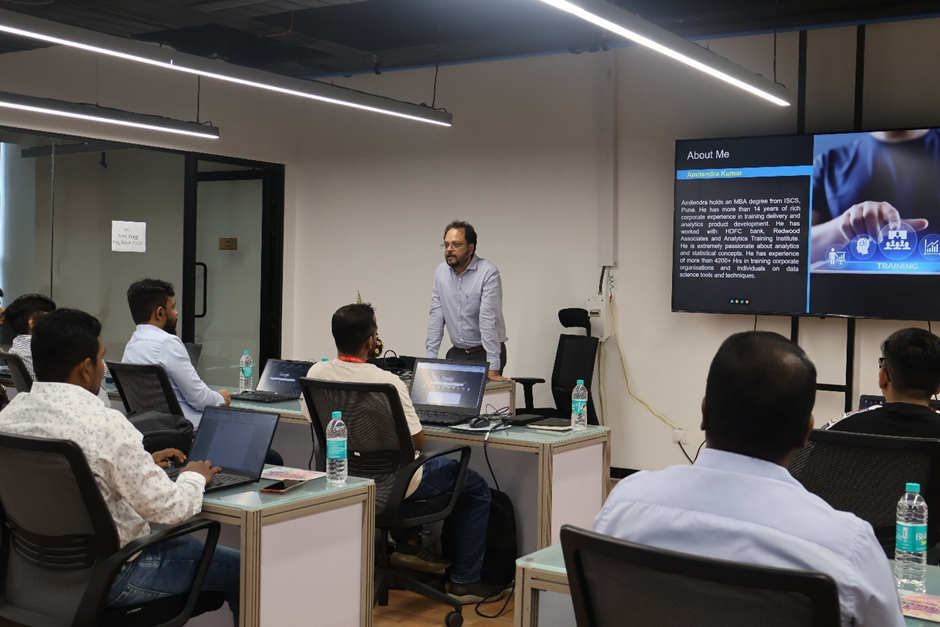
You’ve trained thousands of professionals. What differentiates participants who actually implement AI in their business from those who remain stuck in exploration?
I’ve noticed three clear differences. First, implementers pick one use case instead of chasing ten ideas at once. That focus helps them move quickly. Second, they involve the business owners early, so the ROI conversation starts from week one rather than at the end of the project. Third, they don’t stay in experimentation mode. Implementers go straight from learning to prototyping, pilot and then scale.
With competitors investing in AI-ready teams, where do you think early adopters in the Indian jewellery sector will gain the strongest competitive edge over the next two years?
I see three areas where early adopters will gain the strongest edge. The first is speed: faster cataloguing, faster quotations, and faster production cycles. The second is consistency, with fewer human errors across pricing, CAD, forecasting, and other repetitive processes. The third is scalability. Teams will be able to produce far more without increasing the headcount.
Companies that adopt AI now will operate with augmented intelligence, becoming faster, more predictable, and ultimately more profitable than their competitors.