
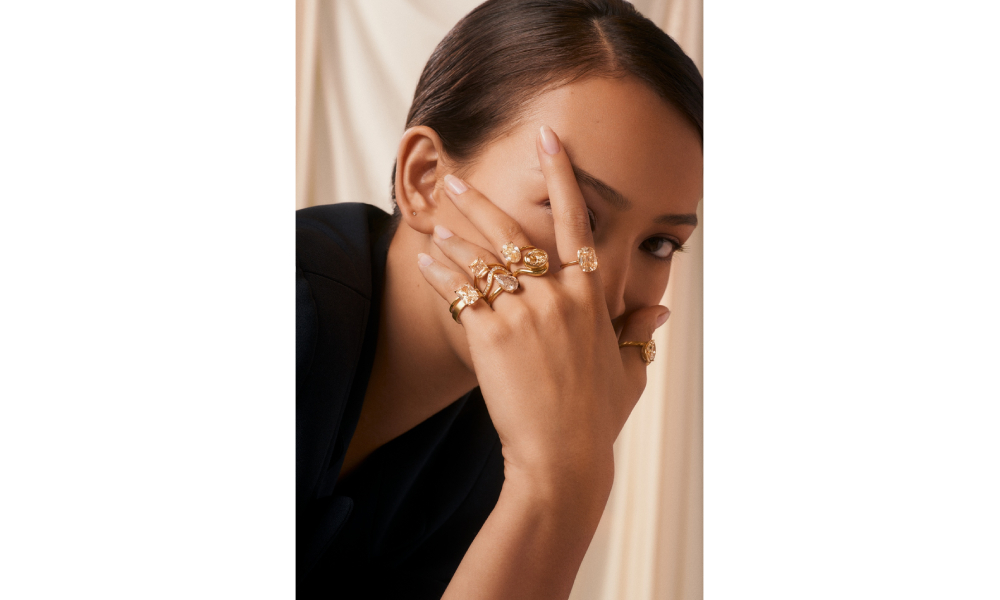
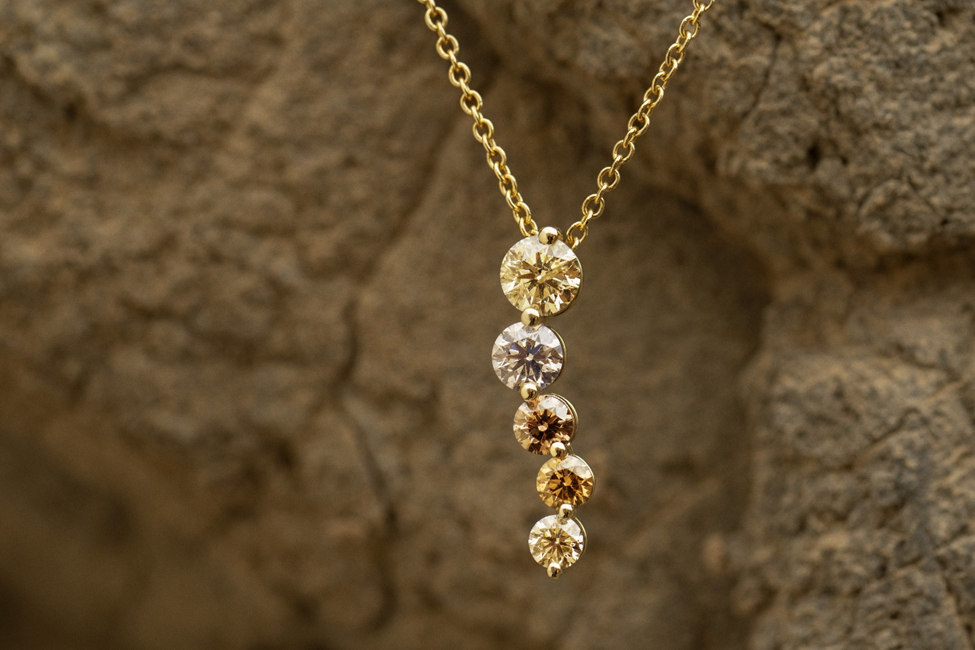
Subtle, muted, sophisticated, and never in your face — we’re witnessing a gradual rise of brown diamonds. Thanks to De Beers’ Desert Diamond line, the trend has taken hold, with designers from New York to Edinburgh embracing brown, champagne, and cognac diamonds, reimagining them in contemporary jewellery.
First unveiled at JCK Las Vegas, Desert Diamonds marks De Beers’ newest design beacon, drawing on the wild, unfiltered nature of diamonds and the desert landscapes from which many are formed. The collection celebrates a natural gradient — from “warm white to champagne and amber” — positioning colour as an authentic signature of each stone. “We are seeing desire for unique, characterful diamonds growing everywhere,” says Sandrine Conseiller, CEO of De Beers Brands & Diamond Desirability.
Italian jeweller Pomellato, too, leans on brown hues for its new Sabbia (‘sand’ in Italian), pieces that spotlight its signature irregular pavé, a tapestry of brown and white diamonds arranged in an intentionally organic pattern. True to its name, the collection articulates sunlight glinting across a dune, evoking an interplay of light and shadow.
Though often overlooked in the wider market, London-based jewellery designer Cora Sheibani sees brown diamonds as “highly underrated,” especially given how “striking they appear against gold and how flattering their warm hue is on every skin tone.” Brown diamonds, she points out, are more affordable than colourless diamonds, making them a meaningful yet attainable choice for fine jewellery.
New York-based Reema Chopra, Founder of Khepri, has seen a shift among clients seeking pieces that speak softly yet luxuriously. “Many of my clients, especially those with a deep appreciation for understated luxury, see traditional white diamonds as too ostentatious for everyday wear.” For Reema, brown diamonds offered a way forward. “I saw an opportunity to reimagine them through a modern, elevated lens.” Reema developed “a distinctive palette that blends green, yellow, red, and orange hues with subtle brown undertones,” capturing warmth and “vintage romance.” The designer pairs brown diamonds with 18-karat and 22-karat gold for distinctly modern designs.
Keira Wraae-Stewart, Founder of Aetla, has observed an enduring appreciation for warmer diamond hues. Since opening the boutique in Stockbridge, Edinburgh, five years ago, she has consistently seen interest in champagne and cognac diamonds, as part of a broader demand for alternative engagement rings. “These tones have remained steady rather than trend driven. A champagne or brown diamond set in yellow gold offers a more neutral, understated look, the equivalent of a white diamond in a white metal. That softer contrast appeals to many of our customers.” The palette, shares Keira, is also championed by independent designers such as Ruth Tomlinson and Flora Bhattachary, whose creations continue to perform well at the boutique.
Growing in the Highlands of Scotland, Ellis Mhairi Cameron has “always loved the subtlety of earthy tones,” ever since she started her namesake brand in 2018. The environment continues to influence her aesthetic and informs her intentionally expansive colour palette that ranges from “light champagne through to deep cognac hues, there’s a huge variety of colours and shades within that spectrum.” These colours are still very apparent in her work today and she “actively seeks out stones with inclusions or interesting tones.”
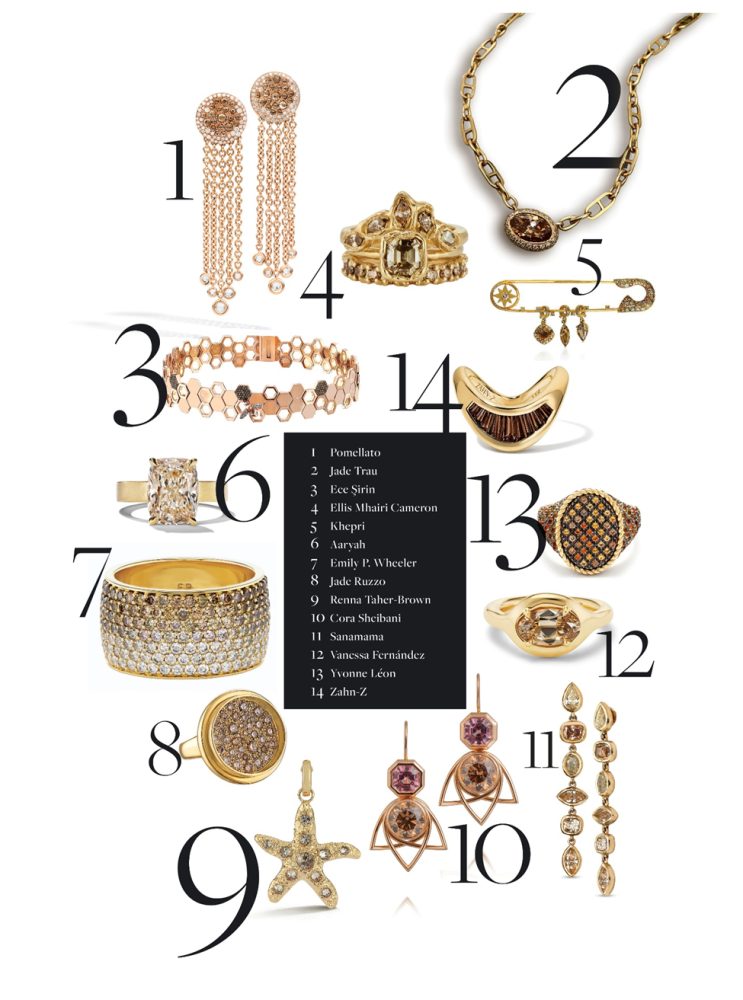
At New York brand Aaryah, founded by Megan Kothari of Indian heritage, the allure of brown, champagne, and cognac diamonds has long been intertwined with the brand’s design language. For the 2025 collection, this palette expands into golden champagnes, honeyed browns, and rich cognac shades across designs. Rather than treating brown diamonds as alternatives to icy whites, Megan champions their “sensual and powerful” character, setting them in yellow or rose gold to “amplify their warm hues,” or using platinum as an element of modern counterpoint.
The “classic richness” of brown diamonds resonates with designer Jade Trau. Her latest pieces spotlight oval diamonds — an unexpected shift from the pear and marquise shapes she often favours. “I was attracted to the colour and brilliance of those diamonds… the shapes were a happy accident,” she explains, adding that ovals offer stronger colour saturation because they “don’t come to a point where colour can often get either diffused or really concentrated.” Though the New Yorker has long worked with natural white diamonds, exploring brown diamonds felt like a natural evolution. “I’ve toyed with them for years… but I think it was more about building the confidence that if I love it, my clients will too.”
Syrian-American architect and designer Hiba Husayni’s latest exploration for her jewellery line, Zahn-Z, is inspired by landscapes where light and sand shape colour. “When I worked with the brown diamonds it added more lustre and details, there was just more depth to the brown. It’s part of the Zaha Collection that I’m exploring. It was very hard and challenging to find that tone and cut in baguette. I love how it turned out,” she adds.
Jade Ruzzo, too, has incorporated champagne and brown stones since the inception of her namesake line. “I think of my pieces as true modern heirlooms, pieces that are meant to be passed down for generations. The earthy, warm hues of champagne diamonds lend themselves to that narrative so naturally. They have more of a whisper than a yell…,” says Jade. This, she adds, makes her designs feel “special and unique… not mass produced in any way.”
For designer Emily P. Wheeler the warmth and individuality of brown diamonds hold a strong appeal. “By reinterpreting them through my signature ombré technique, I’m able to give these stones a new context — one that feels refined and modern while still celebrating their subtle, natural character,” she adds. Her wrap ring and wrap bracelet sport a soft gradient of brown to white that “feels both fluid and architectural,” while the fringe earrings, take on “incredible dimension” with articulated sections of brown and white diamonds.
Bee Goddess, founded by Turkish designer Ece Şirin, has incorporated brown diamonds since its earliest collections. “We embrace the natural inclusions in our brown diamonds… every inclusion becomes a cosmic fingerprint,” she says. In the honeycomb choker, these diamonds echo nature’s sacred geometry, reflecting “the sweetness of divine creation,” while the Sirius star and Venus rings pair warm brown and white diamonds to “channel celestial light, symbolising guidance, love, and divine femininity.” Through her designs, Ece continues to merge mysticism and symbolism.
Vanessa Fernández is drawn to the expressive potential of naturally coloured diamonds, their rarity and the way they open “a new dimension of colour” that moves “into the exotic and less available.” The Cuban-Armenian designer, based in Miami, pairs these earthy-toned stones exclusively with rich yellow gold. “I think the rich yellow of the metal honours the complexity of colour in these diamonds far better than white metals ever could,” she explains, seeking to create “special and rare jewels.”
Brown and champagne diamonds have been an integral part of Sanamama’s collections from the beginning. The brand’s Founder, Gabi Torres shares that brown diamonds are having a moment, adding that she chooses brown diamonds “due to their earthy energy.” Sometimes, it is the imperfections that make the stone extraordinary, remarks the former art therapist-turned-jeweller.
The starfish pendant designed by Renna Taher-Brown, Founder of Renna, features over 1.4 carats of champagne diamonds, each one reverse-set to reveal its culet. “By setting the diamonds with their culets points up, we imitate the texture and playfulness of the starfish in nature,” explains the New Yorker.
Turning to brown diamonds with slight inclusions or imperfections, Parisian designer Yvonne Léon often pairs them with white or yellow gold, and citrine to create harmonious contrasts with other elements of the piece. These tones play a defining role in the La Plage collection, most notably in the Paradise Island pendant, where brown diamonds symbolise the coconut. The stones appear in Le Safari’s Python jewels, where gradients of beige and brown mimic the shifting reflections of a snake’s skin.
In the hands of these designers, brown, champagne and cognac diamonds are no longer the quiet outliers of the gem world but now articulate a new language of modern luxury.