
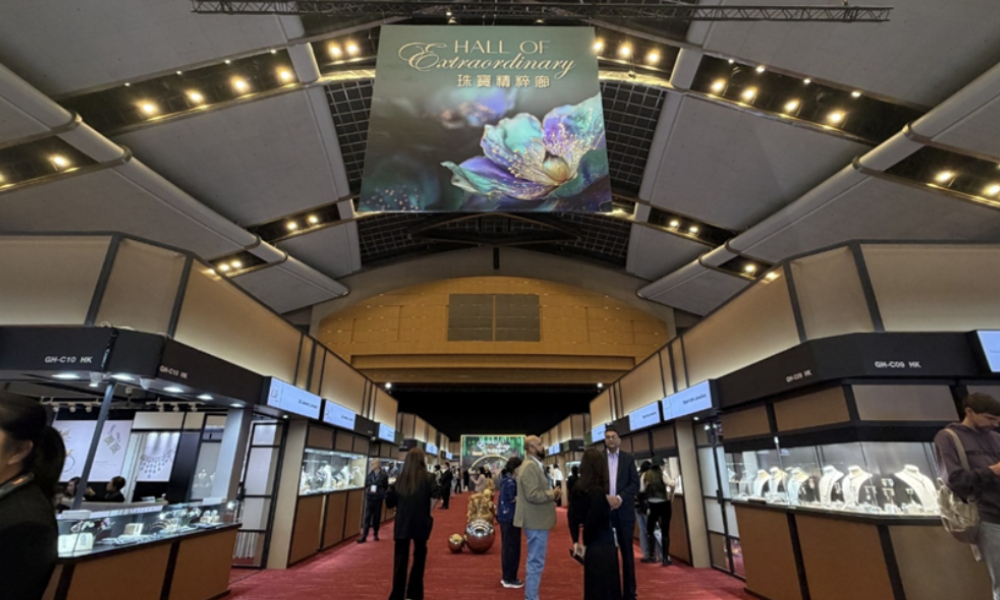
At the 2026 Hong Kong jewellery shows, recovery was visible — but so were geopolitical fault lines, the international rise of hard pure gold, and a stronger market appetite for culturally anchored value. China-based industry analyst Liang Weizhang reports.
Hong Kong’s twin March fairs have long served as a reading of the global jewellery business at a single point in time. This year, the message was more layered than a simple return-to-growth story. Buyer confidence is rebuilding, but unevenly. Geopolitical disruption is reshaping who arrives and who does not. Meanwhile, hard pure gold, jade and even antique jewellery are gaining renewed relevance as the marketplaces greater value on innovation, heritage, and cultural distinction.
Hong Kong’s March Fairs
For the global jewellery trade, Hong Kong’s March fairs have always been more than trade events. They are one of the few places where demand patterns, sourcing priorities, product narratives, and regional tensions can all be read at once.
The 2026 editions of the Hong Kong International Jewellery Show and the Hong Kong International Diamond, Gem & Pearl Show confirmed that role once again. The headline story was not simply that business sentiment had improved, although it had. More importantly, the fairs showed that the structure of recovery is changing. International demand is returning, but selectively. Product categories with stronger cultural and material narratives are gaining ground. And geopolitical events are having a more visible influence on attendance, mobility, and market visibility than many in the trade might have expected.
That combination made this year’s fairs feel less like a straightforward rebound and more like a reset.
One of the clearest signals was that the market is moving away from the paralysis of the past two years and towards a more workable, if still cautious, normal. In diamonds, where price corrections in both rough and polished goods had weighed heavily on confidence, the atmosphere suggested that the trade is gradually adjusting to a new pricing reality. That matters. Recovery does not necessarily begin with optimism; often it begins with acceptance. Once price expectations stabilise, the market becomes more willing to transact again.
A similar dynamic could be felt in coloured gemstones and fine jewellery. Buyers remain careful, but they are also more disciplined and more informed. Conversations are increasingly centred on origin, rarity, product logic, and end-market suitability, rather than on broad-based speculative purchasing. In that sense, the quality of demand may be improving faster than the quantity of demand — a distinction that is likely to define the next phase of the market more accurately than topline traffic alone.
Yet the fairs also underlined how vulnerable global jewellery mobility remains to external shocks. In the days before the shows opened, the geopolitical conflict in the Middle East affected attendance from the region and disrupted the movement of some European buyers who would normally travel through Middle Eastern transit hubs. The impact was not large enough to define the fairs, but it was large enough to be felt. For a trade that still depends heavily on international aviation routes and face-to-face sourcing, this was a reminder that recovery does not happen in a vacuum.
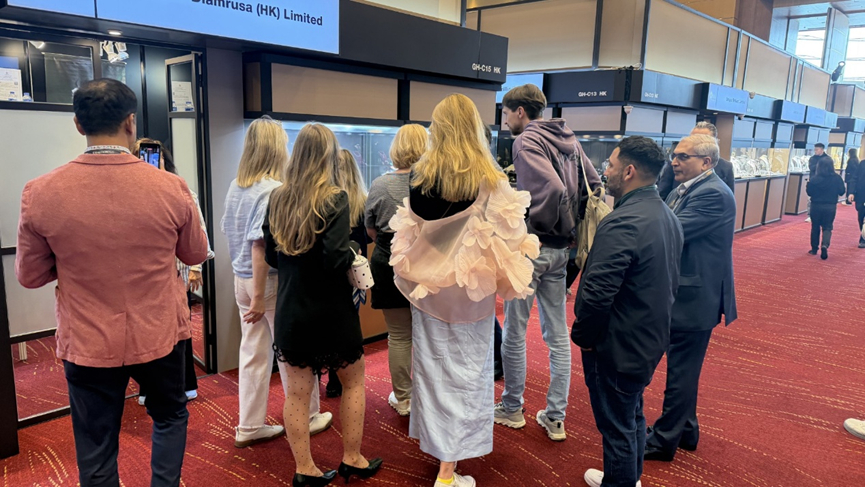
What made the picture especially interesting, however, was that one weakening buyer flow was accompanied by the visible strengthening of another. Across multiple themed pavilions and category zones, Russian buyer groups were notably present. Their appearance suggested rising Russian interest in Chinese manufacturing capability and in Hong Kong’s role as an international jewellery sourcing and distribution centre. In practical terms, this points to more than a temporary attendance anomaly. It suggests that the geography of jewellery trade is being rebalanced in real time, with Hong Kong continuing to function as a strategic meeting point for that shift.
If there was one product story that stood out most clearly this year, it was hard pure gold. For several years, hard pure gold has been discussed mainly as a domestic Chinese innovation — a technological answer to the traditional softness of 24-karat gold, allowing for lighter, more durable, and more structurally ambitious jewellery while retaining the emotional and wealth-preserving appeal of high purity. In Hong Kong this year, however, it appeared increasingly positioned not as a local success story, but as an export-ready category.
The timing is significant. In a high-gold-price environment, weight efficiency has become more than a technical consideration; it is now a strategic one. Hard pure gold offers manufacturers and brands a way to manage material cost while preserving visual impact and opening up greater design flexibility. That combination makes it commercially persuasive across multiple consumer segments.
Its international relevance lies precisely in its adaptability. For overseas Chinese buyers, hard pure gold preserves the cultural legitimacy and investment logic associated with pure gold, while refreshing the category through more contemporary styling. For non-Chinese markets, it offers something different from the dominant language of 18-karat fashion jewellery — a richer, more sculptural, and more materially expressive proposition. Hong Kong, with its unusually broad mix of buyers, was therefore an ideal testing ground for whether the category could speak beyond its home market. This year, it appeared increasingly able to do so.
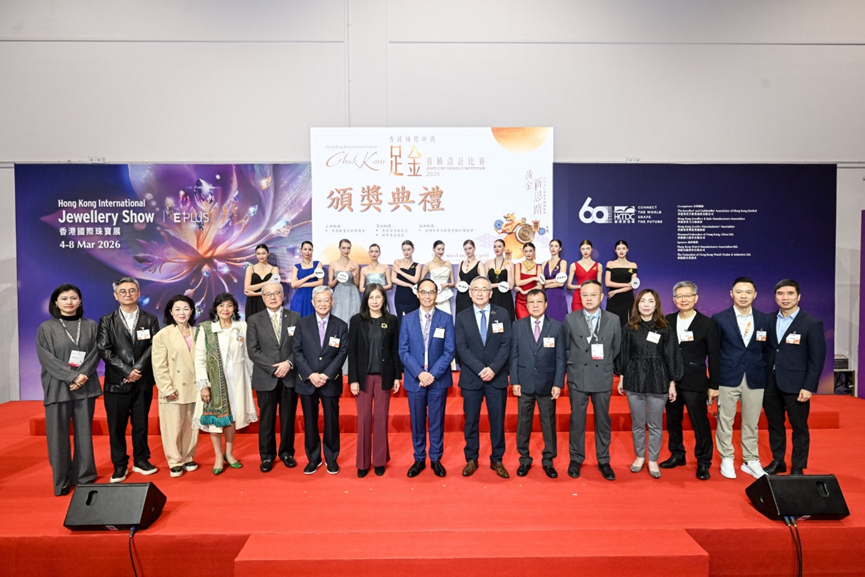
The two design award ceremonies held during the fair reinforced a related point. Their significance lay less in the ceremonial moment than in what they revealed about the industry’s strategic direction. The pure gold jewellery design competition showed how actively the sector is trying to connect Chinese gold craftsmanship with a more contemporary and internationally legible design vocabulary.
The jade and jadeite jewellery design competition pointed to a parallel ambition: to reposition jade as a material capable of entering broader global design discourse, rather than remaining confined to a historically defined cultural sphere.
That shift is not trivial. Materials such as gold and jade are no longer being promoted only through tradition, but through narrative renewal. The industry is increasingly aware that culturally rooted materials must be translated into forms, language and product concepts that travel internationally. Design competitions, in this sense, are becoming tools of market development as much as platforms for creativity.
This helps explain another noteworthy phenomenon at the fairs: the strong traffic in the antique jewellery pavilion. In an exhibition environment often dominated by novelty, the sustained attention drawn by antique jewellery stood out. More importantly, it aligned with a broader shift in luxury consumption. Antique jewellery embodies a value structure that is increasingly relevant to sophisticated buyers: rarity, provenance, craftsmanship, historical continuity, and individuality.
Its appeal is not simply nostalgic. In a market crowded with visually similar products and accelerated image circulation, jewellery with survival value carries a different kind of authority. It signals discernment rather than trend compliance. The popularity of the pavilion therefore suggested more than collector enthusiasm. It pointed to the renewed strength of heritage value as a commercial language in its own right.
Seen together, the renewed interest in antique jewellery, the international reframing of jade and the export ambitions of hard pure gold all tell the same larger story. The market is placing greater weight on products that offer more than surface beauty or raw material worth. Cultural resonance, narrative substance, and symbolic depth are becoming more central to competitive differentiation.
That is why Hong Kong still matters. Its significance lies not only in transaction volume, but in its ability to compress the global jewellery business into one observable marketplace. Materials, design, logistics, geopolitics, and buyer sentiment all intersect here. The result is not merely a fair, but a reading of the market’s next direction.
This year’s reading was clear enough. Recovery is real, but uneven. Attendance flows are increasingly shaped by geopolitical conditions. New buyer geographies are becoming more visible. Chinese product innovation, especially in hard pure gold, is emerging as one of the trade’s more credible growth narratives. And culturally anchored categories — from jade to antique jewellery — are gaining renewed strength in a market that is once again rewarding meaning as much as material.
Hong Kong did not simply show that the trade is returning. It showed that the terms of return are changing.