

This year’s IIJS Bharat Signature, the highlight at BEC, Hall 4 was the Crafts Pavilion where country’s masterful craft traditions and the way they continue to shape modern jewellery design.
The third in our series of crafts is Thewa—a craft that uniquely marries gold and glass. Practised by a close-knit family in Pratapgarh, Rajasthan, for generations, the art is regarded as a near-sacred legacy passed down to future generations. At the show was Raghav Rajsoni, a sixth-generation artist from the celebrated Rajsoni family of Pratapgarh, who has inherited not just technical mastery, but is a living legacy shaped under the guidance of his father, the late Shri Mahesh Rajsoni, a Padma Shri awardee and one of the most respected names in Thewa art.
Raghav Rajsoni holds a bachelor’s degree in commerce, giving him a sound understanding of business and economics, followed by an LLB that strengthened his legal insight. Driven to take the art of Thewa to a wider global audience, he went on to study Luxury Brand Management at the London School of Arts. This exposure has helped him bridge heritage craftsmanship with contemporary branding, positioning Thewa on an international platform while staying true to its roots.
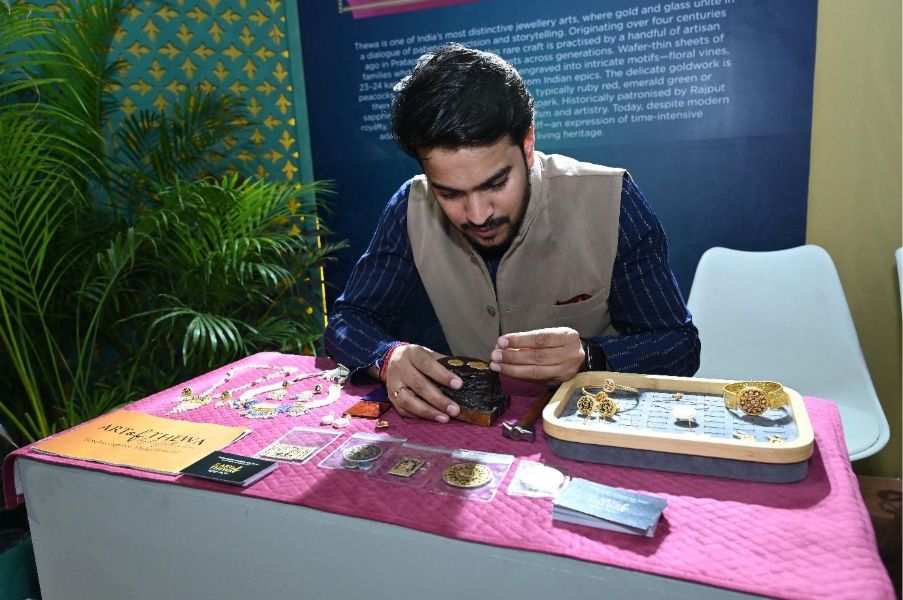
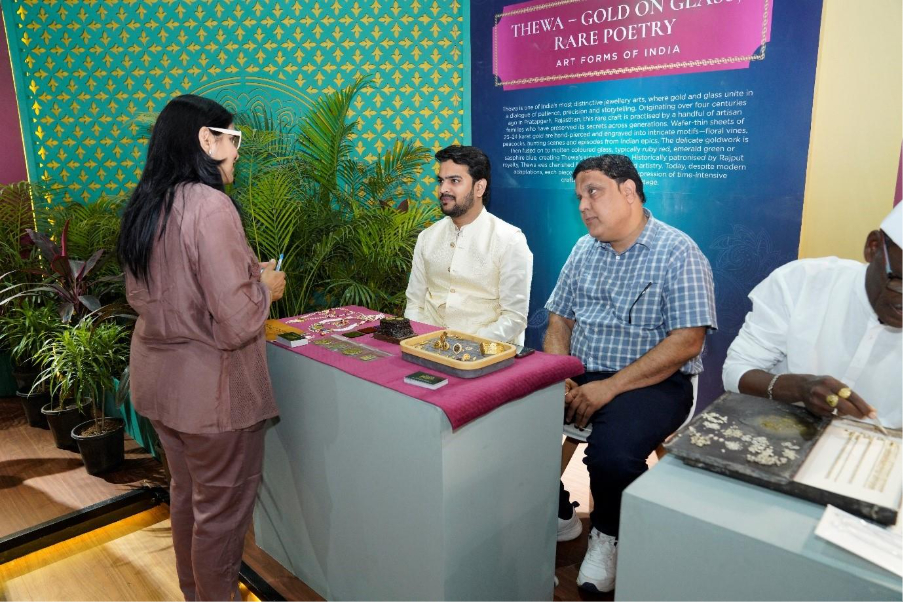
Rajsoni has represented India at various esteemed international events aimed at promoting the traditional art form of Thewa. Supported by the Government of India, he has showcased the art the International Exhibition of Handicrafts, Taraz, Kazakhstan (2023), Namaste France, Paris (2023), and Bharat Utsav, Moscow, Russia (2025).
At the show, he was accompanied by his cousin, Pawan Kumar Soni, who is an exceptional thewa artist in his own right.
More about Thewa
Thewa is one of India’s most distinctive jewellery arts, where gold and glass come together in a marriage of patience, precision, and storytelling.
Originating over four centuries ago in Pratapgarh, Rajasthan, this rare craft remains closely guarded by a handful of families, passed down through generations with staunch devotion.
Thewa involves hand-working wafer-thin sheets of 23–24 karat gold into intricate patterns inspired floral vines, peacocks, hunting scenes, and episodes from Indian epics are delicately pierced and engraved, often so fine that they resemble lace.
This gold filigree is then fused on to molten, coloured glass—most commonly deep ruby red, emerald green, or sapphire blue—creating a luminous contrast that gives Thewa its unmistakable depth and glow.

The process is painstaking. The gold sheet is first flattened and etched entirely by hand, without sketches. Once the design is complete, it is carefully placed on heated glass and bonded using controlled heat and skill honed over decades. Any error at this stage means starting afresh. The finished panel is then framed in gold or silver to create pendants, necklaces, earrings, bangles, or ceremonial pieces.
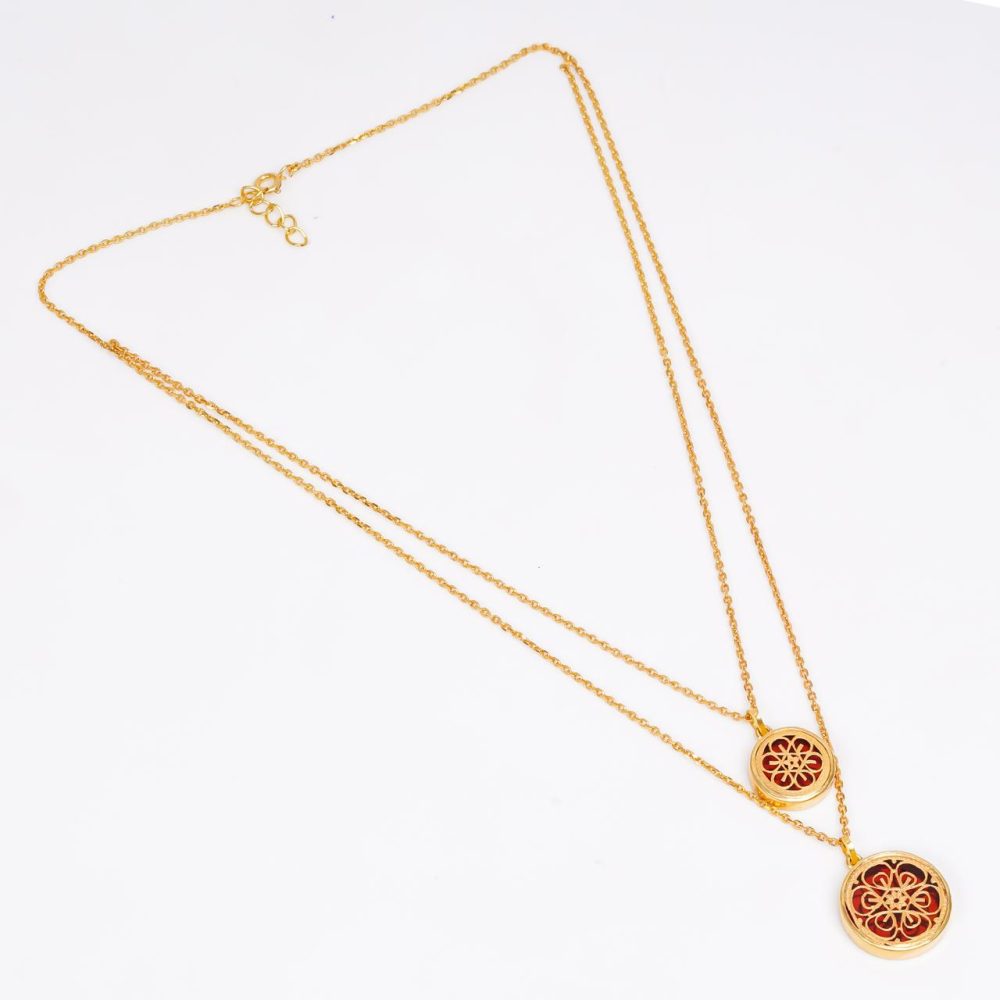
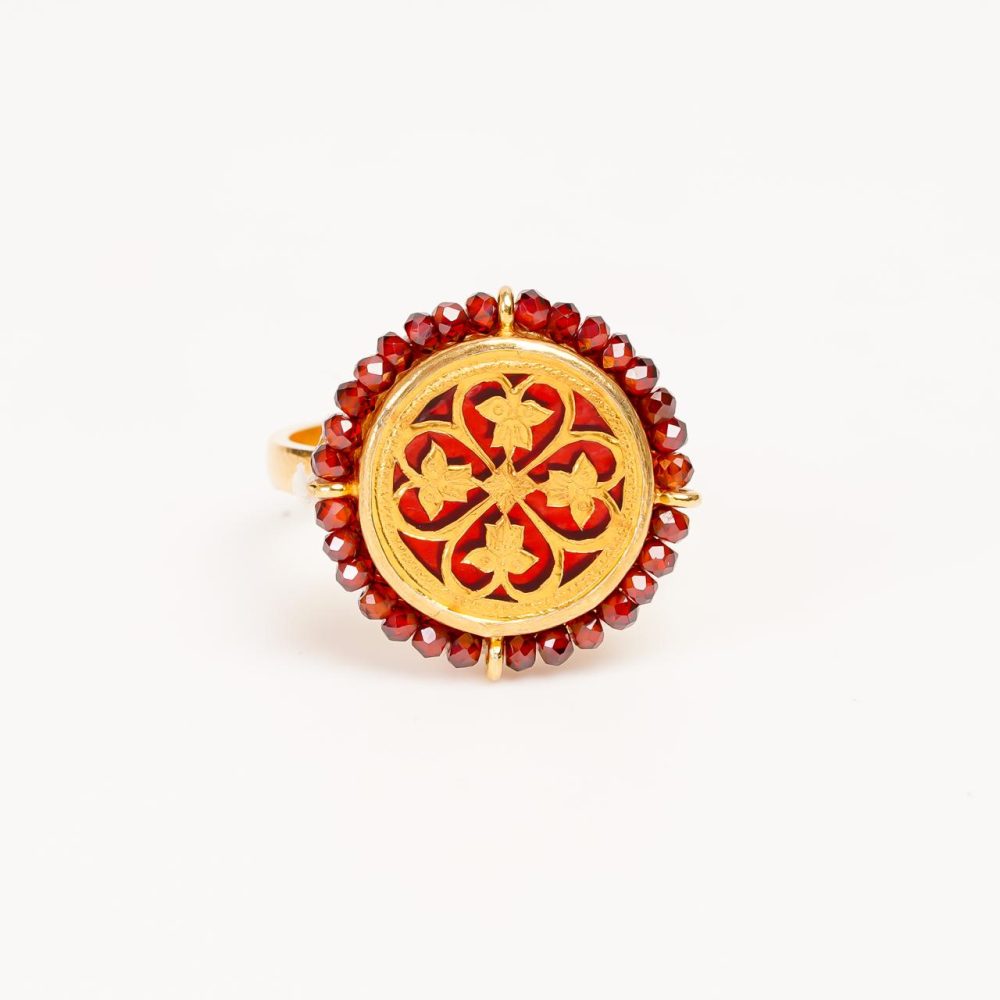
Historically patronised by Rajput royalty, Thewa jewellery was treasured not only for its beauty but also for its symbolism—often gifted during weddings and important milestones. Today, while contemporary formats have emerged, the essence of Thewa remains unchanged: meticulous craftsmanship, pure materials, and narrative-rich design.

In an age of speed and replication, Thewa stands apart as a quiet testament to time-intensive artistry. Each piece is unrepeatable, carrying the imprint of the artisan’s hand and heritage. More than adornment, Thewa is a glowing fragment of India’s cultural memory—golden stories suspended on glass, meant to be cherished for generations.