
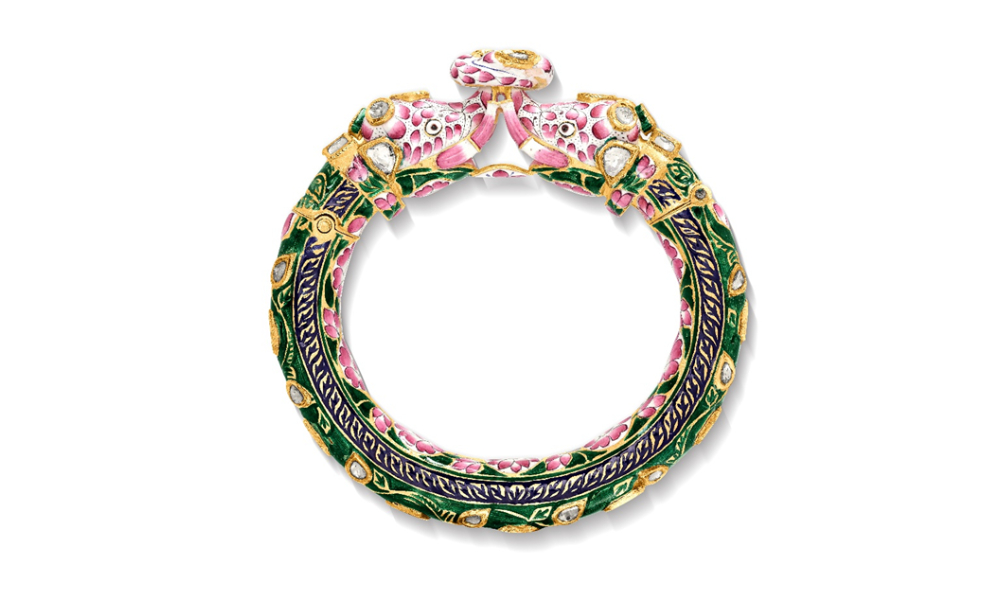
This year’s IIJS Bharat Signature theme, Art Forms of India, focused on the country’s masterful craft traditions and the way they continue to shape modern jewellery design.
One such art form was Benarasi meenakari, where pink and white colours dominate the canvas of each piece. The Crafts Pavilion in Hall 4 showcased live demonstrations by Rahul Soni and Akash Soni, master craftsmen who have been practising this art for more than two decades. The Crafts Pavilion in Hall 4 at BEC, Mumbai, showcased four prominent crafts of India. Here is the second in the series.
Rahul Soni began learning Benarasi meenakari under the tutelage of his maternal grandfather in 2002, and within six years, he had set up his own workspace at his residence. Since then, he has continued learning the nuances of the craft, believing that there is always room for improvement.
The biggest challenge in this craft has been achieving the finest possible detailing. There are also health challenges involved. When outlining with black colour, breath control and hand movement must be precise. The line needs to be even finer than the tip of a pinhead—the finer it is, the more refined and attractive the piece looks, says Soni.
“Drawing is the most important skill in gulabi meenakari. If you cannot draw, you cannot do this work. The better your drawing hand, the better you will be at gulabi meena—beyond that, everything depends on your own dedication,” he remarked, adding, “Earlier, during our elders’ time, three coats of pink meenakari were applied to achieve the desired quality. When we began training younger artisans, we adjusted the process and reduced it to two coats, while ensuring maximum cleanliness and precision. We succeeded in maintaining quality, and many small innovations have emerged through hands-on work—these are things you realise only while practising the craft.”
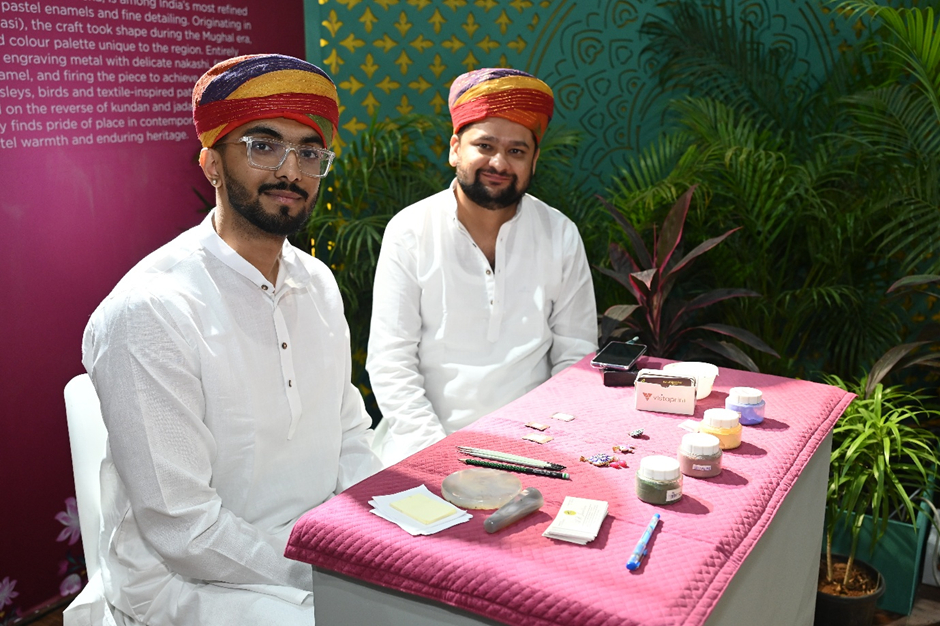
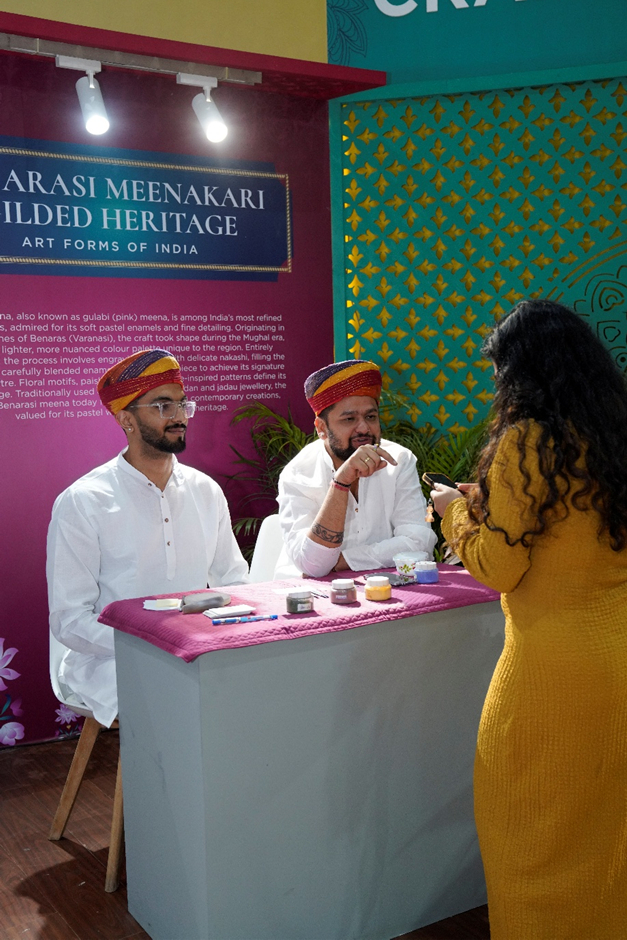
According to Akash Soni, learning never really stops. The main challenge is maintaining quality while meeting tight timelines. If the focus was on quality, timelines would slip; if deadlines were rushed, quality could vary slightly. Today, the situation has changed. Work has slowed down significantly, sometimes almost coming to a halt. The positive side is that there is now time to deliver work with much higher levels of refinement and quality.
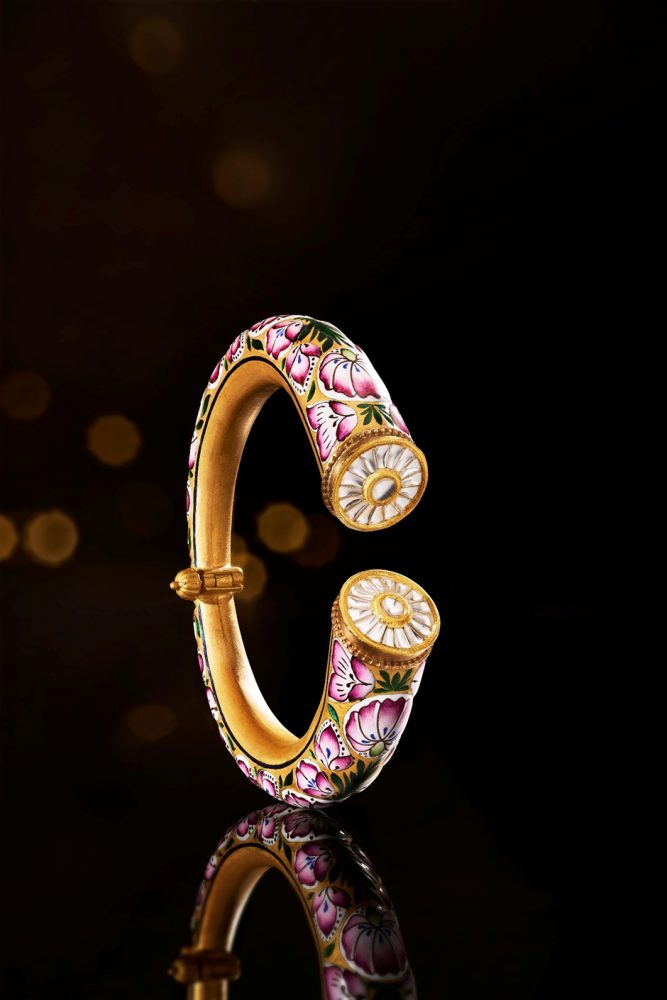
More about Benarasi (Gulabi) Meena)
Benarasi meena, also known as Gulabi or pink meena, is known for its lustrous enamel and intricate detailing. The highlight of Benarasi meena is the easy blending of soft pastel hues on to the metal, the signature soft pink enamel set against a white base, a pairing that creates a stunning tapestry of art.
Originating in the historic lanes of Benaras, now Varanasi, this enamelling craft takes inspiration from the city’s artistic legacy, and transforms gold into a narrative driven adornment. Introduced to the region during the Mughal period, enamelling in Benaras gradually evolved its own language, which is lighter and more pastel in tone.
The process is entirely hand worked. An artisan first begins by preparing a thin sheet of gold or silver, which is cut and shaped to form the base. Then, the piece is engraved to create fine depressions, known as nakashi, that will hold the enamel. Next, for the colour mixing process, powdered glass and metal oxides are ground for hours to achieve the craft’s signature hues. This enamel paste is filled into the engraved grooves, after which the piece is fired in a small furnace, so the colours fuse properly and attain a natural gloss. Once cooled, it is polished by hand for enhancing depth and clarity.
Finally, goldsmiths complete the setting and finishing, turning the enamelled surface into a finished piece of jewellery.
Floral motifs, creepers, birds, paisleys and textile-inspired patterns dominate the visual language. Traditionally seen on the reverse of kundan and jadau jewellery, Benarasi meena also appears on standalone pieces where the enamel itself becomes the focal point. Beyond jewellery, the craft has long adorned trinket boxes, ritual objects, religious figurines and ceremonial accessories.
In recent years, the craft has found a renewed audience. Contemporary designers are embracing Benarasi meena for its versatility — pairing it with diamonds, kundan, polki and even enamel-on-silver for lighter, wearable pieces. This modern engagement has encouraged artisans to experiment with subtler palettes and modern silhouettes, while staying faithful to traditional techniques.
Benarasi meena is an artistry of the skilled hands of craftsmen. The subtle enamel shine, soft colours, lends each piece a character mass-produced jewellery simply cannot match.
The hallmark of Benarasi meena is its distinct character that carries the warmth of history, the dedication of its makers and its impact on defining Varanasi’s artistry.
It is this individuality—shaped by history, handwork and heritage—that continues to define Benarasi meena and secure its place in India’s living craft traditions.