

India’s gem and jewellery exports are breaking free from a US-centric playbook. Powered by the Government of India’s FTA push, new markets across the Gulf, Europe and the Asia-Pacific are now driving the industry’s next phase of growth.
For decades, the United States sat firmly at the centre of India’s gem and jewellery export strategy. It was the largest market, the price setter for polished diamonds, and the anchor for volume-driven growth. That dependence is now easing. Not through a sudden retreat from the US, but through a steady, policy-led broadening of markets shaped by the Government of India’s trade diplomacy and its sustained push to secure high-impact Free Trade Agreements (FTAs) for the sector.
Recent export data makes this shift visible. Between April and November 2025, India’s gem and jewellery exports to the US fell sharply by 43.8%, dropping from $6.29 billion to $3.54 billion. At the same time, exports to several FTA-linked or FTA-aligned markets surged. The UAE rose 32% to $6.25 billion, Hong Kong grew 23%, France jumped 44%, and Australia expanded nearly 36%. The message is clear. India’s export engine is no longer running on a single market.
India’s Gem & Jewellery Exports to Global Markets
| Rank | Countries | April – November 2024 | April – November 2025 | % growth |
| US$ million | US$ million | (YoY) | ||
| 1 | United Arab Emirates | 4,721.32 | 6,251.02 | 32.4 |
| 2 | Hong Kong | 3,079.82 | 3,779.59 | 22.72 |
| 3 | United States of America | 6,296.21 | 3,538.53 | -43.8 |
| 4 | Belgium | 883.58 | 845.57 | -4.3 |
| 5 | United Kingdom | 522.59 | 494.92 | -5.3 |
| 6 | Thailand | 353.34 | 412.89 | 16.85 |
| 7 | Israel | 351.51 | 388.24 | 10.45 |
| 8 | Singapore | 365.27 | 363.97 | -0.36 |
| 9 | Switzerland | 381.32 | 277.48 | -27.23 |
| 10 | Australia | 184.22 | 250.15 | 35.79 |
| 11 | France | 170.68 | 245.09 | 43.6 |
| 12 | Others | 1,544.95 | 2,019.98 | 30.75 |
| Total | 18,854.83 | 18,867.43 | 0.07 | |
Kirit Bhansali, Chairman, GJEPC, said, “India’s gem and jewellery industry is at an important inflection point. For many years, our export growth was closely tied to the US market, which brought scale and stability but also concentration risk. The Government of India’s focused and forward-looking FTA strategy is helping the industry rebalance that equation. Agreements with the UAE, Australia, UK, Oman, New Zealand, along with the EFTA pact and other negotiations underway, are opening doors to markets that value design, craftsmanship and responsible sourcing.
“Indian exporters are gaining tariff advantages, deeper market access and the confidence to invest in new geographies. This is enabling businesses, especially MSMEs, to diversify buyers, expand product portfolios and build long-term partnerships beyond a single market. As these FTAs mature, they will strengthen India’s position as a reliable, competitive and globally integrated hub for gem and jewellery manufacturing and exports.”
Confirming that recent trade agreements are already delivering clear gains for Indian jewellers, K. Srinivasan, Convener – Gold Panel, GJEPC and Chairman, Emerald Jewel Industry India Ltd., added, “Due to the implementation of the CEPA with the UAE and the ECTA with Australia, import duties have been eliminated. This has encouraged international buyers to place higher volumes of orders with India, significantly strengthening India’s global competitiveness and driving substantial growth and long-term benefits for the Indian jewellery industry.”
A Titan Co. Spokesperson commented, “The recent FTAs signed with the UK, New Zealand, Oman are strong enablers to foster competitiveness and growth of India’s jewellery craftsmanship and our brands like Tanishq to present the best of Indian jewellery to our global diaspora.”
Echoing this sentiment, Asher O., MD, Malabar Gold & Diamonds, “India’s expanding network of FTAs has been a strong catalyst for the growth of the gold jewellery industry and for Indian retailers operating globally. Agreements such as the India-UAE CEPA, Australia ECTA, Japan and South Korea CEPAs, ASEAN FTA, the UK and EFTA trade arrangements, and most recently the India-New Zealand FTA, have significantly reduced duty barriers and eased cross-border trade. For a global retailer like Malabar, these FTAs translate into better cost efficiencies, smoother supply chains and the ability to serve international consumers with competitively priced, high-quality Indian gold jewellery. Collectively, they are helping position India as a trusted global hub for jewellery manufacturing and retail.”
The UAE CEPA: The New Anchor Market
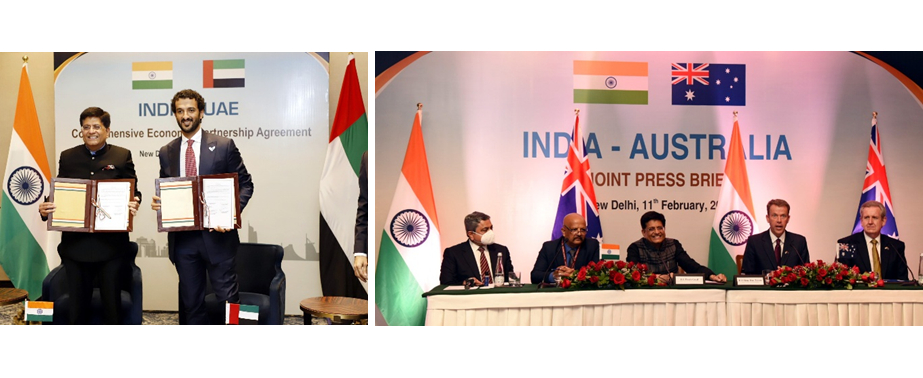
The India-UAE Comprehensive Economic Partnership Agreement, implemented in 2022, has emerged as the most influential trade pact for the sector so far. With zero or sharply reduced duties across key product lines, the CEPA has turned the UAE into India’s largest gem and jewellery destination in the current fiscal period.
Exports to the UAE touched $6.25 billion in April-November 2025, overtaking the US. The growth is broad-based. Cut and polished diamonds rose over 55%, plain gold jewellery grew nearly 25%, studded gold jewellery over 33%, and platinum jewellery more than doubled. This is not just volume shifting. It reflects a change in product mix and buyer intent, with Dubai functioning as both a consumption market and a global redistribution hub.
The UAE CEPA has also altered exporter behaviour. Indian manufacturers and globally expanding retail brands are designing collections specifically for Middle Eastern tastes, investing in faster delivery cycles, and using Dubai as a launchpad into Africa and Europe. Dependence on the US consumer is being replaced by regional diversification.
The UK FTA: Reclaiming a Mature Market
If the UAE CEPA created scale, the India-UK Free Trade Agreement promises value. Signed in July 2025 and awaiting parliamentary approval, the pact will provide zero-duty access to nearly 99% of Indian exports to the UK, including gem and jewellery products.
Currently, India exports around $941 million-worth of gems and jewellery to the UK. Under the FTA, this is projected to rise to $2.5 billion within three years, with bilateral trade in the sector expected to touch $7 billion. The duty advantage will especially benefit plain gold jewellery and gemstone-studded pieces, segments where India already enjoys design leadership but has faced tariff friction.
For Indian exporters, the UK offers something different from the US. It is a design-led, brand-conscious market with strong appetite for responsibly sourced jewellery. The FTA allows India to compete on equal footing with European suppliers, reducing overexposure to US retail cycles.
EFTA: Quietly Strategic, Deeply Important
The India-EFTA Trade and Economic Partnership Agreement may not grab headlines like the UAE or UK deal, but its implications are significant. By eliminating customs duties across the entire Chapter 71 for Switzerland, Norway, Iceland and Liechtenstein, the agreement opens a high-value corridor into Europe.
Exports to the EFTA region currently stand at around $335 million. Industry estimates suggest this could scale to $1 billion in the coming years. Switzerland alone is a critical node in the global diamond and jewellery trade, not just as a consumer market but as a trading and financing centre. Duty-free access strengthens India’s position across the diamond value chain and reduces reliance on US-based trading flows.
Australia and the Asia-Pacific Push
The India-Australia Economic Cooperation and Trade Agreement (ECTA) has already begun delivering results. Australia will remove tariffs on 100% of Indian export tariff lines from 1st January 2026 under ECTA.
Exports to Australia grew nearly 36% in April-November 2025. Gold jewellery, studded pieces and silver jewellery are gaining traction, supported by tariff elimination and easier market access.
This growth matters because it signals India’s deeper integration into the Asia-Pacific jewellery market. Alongside existing agreements with ASEAN, Japan, South Korea and Singapore, Australia adds depth to a region that values design diversity and ethical sourcing. These markets are less volatile than the US and offer steady, long-term growth.
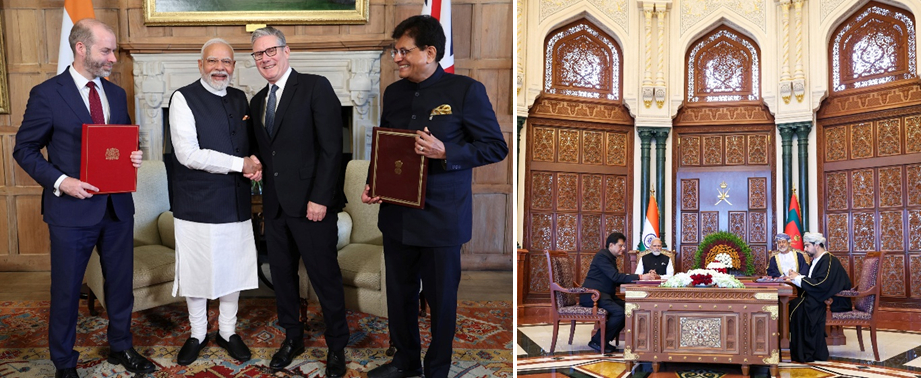
Oman and the Gulf Beyond the UAE The recently concluded India-Oman CEPA extends India’s Gulf strategy beyond the UAE. With zero-duty access, exports to Oman are projected to rise from $35 million to $150 million over three years. While smaller in absolute terms, Oman plays a strategic role as a gateway to the wider GCC and East Africa, further diluting US dependence.
New Zealand and the Long Line-Up of FTAs
Even markets that currently account for modest volumes are part of the diversification story. India’s gem and jewellery exports to New Zealand stand at$16.6 million. With tariff advantages of up to 2.5% under the proposed FTA, exports are expected to scale to $50 million in three years. These are not headline numbers, but collectively, such markets create resilience and reduce concentration risk.
Reading the Numbers Together
What makes the current phase different is the simultaneous growth across multiple non-US markets. While total gem and jewellery exports during April-November 2025 remained flat year-on-year at around $18.87 billion, the internal composition has shifted decisively. The US share fell, while the UAE, Hong Kong, Europe and Australia expanded. This is textbook diversification driven by expansive and forward-looking trade policy.
The Road Ahead
India is still negotiating FTAs with the European Union, Africa, Canada, Israel, and the GCC among several others. Each agreement adds another layer to the diversification strategy. The objective is not to replace the US, which remains an important market, but to ensure that no single geography dictates the industry’s fortunes.
On 13 February 2025, Hon’ble Prime Minister of India, Shri Narendra Modi, and the Hon’ble President of the United States, Mr. Donald Trump, announced Mission 500, a joint ambition to more than double bilateral trade to $500 billion by 2030. In line with this goal, Indian and US trade teams are engaged in discussions to fast-track a mutually beneficial Bilateral Trade Agreement (BTA) that can increase gem and jewellery exports to the India’s biggest market.
The European Union remains one of the largest untapped opportunities for India’s gem and jewellery sector. Negotiations are now in their final phase, with the Government of India expected to enter the last round of discussions in early January. Once concluded, the EU FTA will open access to a multi-billion-dollar market where Indian products will gain a competitive tariff advantage.
After the success of the India-UAE CEPA, attention is now firmly on the broader Gulf Cooperation Council (GCC) framework. The Government of India and the GCC have already agreed on the Terms of Reference, marking the formal start of negotiations.
As of late 2025, India is pushing ahead with an expansive FTA agenda, negotiating new agreements while upgrading existing ones to widen market access and deepen trade integration. Talks span multiple stages, from early exploratory rounds to near-final negotiations, with recent breakthroughs including concluded agreements with New Zealand and Oman, and the signing of the UK deal, now awaiting parliamentary ratification. The focus remains on improving goods access, addressing sensitive sectors and expanding services trade across key global markets.
Key negotiations and status
- INDIA-NEW ZEALAND: Talks concluded in December 2025, providing 100% zero-duty access for Indian exports.
- INDIA-OMAN: Comprehensive Economic Partnership Agreement signed in December 2025.
- INDIA-UK: Agreement signed and awaiting ratification by the UK Parliament, with commercial engagement already gathering pace.
- INDIA–UAE CEPA: Bilateral Comprehensive Economic Partnership Agreement with the United Arab Emirates, implemented in 2022, delivering immediate duty-free access across key jewellery categories.
- INDIA-AUSTRALIA (CECA): Negotiations in progress to build on ECTA gains.
- INDIA-EFTA TEPA: Regional Trade and Economic Partnership Agreement with European Free Trade Association comprising Switzerland, Norway, Iceland and Liechtenstein, signed in 2024, with implementation timelines to be finalised.
- INDIA-EU: Negotiations at an advanced stage, though influenced by broader political considerations.
- INDIA-USA: Ongoing discussions on a Bilateral Trade Agreement, targeting $500 billion in bilateral trade by 2030, with several rounds completed.
- INDIA-EAEU: First round of negotiations held in November 2025.
- INDIA-SRI LANKA (ETCA): Fourteen rounds completed, with talks continuing.
- INDIA-PERU: Nine negotiation rounds held since 2017.
- INDIA-CHILE: Four rounds conducted since April 2025.
- INDIA-KOREA: Discussions underway to upgrade the existing CEPA.
- INDIA-ISRAEL: Talks revived with renewed momentum in late 2025.
- ASEAN-INDIA: Review of the Trade in Goods Agreement currently underway.
- INDIA-AFRICA (AFCFTA): Discussions underway on a proposed cooperation framework with the African Continental Free Trade Area, aimed at strengthening long-term trade engagement, with modalities still under discussion
For Indian gem and jewellery exporters, this means rethinking market strategies, product development and branding. FTAs reduce tariffs, but success depends on how effectively companies adapt to local tastes and regulatory frameworks.
The direction, however, is set. India’s gem and jewellery industry is moving from dependence to balance. And FTAs are proving to be the most effective tool in that transition.