
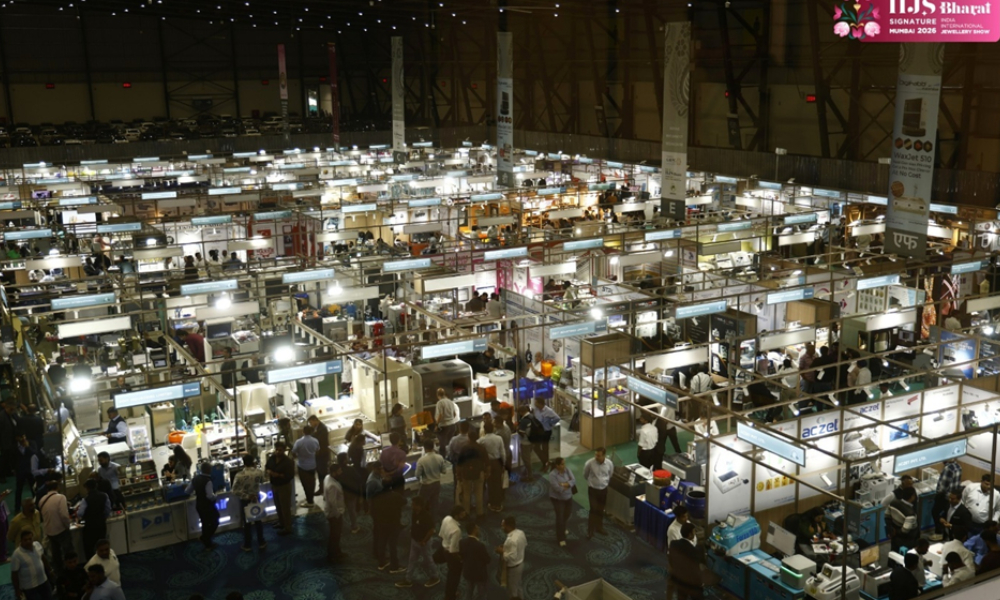
The 18th edition of IIJS Bharat – Signature 2026, organised by GJEPC, concluded in Mumbai, marking a strong start to the global gems and jewellery trade calendar for 2026. As the first major B2B trade show of the year, the event set a bullish tone for the industry, with an estimated ₹75,000 crore in business expected to be realised over the next three months.
The show attracted over 25,000 trade buyers from more than 800 Indian cities, signalling robust domestic demand. Its growing international stature was reinforced by the participation of 1,400 international buyers from 40 countries, along with 12 high-level international delegations, highlighting sustained global interest in Indian-crafted gold, diamond, silver, and lab-grown jewellery.
The inauguration of IIJS Bharat – Signature 2026 was held across both venues in Mumbai. The inaugural ceremony at the Jio World Convention Centre (JWCC) on 8 January was graced by Chief Guest Ms. Sandrine Conseiller, CEO, De Beers Brands and Chair, Natural Diamond Council, along with Guests of Honour Ms. Harsha Bangari, Managing Director, EXIM Bank, and Mr. Saumen Bhaumik, Managing Director, CaratLane. The ceremonial opening at the Bombay Exhibition Centre (BEC) on 9th January was marked by the presence of Guests of Honour Mr. Neeraj Agarwal, Ambassador-Designate of India to Mauritania (West Africa), and Mr. Arun Narayan, CEO – Jewellery Division, Tanishq, alongside the senior leadership of the GJEPC.
Commenting on the successful conclusion, Shri Kirit Bhansali, Chairman, GJEPC, said, “IIJS Bharat – Signature 2026 has sent a clear and confident signal for the year ahead. The estimated Rs. 75,000 crore in business expected to be generated from this edition underscores the scale, credibility, and momentum of India’s gem and jewellery industry. As the first major B2B jewellery show of the year, IIJS continues to set the direction for the global trade calendar. With sustained demand across gold, diamonds, coloured gemstones, silver, and lab-grown jewellery, we remain firmly on course towards our long-term vision of achieving USD 100 billion in exports by 2047 – driven by innovation and global partnerships.”
The Chief Guest, Ms. Sandrine Conseiller, CEO, De Beers, inaugurated the show at JWCC and highlighted, “there is no better place to talk about the future of jewellery than India. From being the birthplace of the world’s diamond story to emerging as one of the fastest-growing markets today, India continues to be a pillar of stability and opportunity for the global gems and jewellery industry. Platforms like IIJS Signature play a critical role in strengthening trust, partnerships and confidence across the ecosystem, while reinforcing India’s position at the heart of the global jewellery trade.”
Highlighting the role of finance and infrastructure in strengthening the sector, Harsha Bangari, Managing Director, EXIM Bank, said, “Gems and jewellery is a traditional yet dynamic sector with a significant contribution to India’s exports and employment. Strengthening infrastructure, improving awareness about financial products, addressing technology and skill gaps, and easing trade bottlenecks are critical for clusters to realise their full export potential.”
Saumen Bhaumik, Managing Director, CaratLane said, “As our industry grows, every stakeholder has benefited, but continued investment in skills and craftsmanship will be key to sustaining this momentum. With the industry expected to grow significantly in the coming years, the availability of skilled hands will become critical. Making artisans a priority is not charity, it is business prudence. If we want to be global leaders, dignity, pride and security for craftsmanship must sit at the centre of our growth story.”
Speaking at the ceremonial opening of IIJS Bharat – Signature 2026 on 9th January, HE Shri Neeraj Agarwal, Ambassador-Designate of India to Mauritania, “The gems and jewellery sector reflects India’s rich heritage and supports millions of livelihoods, and despite geopolitical challenges it continues to grow. From the Ministry of External Affairs, I can assure the industry of the full support of the Government of India under the leadership of Hon’ble PM Shri Narendra Modi, working closely with the Commerce Ministry and other departments to strengthen exports, expand FTAs and open new markets. I also invite Indian companies interested in gold mining to engage with our missions, including in gold-rich regions such as West Africa.”
Arun Narayan, CEO – Jewellery Division, Tanishq said, “IIJS is the crucible where the industry comes together to connect, learn, understand where things are headed and, of course, to do business. IIJS Bharat Signature is the signature event of the year for our industry. Jewellery in India goes back over 5,000 years. You can go as far and as deep as you want, and you will still never reach the end of learning in this industry.”
A key highlight of the IIJS Bharat – Signature 2026 was the launch of ‘JewelStart’, a new GJEPC initiative designed to mentor startups and emerging entrepreneurs in the jewellery sector, ensuring a strong pipeline of innovation and future-ready talent.
The Crafts Pavilion at IIJS Bharat – Signature 2026 received strong interest from buyers and designers, with visitors engaging closely with National Award-winning artisans and traditional craft techniques. Several participants also initiated discussions to seek artisan support and explore the integration of heritage craftsmanship into contemporary jewellery collections.
Further expanding the scale and scope of the event, IGJME Bharat – Signature 2026 was inaugurated alongside IIJS Bharat – Signature in Mumbai. The dedicated machinery and technology showcase brought together cutting-edge manufacturing solutions, advanced equipment, and allied services, offering a comprehensive view of the latest innovations shaping jewellery production. Seamlessly complementing the jewellery exhibitions at the Bombay Exhibition Centre, IGJME created a truly end-to-end sourcing and manufacturing platform for the global gem and jewellery industry.
Speaking on jewellery trends observed during the show, Sidharthaa Sawansukha, Managing Director, Sawansukha Jewellers, said that jewellery priced below Rs. 5 lakh saw particularly strong traction at IIJS Bharat – Signature 2026. He noted that while diamond bridal jewellery sales saw a slight moderation, the overall aesthetic preference remained classic.
“Consumers were clearly moving towards minimalism. This is a no-clutter generation—they were looking for designs with longevity,” he said.
Fancy-cut diamonds, he added, performed exceptionally well during the exhibition. There was also a visible shift towards coloured stones, a trend he believes is set to strengthen further. He also pointed to a renewed interest in organic gems, saying that pearls appeared poised for a strong comeback.
Pear-shaped and marquise diamonds, in particular, delivered standout performance during the show. Addressing the impact of rising metal costs, he said the brand had successfully reduced metal weight by nearly 15% through the use of technology, with many designs transitioning to 14-karat gold.
Vishal Jain, Owner, Shah Vanaji Kesaji & Co., remarked that rising gold prices had pushed the industry to rethink caratage and design strategies. He noted that even traditional family jewellers who had historically focused on higher-purity gold had successfully introduced 18-karat jewellery—a significant shift, particularly in regional markets that traditionally preferred 22-23-karat gold.
He added that acceptance of lower caratage such as 14- or 9-karat remained limited due to cultural preferences and concerns around value, especially in tier III and IV towns. Handmade jewellery, he observed, further restricted this transition, as it did not translate well into lower-karat formats. However, 18-karat collections saw strong traction during the show, particularly in ready stock, signalling a gradual evolution in customer mindset.
He also highlighted innovation in 3D technology as another key driver of change. Initially limited to smaller pieces such as rings and earrings, 3D manufacturing had expanded into bridal jewellery, achieving significant weight reduction—up to 40% compared to traditional designs.
At Savio Jewellery, coloured gemstones drove robust growth during the show. Abhishek Sand, Partner, noted that tanzanite emerged as a clear winner. “People wanted blue, but many hesitated to buy blue sapphire because of its astrological connotations. Tanzanite became the perfect substitute,” he explained.
Beyond its colour appeal, he said tanzanite offered consistent supply, availability in calibrated sizes, strong visual impact and accessible pricing. The bestselling sizes during the exhibition ranged from 1 to 10 carats, with prices spanning approximately $50 to $200 per carat, depending on quality.
“There was also a larger shift towards coloured stone jewellery,” Sand added. “When customers bought emeralds and rubies, blue completed the palette—and tanzanite fit beautifully.”
As the curtains fell on this landmark edition, IIJS Bharat – Signature 2026 has firmly reinforced India’s position at the centre of the global jewellery trade, setting the stage for sustained growth and export momentum in the year ahead.