
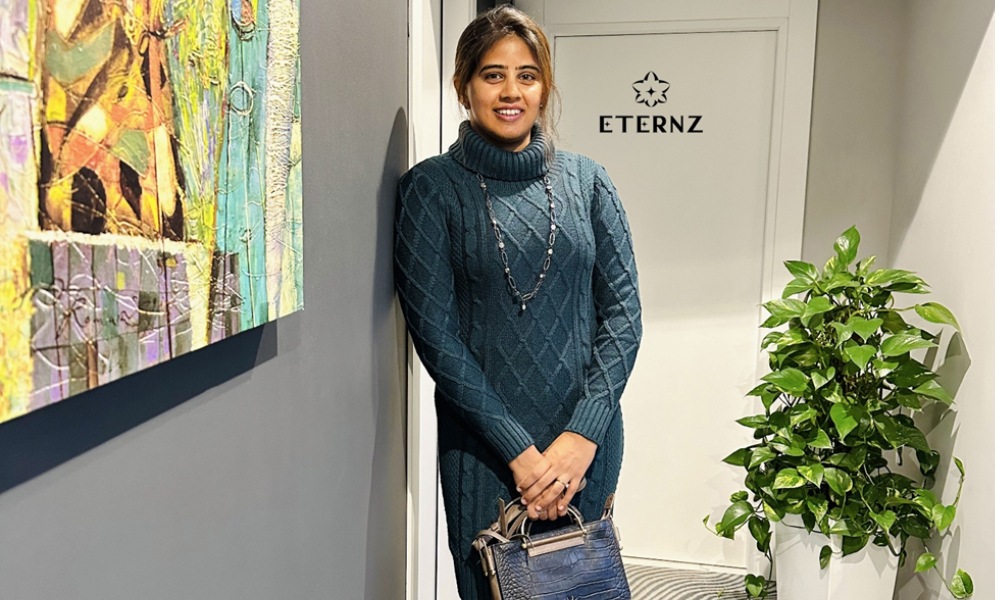
The tech-led premium jewellery label’s Founder & CEO Arthi Ramalingam on curated intelligence, digital trust, and building the future of phygital luxury.
In a category long defined by emotion, heritage, and in-store ritual, Bengaluru-headquartered Eternz is emerging as one of India’s most forward-looking digital disruptors. By merging rigorous curation with interactive technology—from Virtual Try-Ons and AI-led personalisation to playful swipe-based discoveries—the platform is reframing how Indians browse, evaluate, and buy jewellery online.
At a time when design voices in India are multiplying and younger consumers crave authenticity, variety, and transparency, Eternz offers a new kind of ecosystem: one where homegrown craftsmanship meets global-standard tech, and where discovery feels intuitive, elevated, and joyfully consumer-centric. In an interview with Solitaire India, Founder & CEO Arthi Ramalingam breaks down how the platform is reshaping behaviour, building credibility in a digital-first world, and setting the pace for the next chapter of jewellery retail.
Eternz was born from a personal frustration with the jewellery-shopping experience. What, in your view, is the most overlooked need of the modern Indian jewellery consumer?
The biggest gap has always been discoverability. India has incredible design talent, but most consumers end up seeing the same handful of brands everywhere. Over the years, the number of homegrown brands and independent designers in India has increased sharply, yet discovery for these labels remains limited as well. The modern shopper wants choice, transparency, and the ability to explore pieces that genuinely reflect their personal style, not what the industry traditionally pushes. The need for a seamless, curated, trustworthy discovery experience is still hugely underserved, and that is exactly what sparked the idea for Eternz.
India has always shopped for jewellery through emotion and tradition. How do you design a digital ecosystem that honours that sentiment while pushing the industry towards contemporary, tech-led retail?
For us, technology is not a replacement for emotion, it’s an enabler. Jewellery is deeply personal, so our approach has been to bring the intimacy of traditional shopping into a digital format. Whether it’s Virtual Try-On, personalised curation, or rich brand storytelling, the goal is to make the consumer feel understood. We combine data with design sensibility: tech helps simplify decision-making, but the emotional connection still comes from human-centric experience, authenticity, and trust.
Curation is a word many platforms use loosely. What does curation mean to you at Eternz—and what makes a brand or piece ‘Eternz-worthy’?
Curation at Eternz is very intentional. We are not a marketplace that lists everything, we’re a platform that stands for taste, quality, and relevance. A brand becomes ‘Eternz-worthy’ when it has a strong design identity, reliable craftsmanship, transparent processes, and an understanding of today’s consumer. Each piece must have a point of view. We want the customer to feel that every scroll leads them to something meaningful, not overwhelming.
Your platform grew from 10 to 200 brands in a year. What does this say about the state of India’s design landscape—and the appetite for new voices in jewellery?
It tells us that India’s design landscape is entering a very exciting phase. There is so much untapped creativity across cities and categories, and designers are eager for platforms that truly champion them. At the same time, consumers, especially younger buyers, are actively seeking fresh, differentiated voices. They no longer want jewellery that feels generic. Our growth reflects a shift: India is finally ready to celebrate its homegrown design diversity at scale.
Virtual Try-On, a ring sizer, and even a Tinder-style swipe feature—what did you learn about consumer behaviour that convinced you jewellery discovery needed to become more playful and interactive?
We noticed that people enjoy exploring jewellery but often feel intimidated by the process. Adding elements of play reduces that pressure. When discovery becomes interactive, consumers engage longer, experiment more, and ultimately make more confident decisions. The swipe feature, for example, showed us that people love expressing instant preferences; it mirrors how they shop for fashion or beauty. Jewellery shouldn’t feel like a serious, high-stakes decision every single time. It can be joyful.
You’re building India’s largest vertical jewellery-only marketplace. In an industry rooted in trust and touch, what does credibility look like in a purely digital environment?
Credibility comes from consistency. Every brand onboarded on Eternz goes through quality checks, transparency reviews, and operational audits. We highlight certifications, materials, warranty, and brand ethos upfront. Beyond that, our responsibility is to ensure seamless logistics, real-time support, and an honest shopping journey. Consumers trust us because we don’t hide behind the “marketplace” model; we curate, we verify, and we stand by the brands we bring on board.
From gold and silver to demi-fine and lab-grown diamonds, Eternz spans diverse materials. Are you noticing a shift in what consumers value—craftsmanship, price, sustainability, or brand story?
It’s no longer either–or; consumers today evaluate all these aspects together. Younger audiences care deeply about design and wearability—they want pieces they can use every day, not lock up in a locker. They’re also conscious about value: materials matter, but so does transparency around pricing. Sustainability is becoming important, not as a trend but as a mindset. And above all, people respond to storytelling—why a brand exists and what it stands for. The purchase decision now blends emotion with practicality.
With partnerships that include global names like Versace and Guess, what do these collaborations signal about where India sits in the global jewellery and watch conversation?
It signals that global brands recognise India not just as a market, but as an evolved consumer base. Indian shoppers today are design-savvy, brand-aware, and comfortable buying international labels online. For us, these partnerships are a validation that Eternz is building the right ecosystem, one that meets global standards of experience and authenticity. They also show that India is becoming an important node in the global jewellery and lifestyle landscape.
Quick commerce for high-value gifting is an unusual proposition. What does it reveal about how Indians want to buy luxury, and how quickly their expectations are changing?
It shows that convenience has become a form of luxury. Today’s consumer wants immediacy without compromising on authenticity. Whether it’s a last-minute celebration or a spontaneous gesture, they want premium products delivered with the same speed as everyday essentials. This shift reflects how fluid luxury consumption has become; people no longer wait for traditional buying moments—they expect luxury to fit into their lifestyle in real time.
As you prepare to enter offline retail, what role do you believe a physical space should play in the future of a digitally native jewellery brand?
Our physical spaces will be an extension of the Eternz experience—not traditional stores, but discovery-led environments. Offline gives consumers the opportunity to touch, feel, and connect with craftsmanship, while digital gives them scale and convenience. We see the future as phygital: a unified ecosystem where customers move seamlessly between browsing online, experiencing in-store, and completing their purchase wherever they choose. The store becomes a space for inspiration, education, and immersion, not just a transactional point.