
Osmium? Come again? This is the reaction one gets from the jewellery industry when speaking about osmium . A curiosity for much of the jewellery world—but globally, among luxury collectors, watchmakers, and material innovators, osmium is already building momentum. Often described as the last precious metal to enter the world of jewellery, osmium’s super rarity, visual brilliance, and scientific narrative set it apart from anything currently in circulation.
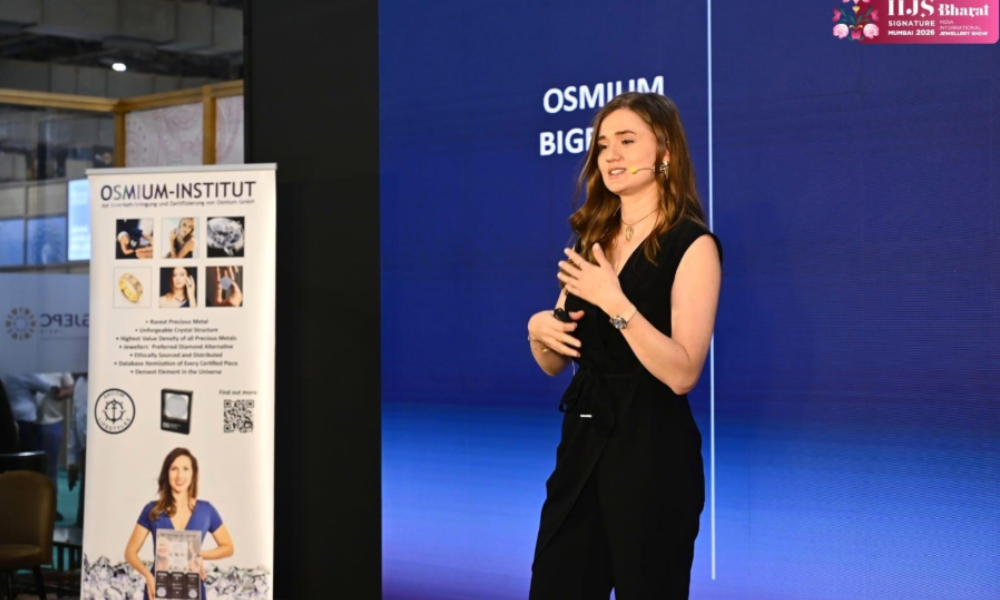
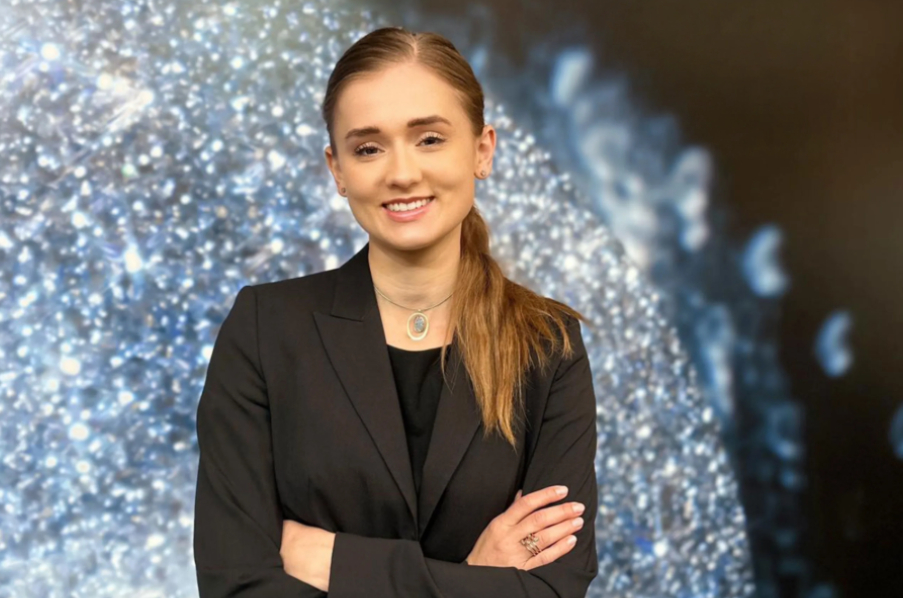
At IIJS Bharat Signature, Solitaire International held a special interview with SCARLETT CLAUSS, Vice Director, Osmium Institute, Germany, and SHEELA SUTHAR, Co-founder of Ancom Lifestyles, the first company to create and introduce osmium jewellery to the Indian market. In this in-depth conversation, they talk about osmium’s extreme rarity, its positioning as both a luxury material and an investment asset, and what it will take for Indian jewellers to meaningfully engage with this extraordinary metal.
Osmium is often referred to as the “last precious metal” to enter the jewellery world. Can you quantify that rarity compared to platinum or gold and explain why no other metal like this will appear in the ecosystem?
Scarlett Clauss: The term “last precious metal” doesn’t imply that osmium was discovered later than gold or platinum—it has always existed alongside the other platinum group metals. What makes it the last is the fact that it is the final element to enter the jewellery and investment market in a wearable, certified form.
From a scientific perspective, the periodic table is complete. Every element is already known, and no new precious metals are expected to emerge.
So, osmium is the last of the naturally occurring precious elements whose properties have only recently been made suitable for jewellery through crystallisation.
That is why the term resonates—it truly marks the end of the line in precious metal discovery.
How rare is osmium when compared with metals like gold or platinum?
Scarlett Clauss: It is in a completely different league. Osmium is mined only as a by-product of platinum. To give you a sense of scale, from 10,000 tonnes of platinum ore, one can extract roughly 30 grams of osmium.
When we first began working with osmium, we believed much larger quantities existed. Over time, we realised that many suppliers were referencing the same limited stock. Today, the most realistic estimate is that less than 350-500 kilograms of ethically mined osmium will ever be available globally.
To give you a sense of scale, if you melt down all the gold ever mined, it will form a cube of more than 20 metres high. All the osmium that can ever be crystallised and used would fit under two or three chairs. That’s the level of scarcity we’re talking about.
With crystallisation nearing its global limits, how do you manage long-term supply continuity?
Scarlett Clauss: Osmium operates on a finite-resource model. It is essentially “first come, first served.” Once it is gone, it is gone.
That said, it cannot be reused. Unlike gold, you can’t melt it down, but you can unset it and reset it—much like a gemstone.
Some brands secure quantities in advance and store them with us under contractual agreements. Others pre-order specific cuts that we hold and release as required. These mechanisms allow brands to plan collections while accepting that osmium is not a mass-market material—it is inherently limited.
How is osmium priced, and how should jewellers understand its weight and value?
Scarlett Clauss: At present, osmium is priced per gram—around €2,400 per gram. However, that often creates confusion because jewellers assume they need multiple grams, as they would with gold. In reality, osmium is used in fractions of a gram.
One carat of osmium equals 0.2 grams. A ring or pendant may contain as little as that. We are actively considering a shift to carat-based pricing because it aligns better with how jewellers and consumers understand the value of an inlay material when used like a gemstone.
How does one purchase osmium?
Scarlett Clauss: The simplest way is to buy it online through our webshop, where individual pieces are clearly listed—you can select and add them directly to your basket. If you’re looking for standardised shapes, that’s even easier. We offer a range of forms such as hearts, squares and circles.
What truly sets osmium apart, though, is the ability to create custom shapes. Almost any flat design is possible. All we need is a CAD file or a technical drawing, based on which we share a cost estimate and proceed with the order. Every piece is cut and certified in Germany, and sold into different countries through our partner networks.
Is it cut by hand?
Scarlett Clauss: No. Osmium is cut using wire EDM cutting—a machine-led process that is extremely precise, even more so than laser cutting.
Tell us about the peculiar characteristics of osmium.
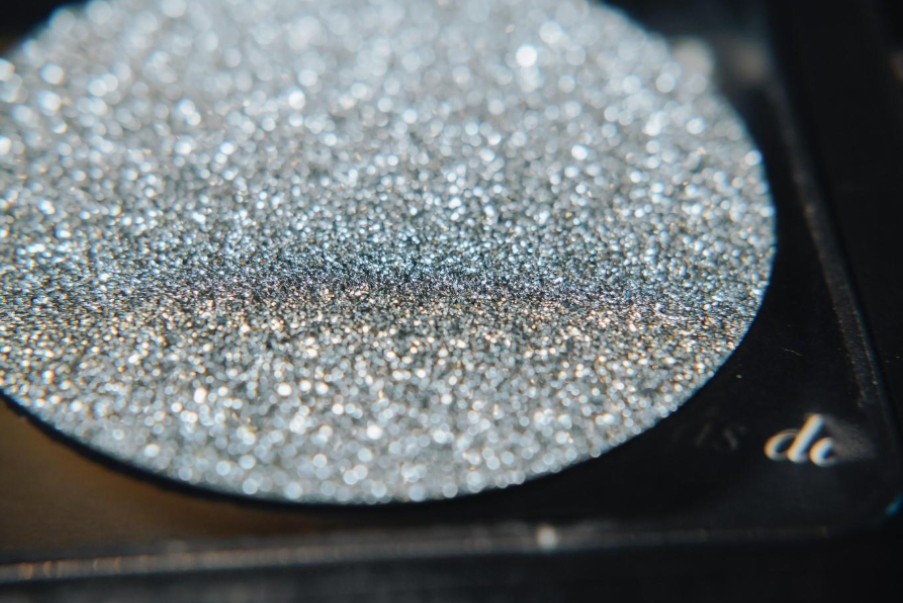
Osmium is inherently very thin—between 0.2 and 1.4 millimetres—and the quality remains consistent throughout. Unlike gemstones, there are no grades as such. Instead, osmium is defined by different sparkle levels.
The purity is the same across the board; what changes is the thickness of the piece. Thicker sections form larger individual crystals, and larger crystals reflect more light back to the eye. A Sparkle 1 offers a smooth, even surface with a gentle shimmer, while a Sparkle 5 delivers bold, dramatic flashes of light—almost like strobe effects.
There’s no better or worse here. It simply comes down to the look you want to achieve in your design.
India is both aspirational and price conscious. Where does osmium realistically sit in the Indian market?
Sheela Suthar: India has always embraced rarity—be it gemstones, metals, or heritage jewellery. We believe osmium fits naturally into that mindset. It appeals strongly to collectors, high-end clients, and jewellery connoisseurs, but it isn’t restricted to a single price bracket.
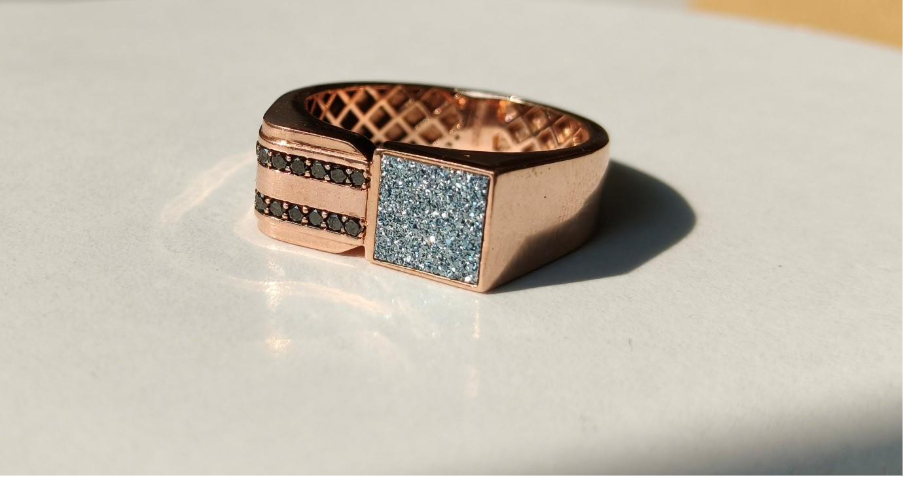
Because osmium is typically used as an inlay rather than a dominant metal, it can be incorporated into designs across a wide range of budgets. Even a small piece carries meaning because of its rarity.
It’s not about volume—it’s about owning something that very few people in the world will ever have.
Are Indian jewellers already experimenting with osmium?
Sheela Suthar: Yes. Ancom Lifestyles is the only jewellery brand so far in India to work with osmium. Functionally, it behaves more like a gemstone than a metal. It is set using familiar techniques—bezel, prong, or inlay—so the learning curve is not steep.
Beyond jewellery, we see strong potential in watches and luxury accessories. Globally, watchmakers have already recognised osmium’s appeal, and India will follow once awareness builds.
How do you plan to position and brand osmium jewellery in India?
Sheela Suthar: Our approach is two-fold. We are engaging with large corporate jewellery houses and established fine jewellers, while also introducing osmium to individual collectors as both jewellery and an investment asset.
Through Ancom Lifestyles and our partner platforms, we are already educating clients, offering certified pieces, and demonstrating how osmium can be integrated into contemporary design. This isn’t a future plan—it has already begun.
Given its scarcity, how do you see osmium appealing to younger consumers?
Sheela Suthar: Its limitation is precisely its strength. Osmium is finite, and that makes it emotionally powerful. For younger consumers, it offers individuality and authenticity.
It can be repurposed, reset, and restyled across generations. That flexibility allows it to evolve while retaining its core value. In that sense, osmium is not just jewellery—it’s an heirloom material with modern relevance.
Buyback is always a key question for Indian buyers. How will osmium perform as an investment?
Sheela Suthar: Over the last seven years, osmium prices have grown more than fourfold—from roughly €500 per gram to over €2,000 per gram. Its value is driven purely by scarcity.
If you look at gemstones like old Burmese rubies that are no longer mined, you begin to understand the trajectory.
Once supply stops, value only moves in one direction. Osmium follows the same logic.
Has osmium entered the global auction ecosystem yet?
Scarlett Clauss: We are currently developing projects with major auction houses. Beyond jewellery, osmium has already appeared in major statement pieces—one notable example being an osmium-inlaid violin that debuted with a starting price of €4 million.
These “lighthouse projects” establish osmium’s credibility in the ultra-luxury space. Jewellery and objets d’art will follow that path.
What makes osmium certification different from diamonds or precious metals?
Scarlett Clauss: Osmium doesn’t rely on external certification alone. Its crystalline surface is the certificate. Each piece has a unique structure—like a fingerprint—recorded under an Osmium Identification Code (OIC) linked to a high-resolution scan in a database. By simply comparing a photo of the piece with the database image, even a layperson can confirm its authenticity. This built-in, user-verifiable identity is why luxury brands value osmium: once incorporated into a watch, ring or accessory, it cannot be replicated, and authenticity can be checked by anyone—something no other material can truly offer.
We also provide a printed certificate or a digital PDF. What truly makes osmium unique is that its surface is permanent—just like a thumb impression.
How can Indian jewellers source certified osmium?
Sheela Suthar: Sourcing is entirely channelised through official partners of the Osmium Institute. In India, every piece is traceable and registered in a global database. There is no ambiguity and no scope for counterfeiting.
We offer osmium as loose certified pieces, custom shapes, or fully crafted jewellery—depending on the client’s requirements.
Osmium was once considered toxic. How is it now safe for wear?
Scarlett Clauss: Raw osmium can form osmium tetroxide, which is toxic. During crystallisation, however, the atomic lattice is completely rearranged, making the metal stable and non-reactive.
Once crystallised, it is safe to wear. Only extreme heat during processing requires caution, and we provide detailed training to jewellers to ensure safe handling.
Any final thoughts for Indian manufacturers and designers?
Sheela Suthar: Education is everything. Once jewellers see osmium, touch it, and understand how it works, hesitation disappears.
Acceptance will come steadily—with knowledge, visibility, and real pieces in hand. Osmium isn’t a trend. It’s a long-term material with lasting relevance.