
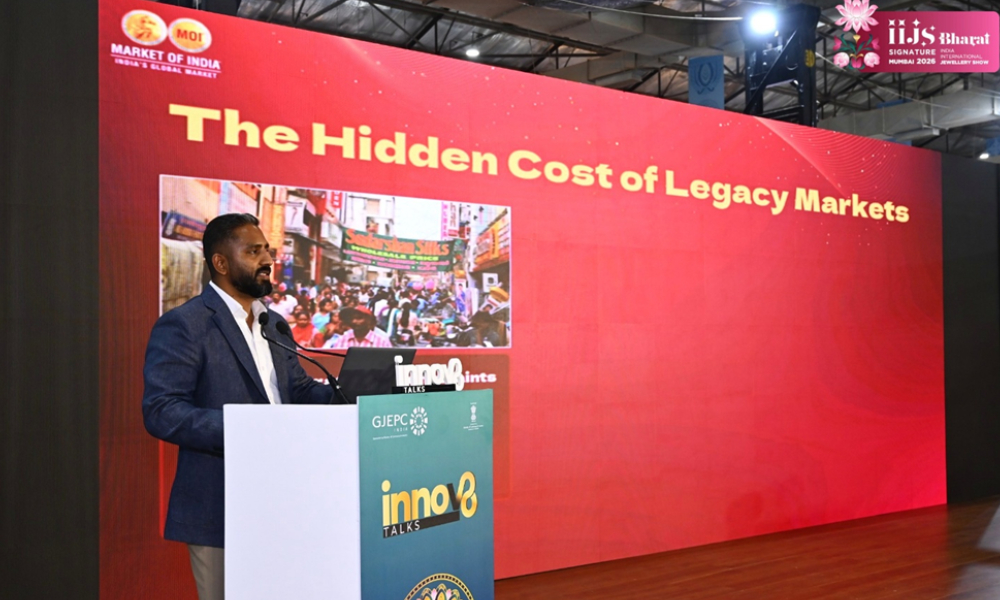
A session on Beyond Lanes and Legacy Markets examined how infrastructure has become the biggest bottleneck for India’s gold and jewellery industry, even as demand and transaction volumes hit decade highs. The talk was delivered by Haresh Sundar at the Innov8 Launchpad, NESCO, on 11 January 2026.
Sundar pointed out that legacy jewellery markets in Mumbai, Delhi and Chennai are struggling with congestion, safety risks, hygiene issues, limited parking and ageing buildings. These inefficiencies, combined with security and insurance challenges, raise costs, limit scalability and weaken brand perception, especially among international buyers and corporates.
He noted that infrastructure directly impacts productivity and growth, citing organised platforms like IIJS where modern facilities significantly increase transaction velocity. Infrastructure, he stressed, is no longer a support layer but a core growth driver.
Highlighting South India’s strategic role, which accounts for nearly 40% of global gold consumption and around 65% of India’s jewellery manufacturing, Sundar outlined the vision behind Market of India – India Gold Capital in Chennai. The 65-acre integrated development aims to modernise wholesale trade through planned market space, advanced security, logistics and compliance-led design.
The session concluded with a clear message: India’s jewellery sector does not suffer from weak demand. It underperforms when infrastructure fails to match ambition, making investment in modern trade ecosystems critical for the next 50-100 years of growth.