
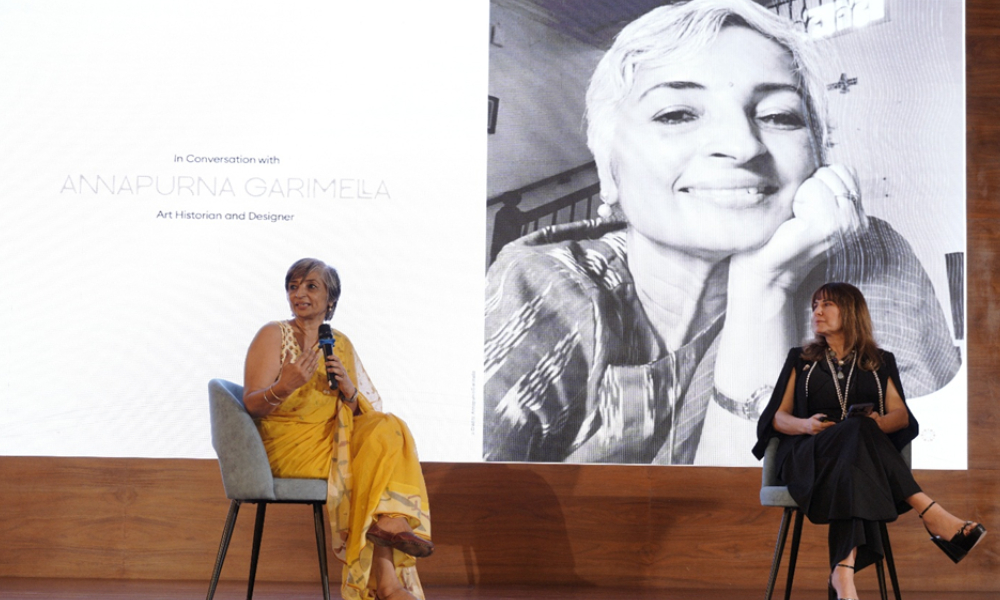
There’s clear sense of clarity with which Dr. Annapurna Garimella, art historian and designer, speaks about Indian craft—measured and thoughtful. As a cultural thinker, she occupies that rare space where scholarship meets practice. Her work consistently reframes craft as a living, thinking force—one that demands deeper engagement from designers, institutions, and industry alike.
At a time when India’s craft grammar is being reinterpreted for global markets, Garimella’s perspective stands distinct. She reminds us that craft is not just about preservation—it is about perception, process, and power. Her insights push the conversation beyond aesthetics into systems, structures, and the future of making itself.
At the recently concluded Design Inspirations seminar organised by GJEPC and curated by Paola De Luca, Creative Director & Trend Forecaster, Founder of The Futurist and Co-founder, Trendvision Jewellery + Forecasting, Dr. Garimella shared valuable insights with the audience.
Integration of Theory and Practice: There is a critical need to break down the wall between design theory and manual practice. Education and industry should recognise that designing and making are interconnected processes where the “vision” is prepared through research and physical engagement.
Growing up in a family of makers, there was no hierarchy between the various kinds of making. I believe that it’s in the doing that thinking happens. And the person who’s making something is designing it during that stage.
The “Vibrancy” of Matter: There is mind in the matter. Designers should view materials not as passive objects but as entities with intelligence, vibrancy, and energy. Matter has its own logic, intelligence, and emotion—elements that must be engaged in a dialogue. My undergraduate education, which combined design and art history, taught me the value of truly paying attention and understanding what emerges from that engagement. “Paying attention” requires the eyes to listen to the heart and the material simultaneously.
Technology as an Adjacent Tool: I feel very strongly that one shouldn’t de facto be against or for technology. Technology should be viewed as a tool that helps one think, rather than a replacement for the mind. It’s something that you can work along with adjacent to. While new tools (like stone-cutting technology) change the aesthetic, they should be used to achieve specific goals rather than being seen as inherently “anti-heritage”.
The Necessity of Archiving: India faces a significant challenge with a lack of organisation and documentation. I would urge designers and the industry to archive thoughts, take notes, and document work beyond just smartphone photos. These archives serve as the “capital” from which a brand identifies its design DNA, knowledge, and manufacturing secrets. .
Valuing Skill to Sustain the Future: A critical concern for the industry is the declining interest among craftspeople to continue in the profession. If the next generation chooses not to enter jewellery making, it could face a ‘potential death’ as the next generation will choose not to enter the profession. Even with advanced machinery, skilled human hands remain irreplaceable.
The sustainability of craft lies in how craftspeople are valued—both economically and socially. The more individuals who are trained and respected for their expertise, the stronger and more competitive the industry becomes,
Intellectual Property and Infrastructure: There is also a growing need to support craftspeople through stronger frameworks such as Geographical Indications (GI), copyrights, and community rights. Recent actions, like the Bidar community taking legal steps to protect Bidri work, signal a shift towards recognising and safeguarding craft knowledge.
While craft traditions are often family-led, ensuring their future requires a broader, more structured approach—one that combines fair valuation, legal protection, and long-term thinking.