
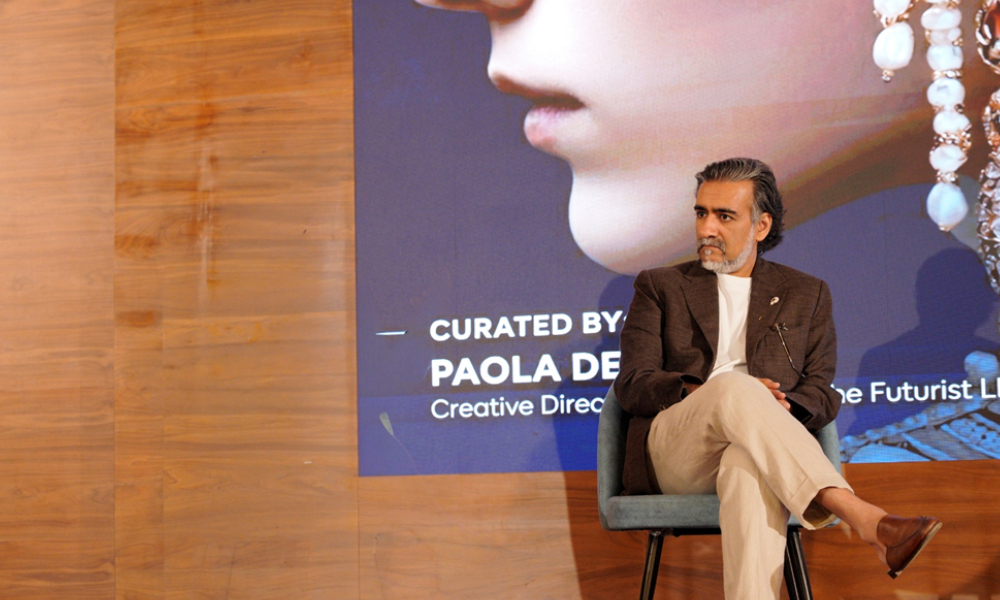
At Design Inspirations, Milan Chokshi, Founder of Moksh, presented “Connecting Heritage and Innovation in India”, offering a nuanced view of how Indian jewellery must move beyond material value and inherited ideas of excess toward a more thoughtful, meaning-led approach to design. Drawing on his own journey and the evolution of his family business, he argued that luxury today is no longer defined by visibility or scale, but by intention, emotion, and the time invested in craft.
Chokshi emphasised that the future of jewellery lies in the human hand, where the skill, patience, and imperfections of the karigar carry far greater value than machine precision. He called for a conscious shift from repeating heritage to reinterpreting it through a contemporary design language rooted in restraint and authenticity. In doing so, he positioned India at a pivotal moment, moving beyond its identity as a manufacturing hub to emerge as a cultural and creative force capable of shaping global design narratives.
Key Takeaways
Redefining True Luxury: Luxury is no longer about excess, loud logos, or what you own, but rather about essence, feeling, and intention. The greatest luxury today is learning to slow down and appreciating the time and craftsmanship embedded in an object. The future of this luxury is being shaped by the quiet, meditative hands of Indian artisans.
The Sacred Nature of Handmade Craft: In an era of AI, automation, and machine precision, handmade items have become profound and almost sacred. The future of jewellery lies in the imperfections of the human touch and the patience of the artisan, preserving a language of creation that machines will never be able to replicate. Brands must elevate their artisans—the karigars—rather than hiding the maker behind the brand identity.
Reinterpreting Indian Design and Breaking Colonial Ideals: The identity of Indian luxury has long been viewed through a Eurocentric and colonial lens that expects opulence, grandeur, and maximalism. Instead, Indian heritage should be reinterpreted using a contemporary design language characterized by restraint, purity, and minimalism. The industry must unlearn conditioned ideas of excess and normalize new beauty standards from a fresh perspective.
Designing for Mindsets, Not Demographics: Rather than chasing specific age brackets or geographic locations, brands should target a global community of individuals who value cultural stories and understand that luxury is conscious rather than conspicuous. Every piece should act as an invitation for the wearer to reconnect with the object, the maker, and themselves.
India’s Global Moment: India is stepping out of its reputation as a mere hub for mass production and is being recognised globally for its deep cultural history and artistic talent. Because of this, Indian brands do not need to adapt to fit global tastes; instead, global tastes should redefine themselves around authentic Indian heritage. The industry focus must be on elevating craft over rewriting trends.
The Power of Legacy and Family Entrepreneurship: The jewellery landscape in India is deeply tied to family history and entrepreneurship, making the business personal and rooted in values much deeper than profit. True success is found in a delicate balance between honoring a multi-generational legacy and innovating for where the world is going.