
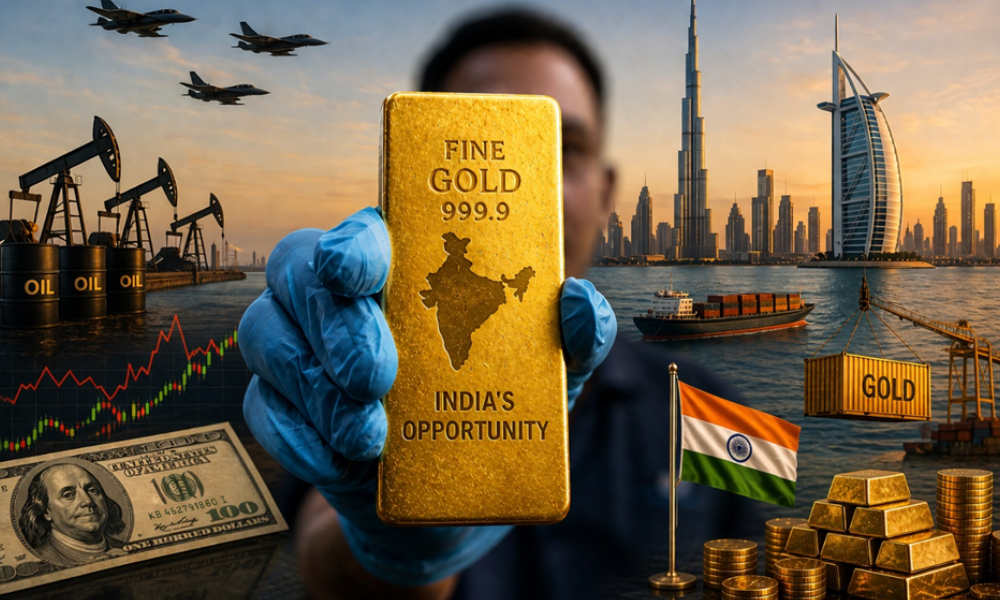
Gold expert Sanjiv Arole dissects the volatile intersection of global warfare, central bank shifts, and the precarious future of the US dollar, ultimately posing a provocative question about India’s potential to seize the crown from a destabilised Dubai.
Leo Tolstoy’s War and Peace was set against the backdrop of the Napoleonic wars and their upheaval of Russian society. Today, we face a similar reality: multiple active theatres of war with no lasting peace in sight. The conflict over Iran, inextricably linked to oil, has sent prices vacillating wildly, surging over $125 per barrel during escalations over the Strait of Hormuz and dipping below $100 on hopes of a ceasefire. Consequently, stock markets soar one day only to crash the next. While currency markets remain volatile, the US dollar reigns supreme, as the war narrative is controlled by a single dominant party.
Fuel shortages have driven prices higher across the board as inflation threatens to run amok. Commodity markets have suffered; industrial precious metals declined sharply, with silver falling from its $121 peak to around $70, briefly even touching $60.
Amidst the ruins, gold strives for steadiness against the war’s collateral damage. After scaling an all-time high of $5,600 in January 2026, it has been pushed back repeatedly. While the war spurred a brief recovery to $5,400, a stronger dollar and high crude prices have since squeezed the metal. Gold is now resolutely defending successive price levels, first $5,000, then $4,800, and now the $4,500-$4,600 range, hovering at $4,629 at the end of April 2026. Is the bull run over? Let us review the year so far.
Despite high volatility in 2026, swinging between $5,600 and $4,098, gold set a record Q1 average price of $4,873 per ounce. According to the World Gold Council’s Gold Demand Trends report, key demand highlights included: (a) Retail investors led the charge, with Q1 2026 bar and coin demand reaching its second-highest quarterly level; (b) A regional divide in ETFs, as Asian inflows were offset by Western liquidations; (c) Central banks remained net buyers, with Turkey’s purchases eclipsing Russian sales, though overall volumes trailed the last three years; (d) Jewellery volumes shrank even as total spending ballooned due to record prices; and (e) Total supply and demand rose 2% year-on-year, with demand value hitting a record $193 billion.
Then, Jerome Powell presided over his final Fed meeting before demitting office this May, leaving interest rates unchanged due to March inflation exceeding 3%. In a blow to gold, he indicated that rates may not be cut until 2027, citing uncertainties from the prolonged war over Iran and the tariff tangle. Furthermore, Powell’s intent to remain as a Fed governor until his term ends, or until renovation investigations conclude, threatens to prolong the Trump-Powell feud.
Perhaps the greatest collateral damage of the US-Iran-Israel conflict has been to the “City of Gold,” Dubai, and the broader Gulf. These nations realised that the US security umbrella could not stop Iranian drones and missiles from targeting regional assets, including international airports.
The resulting closure of airways and seaways brought the gold market to a grinding halt, stalling exports indefinitely and jeopardising Dubai’s free-trade status. Though a fragile ceasefire holds and the Gold Souk has reopened, sentiment remains flat. Consequently, Singapore is siphoning off Dubai’s trade. High-net-worth investors, concerned about insurance and liquidity, are shifting bullion to Singapore, which has seen imports surge as wealthy players seek a more secure alternative hub.
The recent squeeze on gold prices led Morgan Stanley to revise its 2026 average price forecast downward from a bullish $5,700 per ounce to $5,200. This was based on recent bullion market developments: weaker official demand, Western ETF outflows, and rising yields that have fuelled both volatility and a price slump. Ultimately, future prices will hinge on Fed easing, cooling inflation, and the pulse of fresh economic data.
However, it is not all downhill for gold. The US is more dependent on equity markets than ever, with its market cap-to-GDP ratio currently at a staggering 252%, dwarfing the 65% seen during the 1929 Great Depression and the 170% in 2000. As a highly over-equitised nation, the US is also more illiquid than in 2008, with private equity now comprising 16% of institutional portfolios. A 35% correction could spiral the markets into a bear phase, a scenario that could only benefit gold.
Moreover, a prolonged war threatens the Gulf’s geopolitical alignment. The perception that the US can no longer offer adequate protection could gradually wean these nations away from American influence. Such a conflict would not only potentially drive oil toward $200 per barrel but also shatter US credibility. As a result, the USD could come under immense pressure as de-dollarisation gains momentum, making a shift toward a gold-backed monetary system more than just a pipe dream.
Geopolitical tensions could escalate further if the US follows its stated schedule to target Cuba after Nicaragua and Iran. While the war over Iran sidelined the US tariff fiasco, the issue is set to explode. The US Supreme Court has ordered $166 billion in refunds to affected parties, yet the President has asked them not to demand the money. As deadlines loom over this tariff mess, the trade war is far from over. Gold stands ready to pounce on such escalations as global uncertainty intensifies.
The war has changed all equations in the Gulf, as nations hosting US military bases have endured a barrage of Iranian drones and missiles. Once the dust settles, it remains to be seen if regional dynamics with the US will ever return to the status quo. Some countries may conclude that US security guarantees are insufficient and embark on independent courses of action. Such a shift would put US dollar-backed payment systems under significant stress and further accelerate the process of de-dollarisation.
Therefore, the UAE’s recent decision to exit OPEC could be a recipe for disaster for the US. Not only could it flood the market with crude oil beyond OPEC-controlled quotas, but it could also trigger a cascade leading to the breakup of OPEC itself, the very backbone of the USD-controlled global payment system. Such a shift could finish Dubai as a premier world trading hub and, eventually, fundamentally change the face of the global bullion and diamond industries.
Meanwhile, the impact of the war and reciprocal US tariffs is reflected in the GJEPC’s export numbers for the fiscal year ending 31 March 2026. Cut and polished diamond exports fell by 8.52% to $12.16 billion, while plain gold jewellery exports declined by 7.42% to $4.84 billion. Conversely, studded gold jewellery grew by 6.27% to $6.52 billion, silver jewellery surged by 52.21% to $1.47 billion, and platinum jewellery rose over 39% to $254.60 million.
Now, the diamond industry has been in a slump for quite some time. The high gold price through the last year as well as the first month of 2026 saw demand for gold jewellery decline in the Indian domestic market. Normally, during a period when domestic demand for gold jewellery declines significantly export of gold and silver jewellery increases substantially as well. However, this time while plain gold jewellery exports have declined, studded gold jewellery have risen significantly partially offsetting the decline in plain gold jewellery exports. This marriage of diamonds and gold is a comparatively new phenomenon that would necessitate some more detailed analysis
The IIJS Tritiya exhibition in March, intended as a prelude to April’s Akshaya Tritiya festival, saw a decidedly cool response. Despite lower gold and silver prices at the time, buyers were reluctant to commit, preferring a wait-and-watch approach. A hint of panic surfaced as precious metals prices declined steeply and steadily. While the subsequent Akshaya Tritiya occasion saw an increase in buying in value terms, volume terms registered a decline compared to the previous year.
The war’s collateral damage has also hit gold imports. Since 1 April 2026, all bank imports of gold have halted due to an IGST issue, resulting in zero bank imports. Furthermore, the DGFT has stalled gold dore import license renewals for over 90 days, with only one company’s license renewed to date. Consequently, most refiners face imminent shutdown and could stop supplying gold from dore. Currently, gold can only be imported via the IIBX by qualified jewellers, yet volumes in the last few days through the exchange haven’t even reached 2 tonnes.
Finally, news from the Gulf indicating Dubai’s vulnerability as a global trading hub for diamonds and bullion creates an opening for other centres to seize its position. Singapore is already attracting high-net-worth institutions and individuals fleeing Dubai.
It is worth remembering that Dubai’s emergence as a gold hub in the ’60s and ’70s was largely fuelled by India’s own gold import bans from 1962 to the 1990s. Now, a small window of opportunity has opened for India to reclaim its rightful place in the global gold and diamond industry. Whether India will grab this chance or fluff it depends on its ability to be proactive, nimble, and innovative. Wake up, India! A glorious chance at redemption is knocking at the door.