Have a strong appetite for estate jewels? Here’s an early preview of Christie’s forthcoming Magnificent Jewels auction, to be held live on 13th May 2026 at the Four Seasons Hotel des Bergues in Geneva.
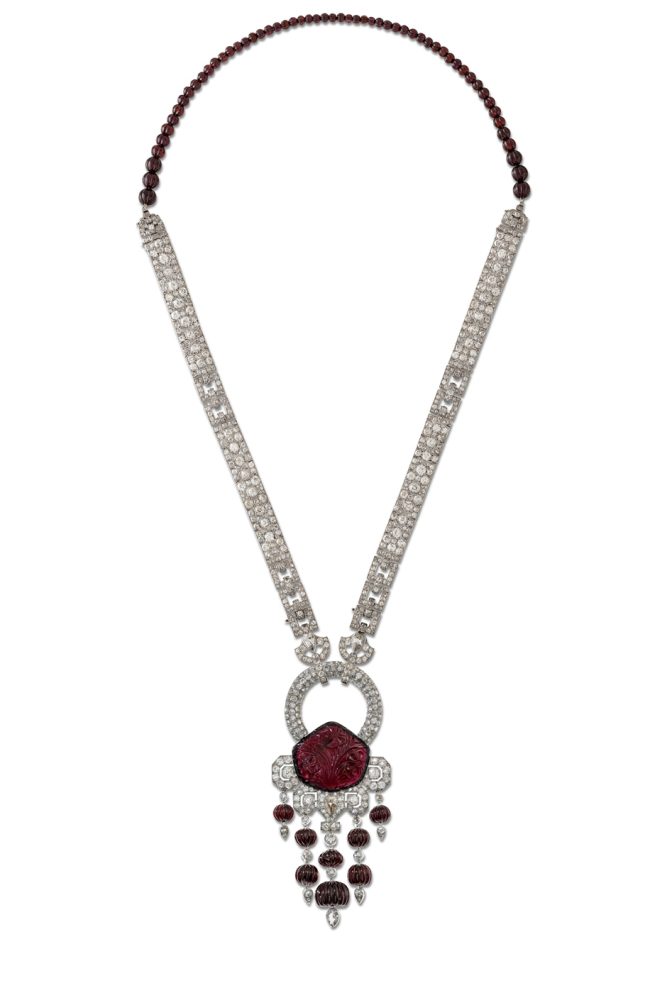
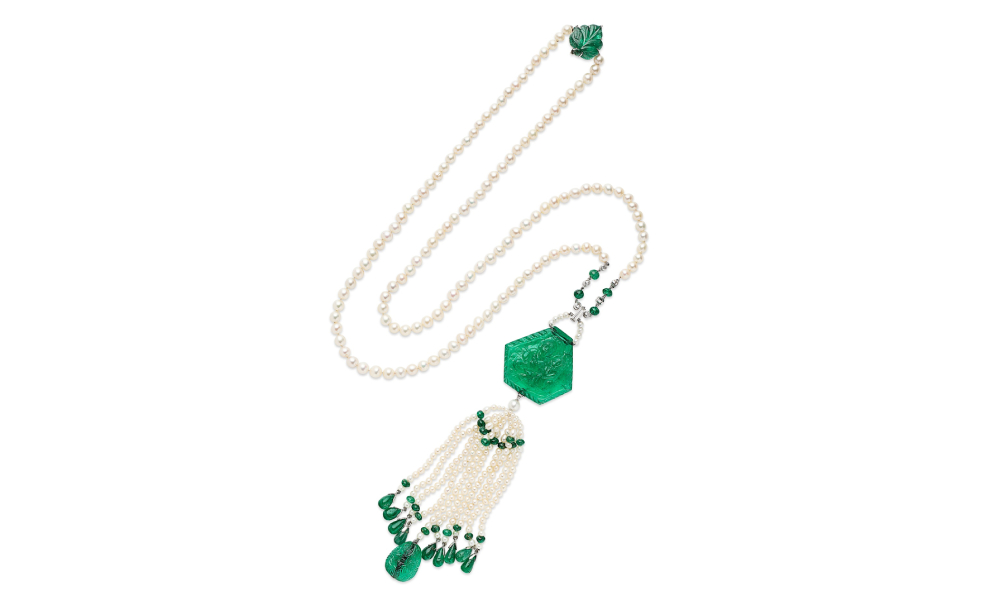
Among the standout lots are a Cartier Art Deco emerald, pearl and diamond sautoir—worn in the film adaptation of The Great Gatsby—and a Boucheron ruby, emerald, onyx and diamond necklace, both created circa 1925. These exceptional jewels represent the creative brilliance of the Art Deco era and feature within a broader offering of museum-quality Art Deco masterpieces presented in the auction.
The Cartier Sautoir featured in The Great Gatsby
Created by Cartier New York in 1925, the Sautoir was a special commission for one of the Maison’s most important clients, who already owned the remarkable carved emerald, requesting it be reimagined as a masterpiece of Art Deco design.
The result is a long necklace of pearls and emerald beads centred on a spectacular 86.71‑carat carved emerald depicting the Hindu deities Shiva and Parvati (estimate: US$ 310,000–510,000).
In the same year, 1925, F. Scott Fitzgerald’s third novel, The Great Gatsby, was published. which came to be regarded as the “Great American Novel.” Nearly 50 years later, in 1974, the Cartier jewel played a starring role in the film adaptation of The Great Gatsby, where it was worn by Jordan Baker, portrayed by Lois Chiles. To capture the opulence of the Roaring Twenties, Mia Farrow and all the principal female cast members were adorned in Art Deco jewels supplied by Cartier.
The Sautoir appears during the group’s dramatic trip to New York City for an evening on the town. Its fluid strands of pearls and emerald beads, culminating in the carved emerald pendant, make it one of the most memorable jewels associated with the film.
The film’s costume designer, Theoni V. Aldredge, received the Academy Award for her outstanding work on The Great Gatsby.
Working closely with Cartier and longtime house designer Alfred Durante (1923–2022), Aldredge curated an unforgettable jewellery wardrobe for the production.
Two years after the film’s release, Cartier celebrated its storied heritage with the Louis Cartier Retrospective exhibition in New York, where many of the jewels worn in The Great Gatsby were showcased, further cementing their place in jewellery and in cultural history.
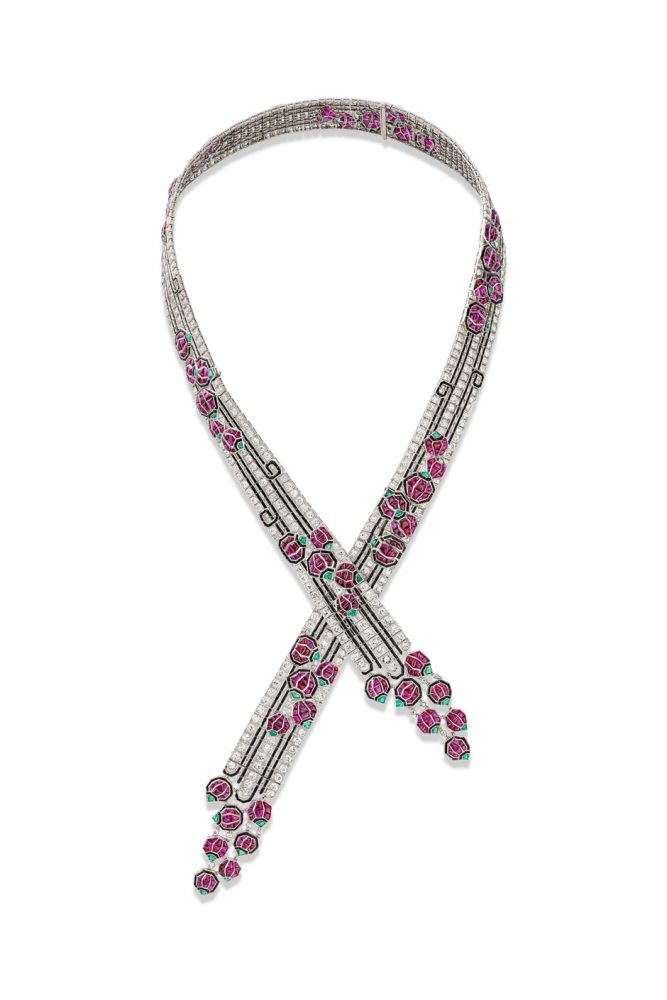
The Boucheron Necklace
Around 1925 the jewellery designers at Boucheron on Place Vendôme created the above necklace, a testament to the Maison’s continued innovation and its ability to adapt to the evolving aesthetics of the period.
Composed of rubies, emeralds, onyx, and diamonds, set in platinum, the jewel is ingeniously constructed to detach into four parts, allowing it to be worn as two bracelets and a choker (estimate $310,000-510,000).
The rose motif was an important decorative theme in Paris in the early twentieth century and was closely associated with the fashion designer Paul Poiret (1879-1944).
The illustrator and designer Paul Iribe (1883-1935) created the famous stylised rose pattern for Poiret around 1908–1909, a design that became emblematic of the House Poiret and influenced creators well beyond the world of fashion.
At the 1925 Exposition Internationale Des Arts Décoratifs et Industriels Modernes in Paris, widely considered the birth of Art Deco, Boucheron presented this necklace decorated with these stylised roses, recalling Iribe’s earlier design for Poiret. Designed to be worn in innovative ways, this necklace is a continuation from the 1879 presented Question Mark necklace—a revolutionary feat of craftsmanship that reimagined how jewellery could move with the body and the 1889 introduced feather-light designs that redefined the poetic elegance of modern jewellery.
Some more exceptional pieces that will catch the eye at the auction: