
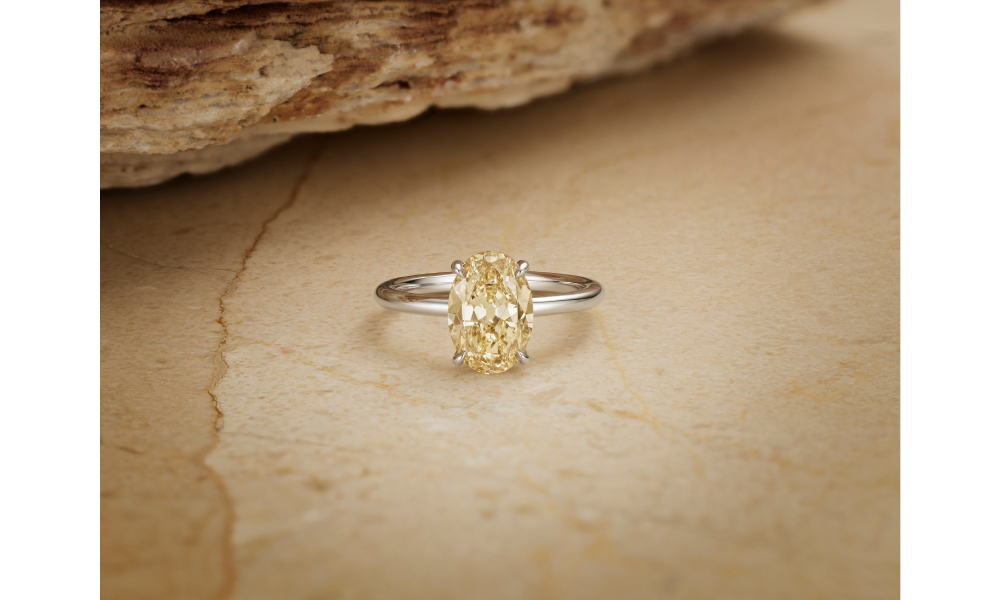
Buoyed by growing engagement around its “Desert Diamonds” campaign, De Beers is intensifying efforts to build fresh demand for natural diamonds.
In a recent episode of the Paul Zimnisky Diamond Analytics Podcast, De Beers’ Marketing Executive Sally Morrison laid out a candid view of what the company sees as the total addressable global market for diamond jewellery.
Morrison noted: “We know from our data that 15-20% of people are hardcore lab-grown (diamond) purchasers…we also know that about 15-20% are hardcore natural (diamond) buyers…but there’s this huge chunk of consumers in the middle, they are open to either…and for us, it’s like looking at voters in a swing state, those are the people that you can really move with communications and can be won.”
According to Paul Zimnisky estimates, the global diamond jewellery market is valued at about $85 billion today and is forecast to grow to $100 billion by the end of the decade. Using Morrison’s data as a proxy, this means that $60 to $70 billion of diamond jewellery demand will be up for grabs by the end of the decade.
For the natural diamond industry, driving incremental demand for “diamond jewellery” as a product helps, but the key is to convince consumers to spend dollars on natural diamond jewellery specifically.
As such, Morrison and the De Beers marketing team deemed that promoting “warm white to champagne” hued natural diamonds would be a strategic move to present diamond jewellery to consumers in a way that highlights the inherent individuality of natural stones – a characteristic that differs from mass-produced, machine-made diamonds (which are intentionally manufactured to be as close as possible to colourless and flawless).
Further, the strategy implicitly generates demand for the full spectrum of run-of-mine goods – of which the large majority are (by nature) less than perfect. For context, Paul Zimnisky estimates that approximately 80% of gem-quality goods mined are less than VS1-clarity and 65% are below “colourless” grade. By contrast, it is becoming difficult to source lab-grown diamonds below VS/colourless grades as advances in production methods have effectively rid “inferior” goods from supply.

Marketed as “Desert Diamonds,” De Beers’ campaign debuted for holiday 2025, supported by the company’s most aggressive multi-media strategy in years.
On the Podcast, Morrison noted that the efforts directly drove an estimated 8 million consumers into jewellery stores late last year and boosted “consumer consideration” for purchasing a natural diamond by 10% YoY – noting that the campaign gave retailers “a story…(as) the colour range in the palette was a metaphor to allow them to talk about natural (diamonds) and the connection to origin.”
Morrison added, “for independent retailers that were interested in pivoting back into natural diamonds or growing their natural diamond business…it worked extremely well…particularly for those that did the training and used the (marketing) materials.”
In mid-April, De Beers launched a second iteration of the campaign, specifically targeting the bridal market in time for the northern hemisphere’s 2026 summer wedding season.
Similar to last year’s more fine-fashion oriented aim of targeting self-purchasers, the concept is to continue building “cultural momentum” around desert-hued natural diamonds. The bridal palette will skew more towards the “softer, lighter” end of the colour spectrum.
A resilient, broad-reaching campaign like this could serve as a much-needed catalyst for natural diamond demand amidst a prolonged four-year lull that has been compounded by the mainstream introduction of inexpensive lab-grown diamonds unscrupulously marketed as “indistinguishable” from natural stones.
Combined with a material paring of mined diamond production of some 25% over the same period, the natural diamond market could be poised for a squeeze which could send prices notably higher just as no one is expecting it.
Paul Zimnisky, CFA is an independent diamond industry analyst and consultant based in the New York metro area. For regular in-depth analysis and forecasts of the diamond industry please consider subscribing to his State of the Diamond Market, a leading monthly industry report; an index of previous editions can be found here. Also, listen to the Paul Zimnisky Diamond Analytics Podcast on Spotify or Apple Podcasts for exclusive full-length conversations with special guests from the gem and jewelry industry. Paul is a graduate of the University of Maryland’s Robert H. Smith School of Business with a B.S. in finance and he is a CFA charterholder. He can be followed on X @paulzimnisky and on YouTube @paulzimnisky.
Disclosure: At the time of writing Paul Zimnisky held a long equity position in Brilliant Earth Group.
