
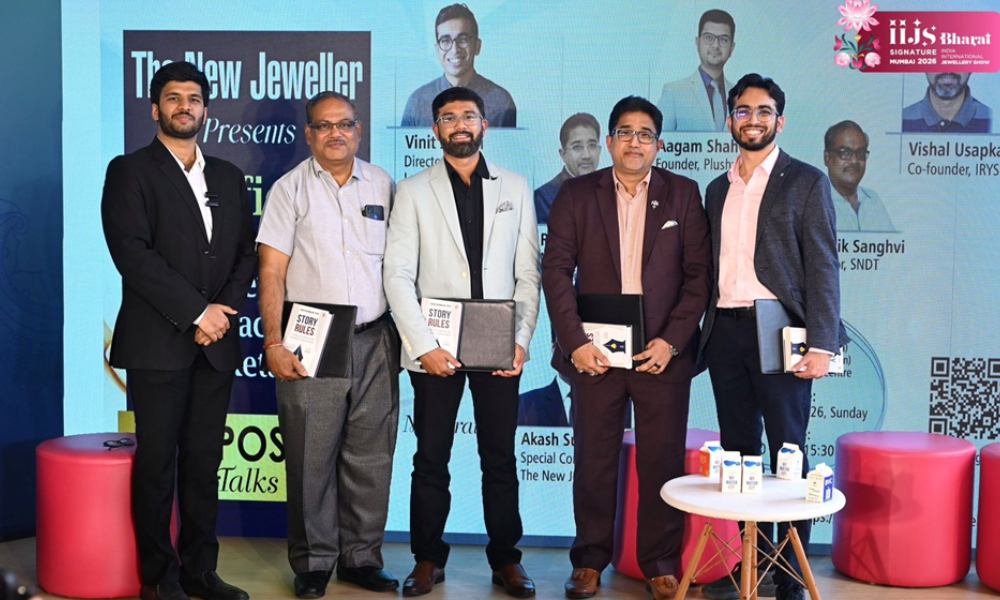
Artificial intelligence is rapidly moving from experimentation to execution across India’s gem and jewellery industry, speakers agreed at a focused symposium held at NESCO on 11th January 2026. Titled Artificial Intelligence in Indian Jewellery Manufacturing & Retail, the session brought together voices from technology, education, manufacturing and retail to examine how AI is reshaping the industry’s operating models.
The discussion was moderated by Aakash Subramanian, Special Correspondent, The New Jeweller – International Media Group, and featured Vinit Jogani, Director, Lemon-Diatech Group; Rahul Desai, Managing Director, International Institute of Gemology (IIG); Kaushik Sanghvi, Professor, SNDT University; and Vishal Usapkar, Co-founder, IRYS.
Setting the tone, the panel positioned AI as a strategic enabler across the jewellery value chain rather than a standalone technology. Jogani outlined AI adoption across four key stages: design & merchandising, manufacturing, inventory & compliance, and finally marketing & customer engagement. He noted that while rule-based and predictive AI have long supported structured processes, generative AI is now influencing creative and customer-facing functions, from design ideation to content creation and pricing simulations.
The conversation extended into retail and marketing, where AI-driven visual search, automated content, personalised recommendations and omnichannel listings are breaking down traditional role silos. Panellists observed that AI is enabling individuals and teams to execute tasks that previously required multiple tools and departments.
A key highlight was the role of RFID and data capture in strengthening AI outcomes. Usapkar explained how RFID-enabled “smart trays” are enhancing in-store experiences by instantly displaying product information while simultaneously capturing behavioural data such as dwell time, conversion ratios and inventory movement. He emphasised that AI’s effectiveness is directly linked to data quality and disciplined process adoption.
On the question of creativity and employment, the panel was unanimous that AI complements rather than replaces human skill. Designers and artisans remain central, with AI accelerating ideation, reducing repetitive tasks and enabling faster experimentation. Challenges such as design repetition, they noted, can be managed through better prompts and human oversight.
Education emerged as a recurring theme. Desai stressed that meaningful AI adoption must be preceded by structured learning, arguing that technology without education limits long-term value. From trend forecasting and stock optimisation to personalised retail and supply chain planning, he outlined how AI-supported decision-making is becoming critical as consumer expectations evolve.
The session concluded with a clear consensus: AI is no longer optional for the Indian jewellery industry. Its impact will depend not just on tools, but on mindset shifts, collaboration across stakeholders, and a coordinated approach to education, data transparency and implementation.