
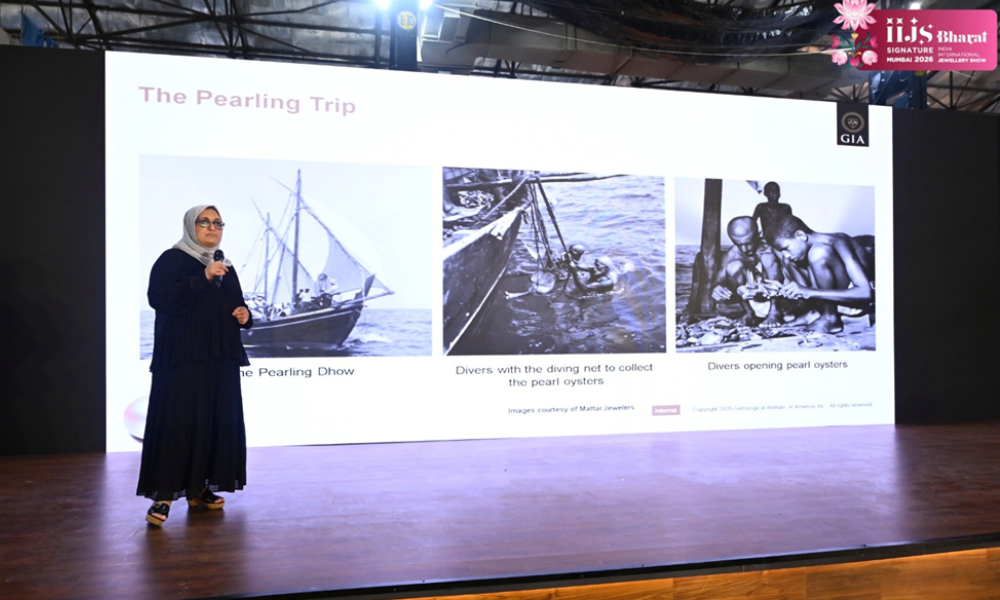
A session on The Legacy of the Arabian Gulf: Natural Pearl Trade and Evaluation offered a layered look at the history, valuation and renewed relevance of natural pearls, reaffirming why these organic gems continue to hold a distinct place in fine jewellery. Held on 10th January, the talk drew strong interest from jewellers, collectors and gem professionals.
The session was led by Abeer Al-Alawi, former Executive Director of the Danat Pearl Testing Laboratory, who positioned the Arabian Gulf as the world’s most important source of saltwater natural pearls. She traced Bahrain’s role as the historic epicentre of the trade, supported by pearl beds across Kuwait, Qatar and the UAE, and explained that nearly 90% of the region’s natural pearls come from the Pinctada radiata species.
Al-Alawi also unpacked the long-standing India-Middle East connection, clarifying that so-called Basra pearls were traded through Iraq but sourced across the Gulf, before being drilled and strung in India as the famed Bombay bunches.
The session explored traditional diving practices, the risks involved, and the Chow system of evaluation, alongside modern testing and certification. With Bahrain and Kuwait reviving pearl beds and promoting regulated diving, Al-Alawi noted that high-quality natural pearls have shown steady value growth since the 1960s, reinforcing their appeal as both heritage pieces and long-term assets.