
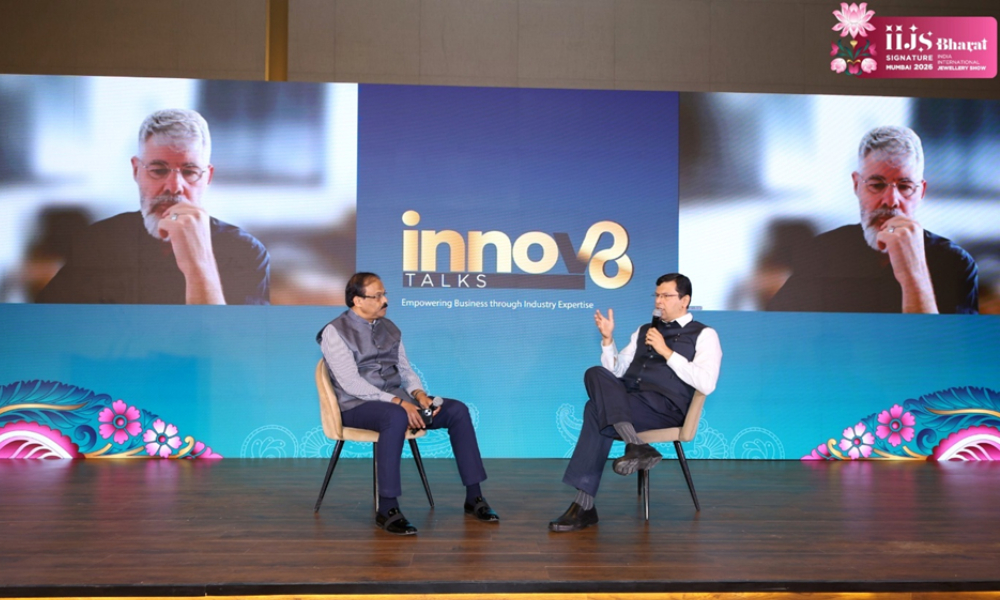
The Innov8 seminar on The Future of the Natural Diamond Market: Recovery, Challenges and New Opportunities, held on Day 1 of IIJS Bharat Signature 2026, set a clear tone for the conversations the trade is grappling with right now. Bringing together market data, consumer insights and long-term projections, the session featuring Prasad Kapre, Industry Analyst and Consultant at Blue Sky Business Management Group; Pranay Narvekar, Partner at Pharos Beam Consulting LLP; and Edahn Golan, Managing Partner at Tenoris, mapped where natural diamonds stand and what the industry must confront next.
Industry analyst Edahn Golan opened the discussion with a data-led view of shifting consumer behaviour. His presentation showed that demand below the $2,500 price point continues to weaken, while purchases in the $2,500–$5,000 range remain the market’s core. At the top end, however, growth remains resilient, with a notable rise in high-value diamond jewellery purchases in the US, underlining that consumers with spending power are still choosing natural diamonds.
A key concern highlighted was the bridal segment. Golan pointed out that while wedding numbers in the US have flattened at around two million annually, markets such as Japan and China have seen sharper declines, affecting diamond demand at its traditional entry point. India stood out as an exception, supported by demographic growth and strong cultural attachment to jewellery, even as Western markets show fatigue.
Lab-grown diamonds featured prominently in the discussion, particularly their growing share in US engagement rings, where they have crossed the 50% mark by unit sales. The concern, speakers noted, is not the presence of lab-grown diamonds, but the lack of clear differentiation. Without it, there is a risk of natural diamonds losing their luxury positioning in the minds of younger consumers aged 25 to 35, a cohort that is increasingly price-aware and less emotionally invested in the traditional diamond narrative.
Pranay Narvekar, Partner, Pharos Beam Consulting LLP, expanded the lens to the broader industry cycle. He explained how post-Covid consumption spikes have reversed, with the market now absorbing the delayed impact of tariffs, inventory corrections and what he described as a “bullwhip effect” moving through the supply chain. While price stability is expected to return by mid-2026, he cautioned that stability should not be mistaken for growth.
Tariffs, the panel agreed, matter most where they distort demand rather than supply. While India’s midstream is likely to feel a temporary impact, the larger adjustment will come from aligning production, polishing capacity and market expectations to a more measured demand environment.
Prasad Kapre, Industry Analyst and Consultant, Blue Sky Business Management Group, reinforced the need for stronger industry stewardship. With no single player now able to act as a custodian of category demand, he argued that collective responsibility, clearer messaging and sustained category marketing are essential to keep the “diamond dream” relevant.
The session closed with a consistent takeaway. Natural diamonds are at a crossroads. Long-term demand remains intact, particularly at higher price points, but survival will depend on sharper differentiation, renewed marketing focus and a conscious effort to protect the luxury perception that has underpinned the category for decades.