
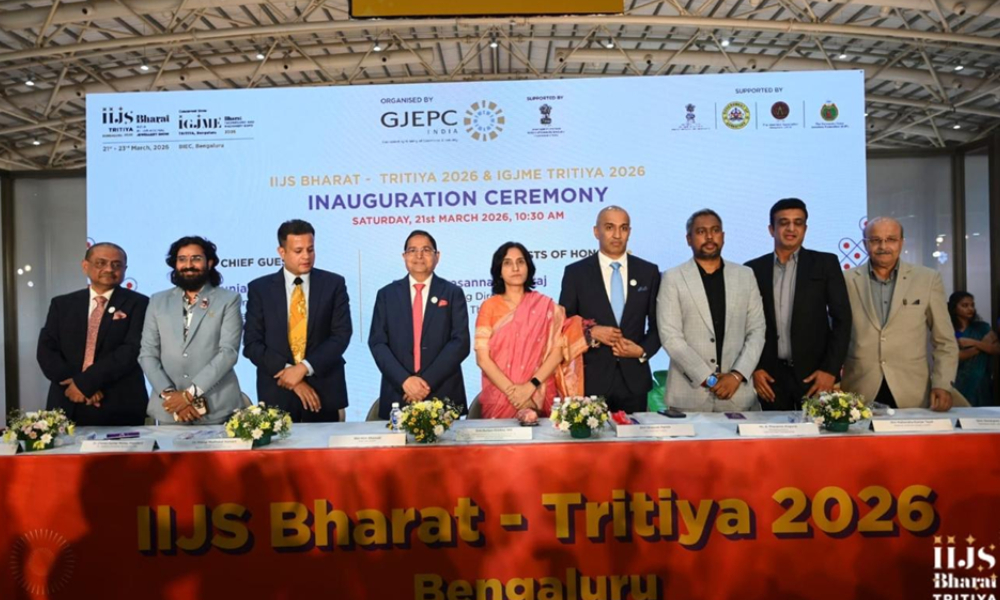
The 4th edition of IIJS Bharat – Tritiya 2026, one of India’s largest B2B jewellery exhibitions, at the Bangalore International Exhibition Centre (BIEC), Bengaluru, from 21st to 23rd March 2026, concluded successfully.
Supported by the Government of Karnataka; the Ministry of Commerce & Industry, Government of India; the Ministry of Micro, Small & Medium Enterprises, The Jewellery Association – Bengaluru (JAB); the Karnataka State Jewellers Federation (KJF); along with several national trade associations, the show offered a vibrant sourcing platform for domestic and international visitors.
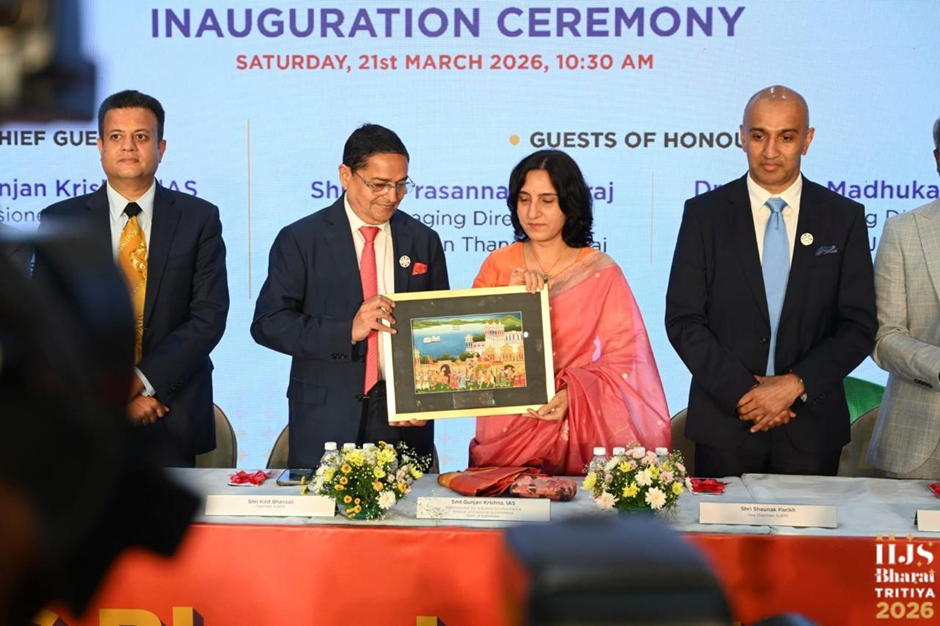
The inauguration ceremony was held in the presence of Chief Guest, Smt Gunjan Krishna, IAS, Commissioner for Industrial Development & Director of Industries & Commerce. Guests of Honour included A. Prasanna Anguraj, Managing Director, Sree Kumaran Thangamaligai, and Dr Pratap Madhukar Kamath, Managing Director, Abaran Timeless Jewellery Pvt. Ltd.
They were joined by other dignitaries on stage including, Shri Kirit Bhansali, Chairman, GJEPC; Shri Shaunak Parikh, Vice Chairman, GJEPC; Shri Mahendra Kumar Tayal, Regional Chairman (South), GJEPC, Shri Sabyasachi Ray, Executive Director, GJEPC; Dr. Chetan Kumar Mehta, President, The Jewellers Association Bengaluru (JAB); and Shri Shrikanth Kari, Chairman, Karnataka State Jewellers Federation (KJF).
In her keynote address, Smt Gunjan Krishna, noted: “My association with the Council goes back to 2020, when they were exploring options to host their premier show outside Mumbai. At that time, we saw it as an opportunity and despite the challenges of the pandemic, the entire government machinery came together to support the initiative, and it proved to be a successful effort. This show reflects the growing importance of Bengaluru as a destination for the gem and jewellery industry.
“While our economy remains strong, we must acknowledge the challenges posed by global geopolitics, fluctuating tariffs, and rising metal prices. Thus, it becomes even more important for us to strengthen and promote India’s gem and jewellery sector.
“Exhibitions like IIJS Bharat Tritiya play a vital role in this journey. They enable exchange of ideas, showcase global trends, and help the industry stay aligned with evolving consumer preferences. We look forward to making these platforms bigger and better—perhaps even hosting multiple shows each year.”
Kirit Bhansali, Chairman, GJEPC said, “The industry is navigating a phase of multiple challenges — from rising gold prices and global uncertainties to evolving market dynamics. Despite this, between April 2025 and February 2026, India’s gem and jewellery exports reached ₹2.28 lakh crore, registering over 4% growth. This reflects our ability to adapt through innovation, diversification, and strong market focus. IIJS Bharat Tritiya stands as a reflection of this strength — where the industry moves forward with confidence.”
“Rising gold prices have certainly posed a challenge for the industry, but manufacturers and retailers are innovating across design, caratage, and price points to stay aligned with evolving consumer needs. IIJS Bharat Tritiya reflects this transformation — where innovation is not just visible, but driving the industry forward,” added Bhansali.
Shaunak Parikh, Vice Chairman, GJEPC said, “The scale and diversity of participation at IIJS Bharat Tritiya 2026 clearly reflect the strength of our industry. With over 1,100 exhibitors and a growing number of new entrants, the show highlights how the industry continues to evolve. In response to rising gold prices and changing consumer preferences, businesses are innovating rapidly — and this transformation is visible across the exhibition floor.”
During the opening, an MoU was signed between GJEPC and The Jewellers’ Association Bengaluru (JAB), with GJEPC Chairman Kirit Bhansali and Dr. Chetan Kumar Mehta, President, JAB, sealing the collaboration to support the growth of Karnataka’s jewellery industry and enhance participation at IIJS Bharat Tritiya 2026.
With gold prices impacting affordability across segments, manufacturers and retailers are rethinking design, pricing, and product strategies. Across the exhibition, a clear trend is visible — a shift towards lighter designs, lower carat jewellery, and more accessible price points, closely aligned with evolving consumer preferences.
IIJS Bharat – Tritiya 2026 featured 1,100+ exhibitors from 40+ cities, showcasing across 1,900+ stalls at BIEC, bringing together leading manufacturers, wholesalers, retailers, and designers under one roof.
A key highlight of this edition was “The Select Club”, a premium section dedicated to high-end couture jewellery.
Adding further scale, 270+ new companies participated this year, strengthening the diversity of the exhibition.
Running concurrently was the India Gem & Jewellery Machinery Expo (IGJME) Bharat – Tritiya 2026, featuring 79+ companies, presenting the latest in jewellery manufacturing technology, machinery, tools, and packaging solutions.
Overall, the exhibition provided strong business opportunities, networking, and knowledge exchange.
One of the show highlights was the Crafts Pavilion showcasing India’s GI-tagged jewellery traditions, including Benaras Meenakari, Cuttack’s Tarakasi filigree, Thewa jewellery from Rajasthan, and Hupari silver craft, celebrating the country’s rich heritage of craftsmanship.
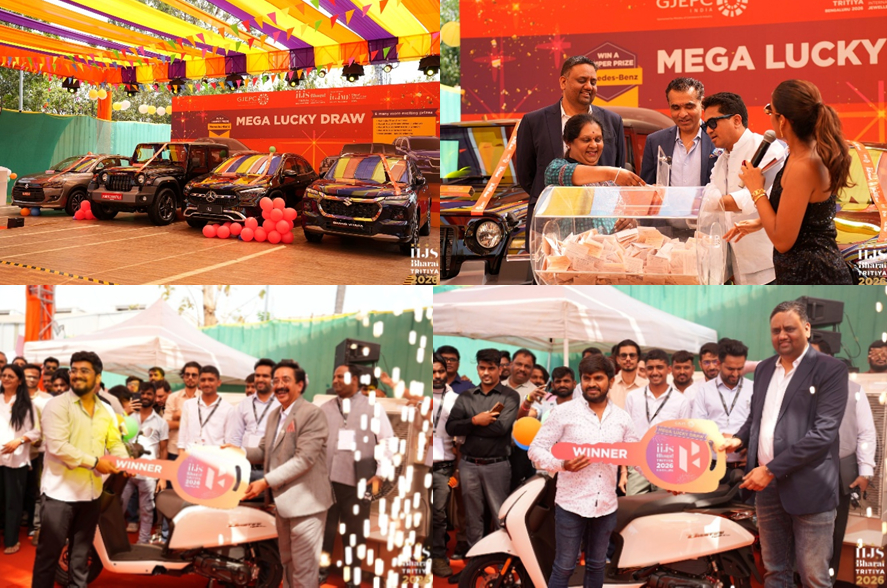
A Mega Lucky Draw for paid visitors on the concluding day added a celebratory note to the show, with lucky winners taking home prizes that included 10 Hero Destini 125 scooters, a Maruti Suzuki Alto, a Maruti Suzuki Swift Dzire, a Maruti Suzuki Vitara, a Mahindra Thar, and the grand prize — a Mercedes GLA.
On The Show Floor
The fluctuating, see-saw movement in gold prices created uncertainty among buyers, affecting overall sentiment. South India, traditionally the stronghold of gold jewellery connoisseurs, witnessed slower-than-expected sales as the unstable rates made buyers cautious.
Another major challenge was the geopolitical situation, which impacted export orders. Several exhibitors had stock ready for overseas shipment, but dispatches were delayed, forcing them to hold back inventory amid the uncertain global climate.
Kosha Fine Jewels’ Owner, Viral Kothari, who presented a range of modern-day diamond-studded haslis (chokers), said that business with domestic corporate retailers has remained steady. “Importantly, since diamond prices have corrected, they have become more affordable. While the domestic sentiments are strong, our exports are on complete hold because of the situation which is beyond our control.”
Nikunj Jain, Executive Director of Sundaram Chains, noted that if gold prices stabilise even for two months, they will see a spike in sales. Despite the slow pace, Jain said that their lightweight chains below 5 grams were a fast moving segment, and so were there heavy-looking broad chains below 60 grams were popular. This time, they got buyers from the southern region. “Our exports are down to 15% as we are unable to send the goods to the Middle East, which is our prime market other than Singapore.”
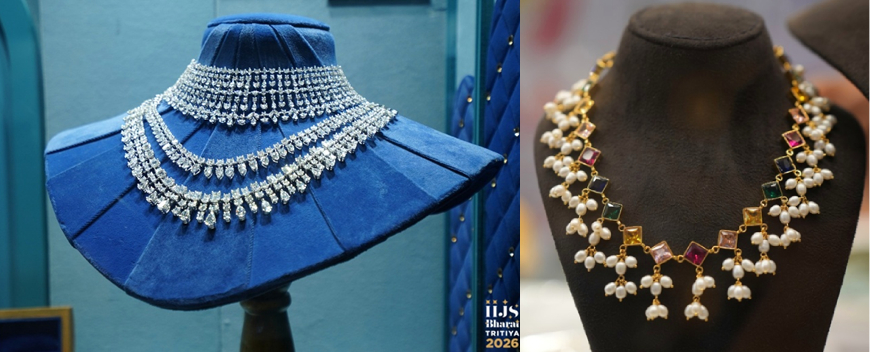
Some exhibitors had an exceptional show. For instance, Mathew Tony, Manjally Jewellery, Thrissur, informed that his lightweight jewellery that has a typical Kerala flavour, has been a hit at the show. “It was a pleasant surprise for us given the fact that gold rates were on a roller coaster ride. What worked in our favour was the containment of the grammage of the metal. Our 22-karat ear studs are less than a gram and the fuller-looking necklace is just about 10 grams, adorned with Palakka (leaf in Malayalam), a flat, green, leaf-shaped stone, a typicality of Kerala jewellery. We have received many queries at the show.”
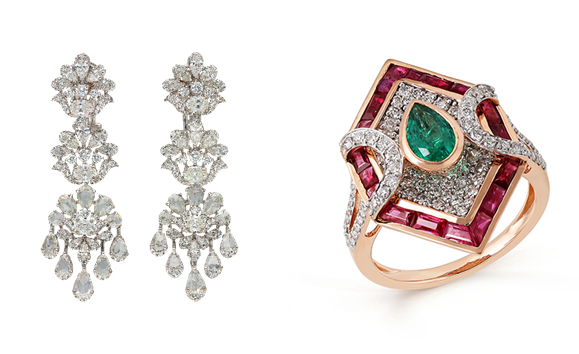
Jewels By Sephora specialises in modern, contemporary jewellery, and our primary market continues to be India. Divyanshu Bardia, Owner, said, “For this show, our highlight collection has been our multi-tourmaline pieces, which are currently one of the strongest trends in the coloured gemstone segment. These vibrant multi-hued tourmalines have received excellent response due to their versatility, freshness, and modern appeal. Regarding the show, it has been mediocre in terms of footfall and buying behaviour. Given the current geopolitical instability, a strong domestic focus definitely feels like the safer and more stable strategy. India’s modern jewellery market is expanding, and customer confidence remains steady. For us, Western India, the NCR region, and the South continues to perform particularly well. Also the market is clearly shifting towards value-driven buying. Customers want uniqueness, craftsmanship, and trust, and brands that offer authenticity and consistency will continue to grow, regardless of global fluctuations.”
Kayvan Taswala, Partner, Peacemoon Traders, “The second day for us was good, and overall the clients who came were genuine, serious buyers, who came with clear intent to do business. Yes, the number of visitors was lower, but that is understandable given the current market conditions. Most of our clients were from South India, mainly looking for high-end jewellery in the range of ₹5 lakh to ₹15 lakh, some also showing interest in bridal sets in higher price range.”
Prashant Kiran, Director, Laxmi Jewellery Chennai Pvt. Ltd., “The first day of the show was good, though footfall was moderate, but the buyers who were serious. We had a good mix of visitors from Chennai, Mumbai, and different parts of Tamil Nadu, Karnataka, and Kerala. The advantage this time was that we had enough time to sit with buyers, discuss business aspects minutely, which is equally important. We deal mainly in 22-karat gold jewellery, and at present the volatility in gold prices has made consumers a little cautious. Today’s buyers, especially the younger generation, are well informed and keep track of prices, so they tend to wait and watch before making a purchase.”
Rahul Mehta, Managing Director, Diarah and Silver Emporium, put it succinctly, “Shows like IIJS are not just about selling — they are about meeting people, building networks, and staying connected with clients. In today’s market, that interaction becomes even more important. When prices of metals fluctuate sharply, confidence in the market does get affected, and buyers become cautious.
“Still, platforms like this give us the opportunity to meet customers face-to-face, understand their needs, and keep the business moving forward. I believe participation should always feel voluntary and positive, because when exhibitors come with the right mindset, the overall experience of the show becomes much better for everyone.”