
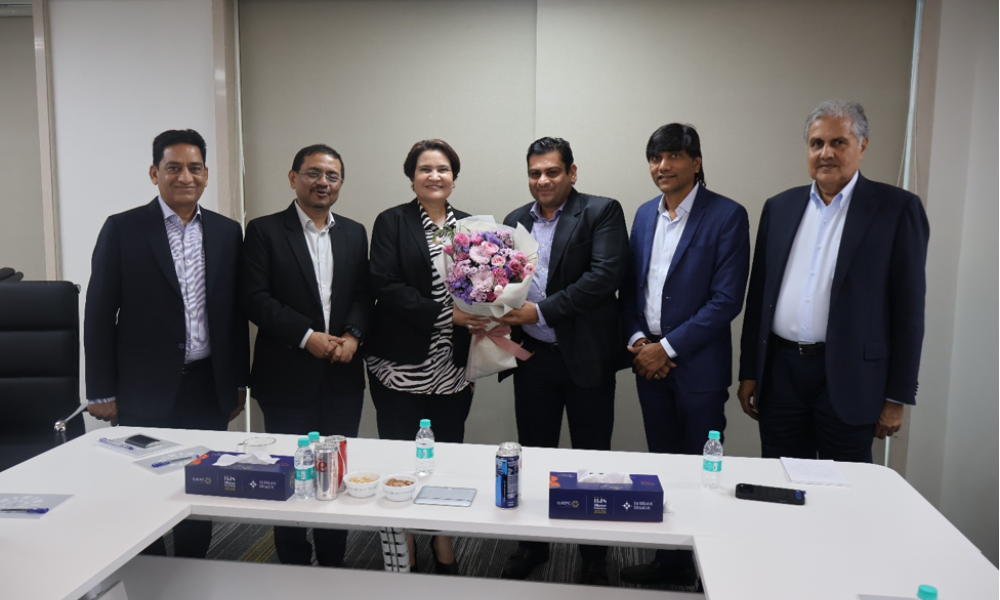
A senior Namibian delegation led by Ms. Gaudentia Krohne, Deputy Minister, Ministry of Industries, Mines and Energy, visited Mumbai on 11 August as part of a B2B engagement aimed at exploring greater cooperation between Namibia and India’s diamond industry.
The delegation included Rehabeam Nepaya, Deputy Director, Diamond Affairs; Secret Ruhaka and Titus Amukwelele, Diamond Inspectors; and Balchand Jain, Honorary Consul of Namibia in Mumbai.
The group visited the GJEPC office, the Bharat Diamond Bourse (BDB), and the Indian Diamond Trading Centre (IDTC), before touring customs facilities and other infrastructure.
The delegation was welcomed by Anoop Mehta, Convener – Diamond Panel, GJEPC; Ashish Borda & Bharat Ghori, both Members – Diamond Panel, GJEPC; and Mr. Sabyasachi Ray, Executive Director, GJEPC.
The visit has come at a significant moment for India’s diamond trade. The recently introduced Taxation and Other Laws (Amendment) Bill, 2026 proposed a 15-year income-tax exemption on income from the sale of rough diamonds through notified Special Notified Zones (SNZs) at BDB and Surat Diamond Bourse. The measure was subsequently reported as part of the government’s effort to strengthen India’s position as a global rough diamond trading hub.
The proposed exemption covers foreign mining companies, sightholders, brokers, aggregators, and tender and auction entities connected with rough diamond sales. The exemption was proposed to apply from 1 October 2026 through the tax year ending 31 March 2041.
Namibia is a significant diamond producer, with Kimberley Process data showing production of 2.09 million carats valued at US$721.4 million in 2025. Its average production value of US$343.88 per carat was the highest of all producing countries last year. Namibia was the fifth largest diamond producer by value in 2025. It accounted for about 8% of global rough diamond production in terms of both volume and value.
The country also exported 2.04 million carats worth US$578.4 million in 2025, according to the Kimberley Process data.
Krohne highlighted the quality of Namibia’s production. “Namibia is having the best quality of diamonds in the world. We do not have the quantity, but we have the best quality. That’s why I am really proud to come from Namibia and talk about the Namibian diamonds in India,” the Deputy Minister said.
The delegation also saw a potential role for India’s diamond trading infrastructure in bringing Namibian roughs closer to Indian buyers. “We can bring our diamonds here, showcase them here and even sell them. If this platform created by India is already being used by other countries, why can Namibia not make use of it too?” Ms. Krohne added.
The figures underline why Namibia is strategically relevant to India’s diamond ecosystem. India was the world’s largest rough diamond importing market in 2025, importing 106.09 million carats worth US$11.07 billion, accounting for 40.24% of global imports by volume and 43.25% by value.
The delegation’s visit therefore comes as India seeks to attract a wider pool of international mining companies and trading entities into its notified zones. For producer nations such as Namibia, the combination of India’s large manufacturing base, established diamond-market infrastructure and the proposed long-term tax certainty created a potentially stronger route for closer India-Namibia diamond trade.
The visit was also structured to give the Namibian officials a view of India’s end-to-end diamond ecosystem. The BDB programme included an overview of the Indian diamond industry, a meeting with the BDB Managing Committee and a visit to IDTC, while the planned engagement at SEEPZ was intended to provide an understanding of India’s diamond manufacturing ecosystem, infrastructure and operations. The IDTC platform was developed to give smaller Indian manufacturers access to international rough diamonds without the cost of travelling to overseas markets.
For Namibia, the opportunity was clear: India offered scale and processing capacity; the new tax framework offered a longer-term proposition for bringing more international rough diamond trading activity into the country’s Special Notified Zones.