

As the diamond industry looks beyond its established strongholds, a new generation of consumer markets is emerging. Independent diamond industry analyst Paul Zimnisky examines why Indonesia, Vietnam and Brazil possess the economic momentum, demographics and evolving luxury appetite to become the next engines of global diamond jewellery demand over the coming decade.
New markets have historically represented significant secular growth drivers for diamond demand.
Following the famous initial diamond campaign in the US post-World War II, De Beers successfully marketed diamonds in Japan beginning in the late-1960’s and in China beginning in the mid-1990’s. Both were major growing consumer markets that lacked a culture of gifting diamond jewellery.
In both cases, within two decades, diamond rings became a fixture in about half of marriage engagements – a tradition that was effectively nonexistent beforehand.
Most recently, India has rightfully taken centre stage as the priority growth market for the diamond industry. De Beers is currently promoting its high-end diamond brand Forevermark exclusively in India, while domestic corporate jewellers like Titan Company’s Tanishq have levered their own proprietary diamond campaigns amidst the momentum. For instance, Tanishq recently launched its “Soulmate Diamond Pair” collection which is based on the concept of one cleaved diamond crafted into two diamond rings: one for her, one for him.
While consumerism is globally more universal these days with the advent of the internet and social media, targeted category marketing continues to yield results, especially when executed in a culturally sympathetic way.
At present, diamond jewellery consumption is overwhelmingly driven by the US, with upwards of a 60% share, followed by India at just over 10% and China at just under 10%.
Demand used to be less skewed. For instance, 25 years ago, the three largest markets were the US with a 50% share, followed by Europe with 17%, and Japan with 16% – notably, the latter two hold at best a mid-single digit percent share today.
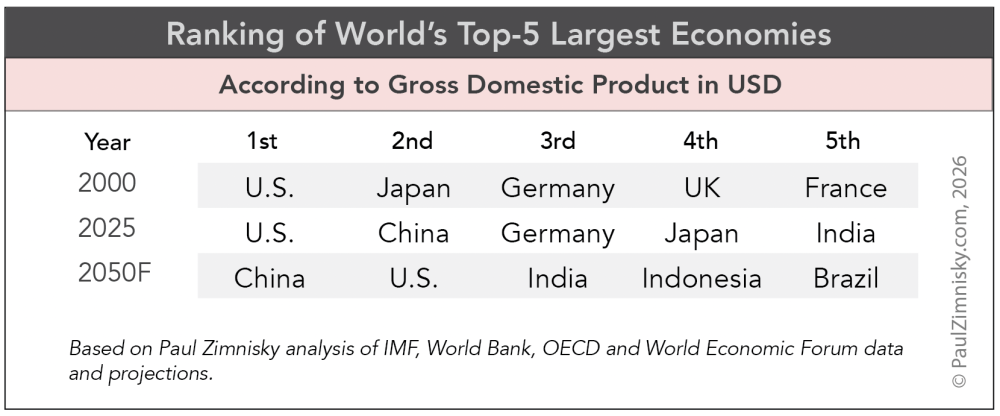
A substantial part of this evolution has been driven by relative economic growth trends, i.e. Europe and Japan have slowed, while China and India have surged (see table). US growth has remained relatively consistent –with intermittent bursts driven predominantly by the tech sector (we are amid another one of these right now).
Looking ahead to markets that are poised to be the next major growth drivers of diamond jewellery, Indonesia and Vietnam in the Eastern hemisphere and Brazil in the West are top candidates.
Indonesia is one of the fastest growing economies in the world, driven by a rising affluent middle-class population and corresponding urbanization. Demographically it is significantly younger than most developed nations, and the culture is punctuated with a strong penchant for luxury goods, jewellery in particular.
Vietnam is another Eastern nation worth mentioning. While economically only a third the size of Indonesia, it possesses a similar demographic setup making the market an ideal candidate for diamond jewellery consumption. Vietnam is currently growing at upwards of 8% annually, making it the fastest growing mid-size-plus economy in the world.
Similar to major Asian markets like China and India, gold jewellery is dominant in Indonesia and Vietnam, however younger generations have shown inclination to step outside of traditional norms and purchase luxury products that reflect more cosmopolitan taste, such as diamond jewellery for weddings and everyday wear alike.
Brazil has long been considered one of the world’s top growth candidates. In 2001, Goldman Sachs famously coined the BRIC acronym to highlight its forecast of the top-4 fastest growing economies over the next half century. Brazil represented the “B,” along with Russia, India and China, respectively. However, over the last 25 years, Brazil has struggled to live up expectations due in part to political instability and an inability to successfully transition from natural resource dependence into manufacturing and more generally, productivity-led growth.
That said, Brazil has succeeded at modernising its energy infrastructure – it currently generates 90% of its power from renewables, and the nation is one of the world’s preeminent agricultural exporters. Further, it hosts a massive middle-class of over 125 million people which positions it well from a consumption standpoint for an industry like jewellery – which will inevitably be further leveraged as the economy’s absolute wealth grows.
Importantly, while the diamond jewellery industry already has a presence in these markets, Indonesia, Vietnam and Brazil combined are estimated to account for less than 5% of global demand, according to Paul Zimnisky analysis. Given the small base the potential for growth remains significant.
Of note, Cartier first opened in São Paulo, Brazil back in 1977. The company later debuted in Jakarta, Indonesia in 1994, and in Ho Chi Minh City, Vietnam, in 2010. Tiffany & Co, Bulgari, and Van Cleef & Arpels have all established a presence in these markets within the last two decades.
Paul Zimnisky, CFA is an independent diamond industry analyst and consultant based in the New York metro area. For regular in-depth analysis and forecasts of the diamond industry please consider subscribing to his State of the Diamond Market, a leading monthly industry report; an index of previous editions can be found here. Also, listen to the Paul Zimnisky Diamond Analytics Podcast on Spotify or Apple Podcasts for exclusive full-length conversations with special guests from the gem and jewelry industry. Paul is a graduate of the University of Maryland’s Robert H. Smith School of Business with a B.S. in finance and he is a CFA charterholder. He can be followed on X @paulzimnisky and on YouTube @paulzimnisky. Disclosure: At the time of writing Paul Zimnisky held a long equity position in Brilliant Earth Group.
Paul will be speaking at the Atlanta Jewelry Show at the Cobb Convention Center in Atlanta, Georgia on August 21, 2026.
