
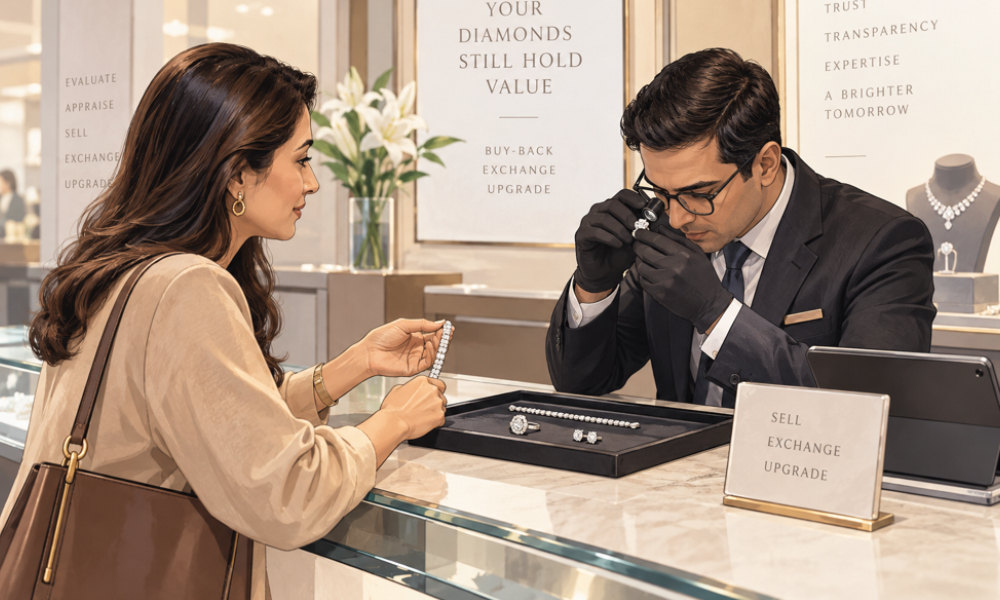
During a recent Titan Company conference call, a participating sell-side analyst implicitly challenged the economics of the company’s recently debuted cash-gold program. Arun Narayan, CEO of Titan’s jewellery division, shot back: “It’s about solving a customer problem, it’s not as much about profiting from it…it’s the responsible thing to do.”
Titan’s primary retail brand Tanishq is also known for being one of the only jewellers in India that offers a diamond exchange program. Customers can exchange previously purchased diamond jewellery for a credit at the price originally paid to be used to buy another piece.
In Aisa, there is a culture of buying and holding fine jewellery as a store of value, especially in the case of higher-karatage gold pieces. However, in major Western markets like the US this is much less common.
With diamond jewellery in particular, the lack of fungibility makes the business of “cash-for-diamonds” inherently difficult, i.e., businesses have to deal with analysing and pricing potentially thousands of categories of diamonds whereas with gold there is a single market.
That said, in a business that is founded on the premise of merchandising valuable possessions, it would behoove the diamond and larger jewellery industry to provide consumers with sufficient liquidity for these assets.
In the context of jewellery, “value” implies that it can be exchanged for money or another item of value. By providing consumers with a convenient market to sell their fine jewellery, it not only reinforces this concept but validates it. Titan seems to get this, but such policies are quite few amongst larger corporate jewellers globally.
Tiffany & Co allows customers to exchange diamonds 0.18-carat and larger towards another purchase if the new purchase is twice the value of the original. Mainstay North American jewellers Kay and Zales offer customers a similar policy. However, Cartier, Van Cleef & Arpels and Bvlgari do not offer any trade-in or buy-back options, nor does China’s Chow Tai Fook.
On the other hand, independent jewellers, especially in larger districts such as New York’s 47th Street, are known to actively buy back diamonds from consumers for cash. For example, jewellers will pay consumers around 75% of a diamond’s wholesale price, according to Paul Zimnisky anecdotes; this equates to approximately 50% of the retail price.
Amidst the mainstream advent of laboratory-grown diamonds (and the related lingering debate over diamond value), making it easy for consumers around the world to sell natural diamonds at fair market prices would truly differentiate the value of natural diamonds from the man-made alternative.
For instance, in China, the recent slump in diamond demand, which Paul Zimnisky estimates to be as much as a 50% falloff from pre-pandemic levels, can, in part, be attributed to a loss in consumer confidence in the value of diamonds.
Chinese consumers seem to be particularly aware of falling diamond prices in recent years, especially as gold prices have surged to record levels, leaving consumers questioning the true store-of-value of natural diamonds. This notion has evolved into a viral narrative shared by younger consumers on social media that has undoubtedly damaged the perception of the entire category.
The drop in diamond demand was so significant in 2024 and 2025 that Chinese retailers sold inventory back to wholesalers in quantities that materially impacted global diamond supply fundamentals.
Instead of seeing the current lull in natural diamond prices as a buying opportunity, many Chinese consumers are afraid to pay “precious material” prices for diamonds even after the steep drawdown – a problem that could arguably be ameliorated with a liquid back-to-back market.
It is worth noting that De Beers had a subsidiary called the International Institute for Diamond Valuation (IIDV) which was operational from 2014 through 2019. The concept was to boost diamond consumer confidence by providing a fair and easy outlet for customers to resell their diamonds.
At the time, De Beers pledged to pay consumers the “highest price possible” for their diamonds on the secondary market. (Note: In a first-hand account in 2019, Paul Zimnisky transacted a diamond through IIDV which was sold for 65% of the purchase price)
Such an initiative for diamonds is lacking in today’s market just as it is needed the most.
Titan’s general approach seems to be right on target: instill value in the product you are selling and provide a needed service for consumers, even if it is not a money maker. It would benefit the larger fine jewellery industry to follow suit.
Paul Zimnisky, CFA is an independent diamond industry analyst and consultant based in the New York metro area. For regular in-depth analysis and forecasts of the diamond industry please consider subscribing to his State of the Diamond Market, a leading monthly industry report; an index of previous editions can be found here. Also, listen to the Paul Zimnisky Diamond Analytics Podcast on Spotify or Apple Podcasts for exclusive full-length conversations with special guests from the gem and jewelry industry. Paul is a graduate of the University of Maryland’s Robert H. Smith School of Business with a B.S. in finance and he is a CFA charterholder. He can be followed on X @paulzimnisky and on YouTube @paulzimnisky. Disclosure: At the time of writing Paul Zimnisky held a long equity position in Brilliant Earth Group.
