
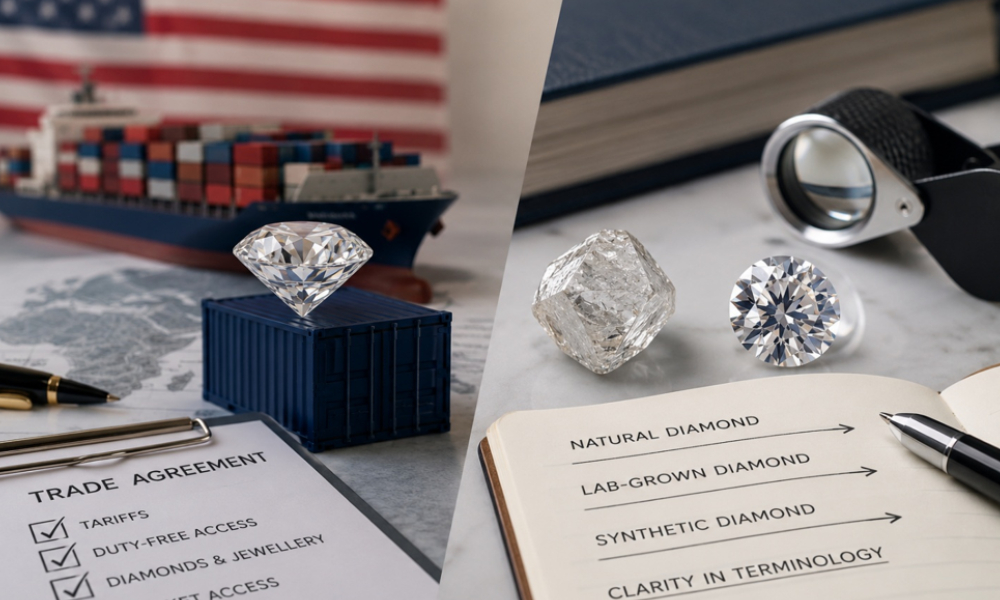
As the diamond industry seeks to restore zero tariffs on US imports, a separate debate over synthetic nomenclature will test its ability to influence policy in Washington.
The diamond and jewellery industry is actively engaged on two policy fronts in Washington that will shape the market for years to come.
The first is an ongoing effort to restore zero tariffs on diamonds and jewellery entering the US. Its outcome will determine the cost of supplying the largest consumer market for diamond jewellery and will be especially significant for India’s manufacturing sector.
The second could shape the language used to distinguish natural from laboratory-grown diamonds. As the Federal Trade Commission (FTC) prepares for its next review of the Jewelry Guides, the industry is making the case for clearer nomenclature.
A recent National Jeweler podcast examined both debates, with two industry representatives providing updates on their engagement with US government officials. Their insights help clarify the separate challenges facing the trade on tariffs and nomenclature.
The Tariff Path
There has been some encouraging news on tariffs, but the issue is far from settled as the US continues to negotiate broad trade agreements, particularly with Canada, China and India.
Representatives of the US jewellery industry recently met with US Trade Representative Jamieson Greer to make the case for zero tariffs on diamonds, coloured gemstones and natural pearls.
Greer stressed during the meeting that the Office of the US Trade Representative is not standing in the way of an exemption, David Bonaparte, president and CEO of Jewelers of America, and Ronnie VanderLinden, president of the Diamond Manufacturers and Importers Association of America, told National Jeweler’s My Next Question podcast.
The problem lies in the broader trade negotiations, the two executives explained.
Countries that have secured trade agreements with the US have subsequently been able to obtain exemptions for diamonds and other products. That has already happened with several important diamond-producing and trading partners. The same pathway potentially exists for India, arguably the most consequential diamond centre given its dominance in manufacturing and polished diamond supply.
Effective 24 July, the US reinstated a 0% import tariff on natural diamonds polished in Europe, ending the 10% duty that had been in place for the previous six months. The move followed discussions with the Belgian government and the Antwerp World Diamond Centre.
Diamond-producing and beneficiation countries Botswana, Namibia, Lesotho, and Zimbabwe also gained exemptions. The duty on imports from India remained at 10%, while Canada, China, Israel, South Africa, Russia, Switzerland, Thailand, and the United Arab Emirates are subject to a 12.5% tariff.
More recently, the US and Canada became embroiled in a trade war, with Washington imposing a 50% tariff on all Canadian goods as of press time.
The message from Washington appears straightforward. If countries conclude trade agreements with the US, there is a pathway for diamonds, gemstones, and pearls to return to zero tariffs. But it is up to local trade bodies to lobby their governments to keep diamonds, jewellery and related products on the zero-tariff agenda.
The reality is that diamonds represent a small part of negotiations involving oil, weapons and geopolitical relations. The diamond industry cannot determine the broader outcome, but it can make its case.
Bonaparte and VanderLinden said they were encouraged to engage their counterparts in India and urge them to make the case to their government. For an industry already struggling with weak margins, restoring duty-free access to its largest consumer market should provide ample motivation.
Drawing the Line
The second regulatory issue reflects a broader trend taking shape across global markets.
Russia has passed a law requiring lab-grown diamonds to be described as synthetic from September, while their weight must be expressed in grams rather than carats. France has similarly taken a hard line on synthetic terminology, and the World Jewellery Confederation (CIBJO) is now moving in the same direction.
CIBJO’s Diamond Commission said it plans to remove the terms “laboratory-grown” and “laboratory-created” as synonyms for “synthetic.” It also recommended restricting use of the 4Cs to natural diamonds, arguing that grading “is a tool intended to define the rarity and uniqueness of natural stones, where each one is different from the other.”
While CIBJO does not have the authority to enforce such policies, its standards serve as an important reference for governments and regulatory bodies. The question is whether the US will follow CIBJO’s lead when the FTC reviews its Jewelry Guides in 2028.
Bonaparte and VanderLinden cautioned the trade to lower its expectations as the US is likely to take a more conservative and consumer-centric approach.
The FTC’s priority is the American consumer, Bonaparte stressed. What Russia, France or CIBJO decides may contribute to the wider debate, but it will not necessarily determine US policy.
Under the current US rules, “synthetic” can already be used to describe a laboratory-grown diamond, provided its use is not deceptive or disparaging. Industry representatives are therefore not necessarily seeking a radical change to the guides. Rather, they want greater clarity around how the different products should be described, arguing that the existing rules, enacted in 2018, have created confusion.
The current framework recognizes laboratory-grown diamonds as diamonds because they share essentially the same chemical composition as natural diamonds. Yet marketers cannot use terms such as “real,” “genuine” or “natural” to describe them. That distinction may make regulatory sense, but it creates an obvious communications challenge.
The natural diamond sector also has reason to revisit the FTC’s treatment of the word “natural.” During its previous review, the commission removed “natural” from its definition of a diamond.
That decision has become more significant as lab-grown diamonds have gained market share. The question is no longer whether lab-grown diamonds constitute a legitimate jewellery product. The challenge is ensuring consumers understand that natural and laboratory-grown diamonds are different products with fundamentally different origins and value propositions.
That is why nomenclature matters.
Russia has chosen regulation to draw that distinction. France has adopted a similarly restrictive approach, while CIBJO is seeking to establish a clearer international standard.
The US is likely to take a more consumer-focused approach, and any change will require evidence that existing terminology creates confusion or enables deceptive marketing.
The industry’s task, therefore, is not simply to demand that regulators adopt its preferred language. It must demonstrate why clearer terminology serves consumers.
The industry’s role differs in each debate. On tariffs, local trade bodies must ensure that diamonds and jewellery remain on the agenda as governments negotiate broader trade agreements. On nomenclature, the task is to demonstrate to the FTC that clearer terminology serves the interests of American consumers.
The issues are separate, but in both cases, the ongoing debate within industry circles is likely to differ from the discussion that will ultimately shape policy.

Avi Krawitz is the Founder of ‘The Diamond Press’ and a leading content creator and consultant in the diamond industry. He is widely recognised for his insightful analysis and storytelling, offering clarity to both industry professionals and curious consumers navigating a complex and evolving market. See more of Avi’s work at www.thediamondpress.com
The views expressed in this article are those of the author and do not necessarily reflect the views of Solitaire or the GJEPC.