
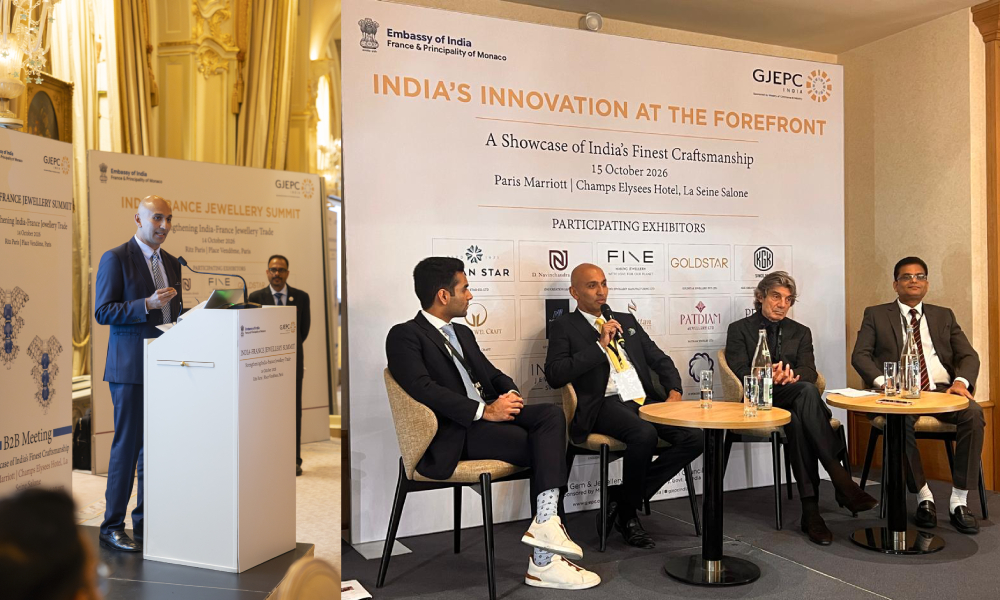
GJEPC brought 17 curated Indian fine jewellery companies to Paris, with the India–EU trade agreement lending fresh momentum to business partnerships, creative exchange and brand-building across France’s luxury ecosystem. The pitch was partnership, not just supply. India is looking to deepen its place in the global luxury conversation—not simply as a leading jewellery manufacturing hub, but as a creative and strategic partner to France’s celebrated maisons.
The India–France Jewellery Summit, organised by the Gem & Jewellery Export Promotion Council (GJEPC), India’s apex jewellery export promotion body under the Ministry of Commerce and Industry, brought a curated delegation of 17 Indian jewellery companies to Paris for three days of market immersion, business meetings and industry engagement. Led by Shaunak Parikh, Vice Chairman of GJEPC, the programme culminated in a Buyer-Seller Meet on 15 October at the Paris Marriott Champs-Élysées.
The initiative took place at a time of growing economic engagement between India and Europe, with the India–EU trade agreement offering fresh impetus to commercial ties. For the jewellery sector, the opportunity extended beyond market access to encompass design, brand-building, sustainability and long-term collaboration.
A growing India–France jewellery trade
India’s gem and jewellery exports to France rose 19.72% year-on-year to US$478.78 million in FY2025–26, up from US$399.93 million in FY2024–25. Gold jewellery exports grew 18.69% to US$159.53 million, while cut and polished diamond exports increased 4.69% to US$204.07 million.
France’s total gem and jewellery imports stood at US$12.61 billion in FY2025–26, with India accounting for 3.8% of the total. These figures highlighted opportunities for India and France to build mutually beneficial partnerships in the jewellery industry.
The India–EU trade agreement, concluded in January 2026 and proceeding through formal approvals, is expected to support closer economic engagement, with implementation targeted for 2027. For the jewellery industry, its longer-term value would depend on businesses translating improved market access into enduring commercial relationships.
Understanding the French luxury consumer
The summit opened on 13 October at the Embassy of India in Paris with a briefing titled The French Market & the Marketing of Desirability. The discussions examined French consumer expectations, luxury positioning, sustainability and traceability, highlighting a fundamental distinction: craftsmanship is essential in luxury, but desirability is built through design, identity and storytelling.
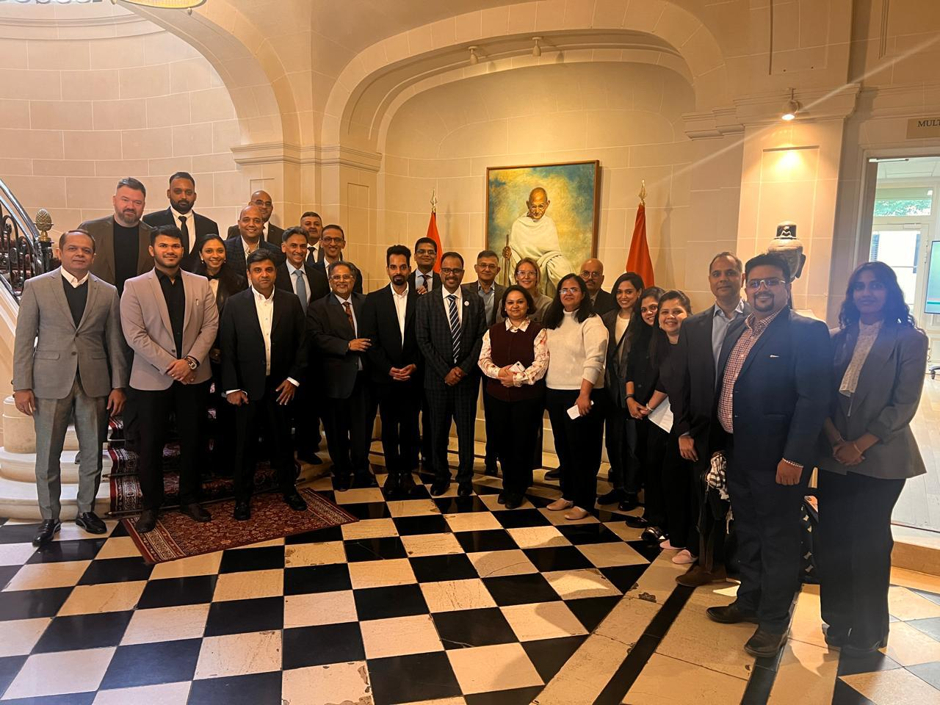
Dr Marta Marcheva, Executive Director of Institut Sup de Luxe, shared perspectives on luxury strategy and brand desirability, while Ms. Céline Dassonville, CEO of ethiwork and former CSR Director at Cartier, addressed jewellery strategy, responsible practices and traceability. Mr. Anish Kumar Singh, GJEPC’s representative in France and founder of Bhartiya Paris Club, outlined the ambition to move from buyer-seller introductions to capability-building and, ultimately, globally recognised Indian jewellery brands.
At the heart of Parisian high jewellery
The engagement continued at the Ritz Paris on Place Vendôme, the historic heart of Parisian high jewellery. Mr. Shaunak Parikh, Vice Chairman of GJEPC, and H.E. Sanjeev Singla, Ambassador of India to France and the Principality of Monaco, addressed the gathering. Mr. Stanislas de Quercize, Board Member of Messika and former chief executive of Cartier and Van Cleef & Arpels, offered an industry perspective.
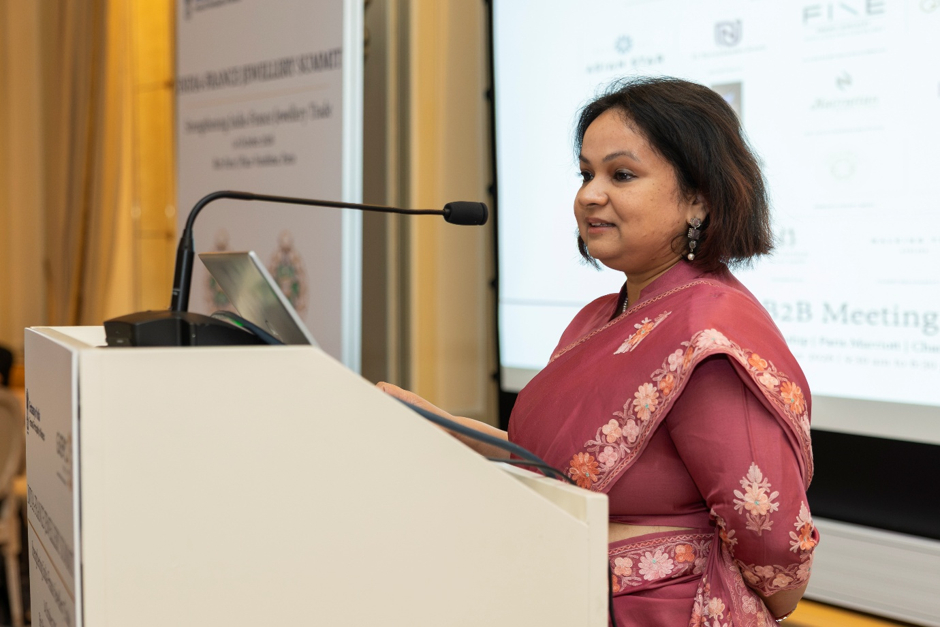
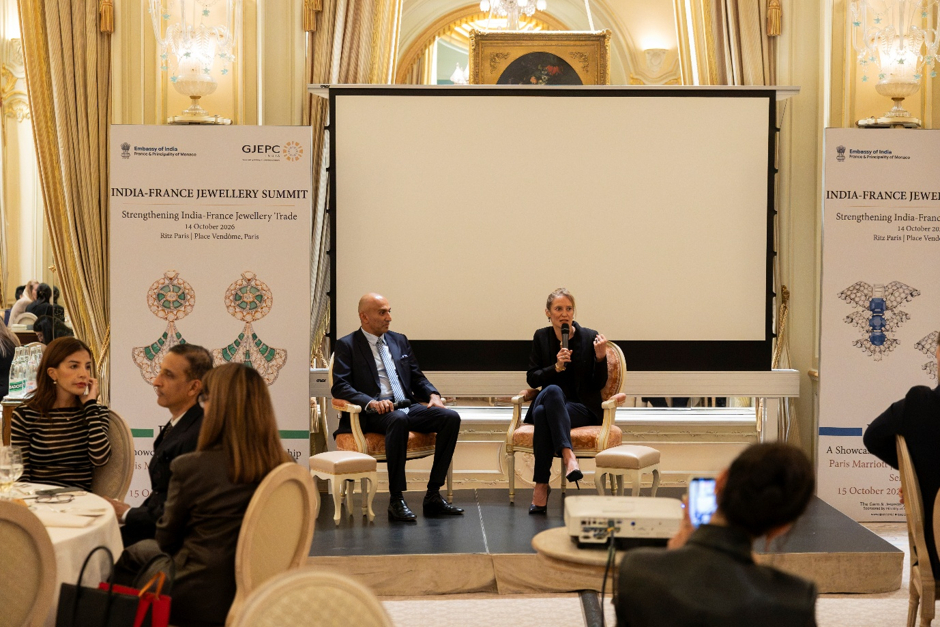
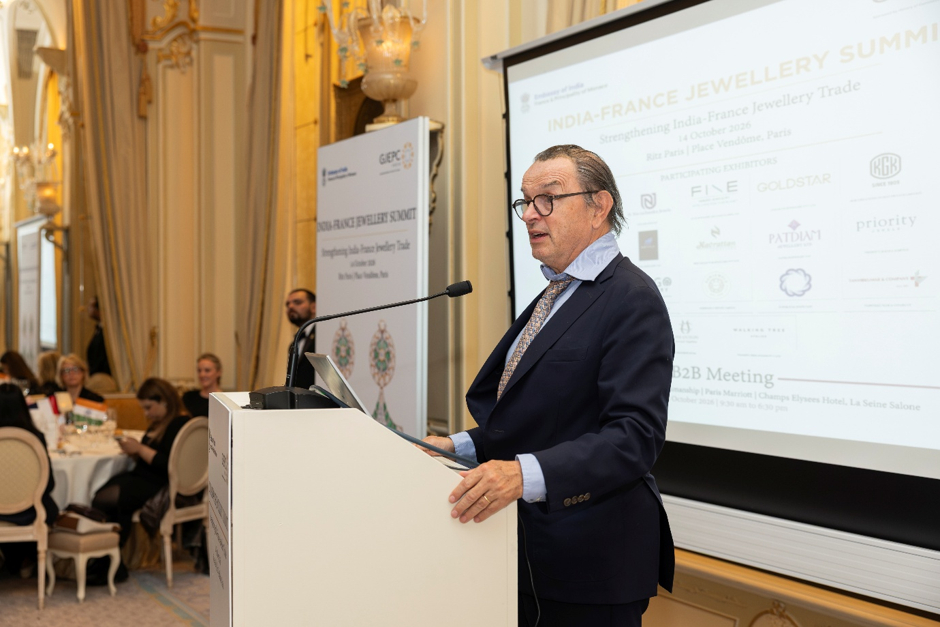
Parikh noted, “We have not come to Paris only to sell. We have come to learn from French maisons how to build brands, tell compelling stories and nurture lasting relationships with customers. India brings scale, technical expertise and skilled artisans. This is not about one side supplying the other. It is about co-creating.”
He also highlighted how India’s jewellery industry has evolved by bringing together centuries-old craftsmanship and sophisticated manufacturing technology. “It is the power of hands meeting machine that gives Indian jewellery both precision and personality,” Mr. Parikh stated.
He underscored the growing importance of responsible sourcing, ethical practices and traceability, noting that international partnerships must be built on quality, adaptability and trust. India, he emphasised, was ready to work with French maisons to exchange ideas, collaborate with design schools and develop new design possibilities that bring together French design sensibilities and Indian craftsmanship.
A shared history, a new creative horizon
The opportunity for collaboration was rooted in a long history of creative exchange between India and France.
Houses such as Cartier, Van Cleef & Arpels and Chaumet created remarkable pieces for Indian royalty, and Victorian lace and Art Deco influences found their way into Indian jewellery.
The cross-cultural exchanges continue to this day. French designer Marie-Hélène de Taillac, for instance, has built her jewellery house around close collaborations with Indian artisans in Jaipur; and Indian couturiers Rahul Mishra and Gaurav Gupta have brought distinctive interpretations of Indian craftsmanship to Paris fashion weeks.
GJEPC also invited French jewellery houses, retailers, design schools and emerging designers to visit India’s manufacturing centres, engage directly with artisans and explore new forms of collaboration.
India’s manufacturing strength meets French luxury expertise
The commercial opportunity extended beyond the immediate scope of the summit. India’s gem and jewellery market, valued at approximately US$85 billion, is projected to reach US$130 billion by 2030. The country is also a global manufacturing powerhouse, with annual gem and jewellery exports of around US$28 billion and a workforce of nearly five million.
Its strengths span diamond processing, coloured gemstones, jewellery manufacturing and advanced production technologies. By combining traditional craftsmanship with modern manufacturing capabilities, Indian companies can serve diverse international markets while adapting to the design requirements, quality expectations and brand identities of individual partners.
“A trade framework is only the beginning. Its real value comes when businesses build relationships and create opportunities together,” Parikh noted.
For GJEPC, the Paris summit marked the beginning of an effort to build sustained engagement with France’s luxury ecosystem. The proposition was one of complementarity: India’s craftsmanship, technical capabilities and manufacturing scale meeting France’s design heritage, luxury expertise and global brand-building experience.
The ambition was to move beyond transactional relationships towards partnerships that encourage creative exchange, build lasting commercial value and open new possibilities for both countries. In Paris, the message from India was clear: the next chapter in jewellery will be shaped not just by who makes the product, but by who creates its story, desirability and future together.
Participating Indian companies: Asian Star, DNJ Creation, Fine Jewellery Manufacturing, Goldstar Jewellery, KGK Creations, Malya Jewel Craft, Neysa Jewellery, NTS Navrattan Jewellers, Patdiam Jewelry, Priority Jewels, Renaissance Global, S. Vinod Kumar Diamonds, Sunjewels, Supergems Jewellery, Tanvirkumar & Company, UniDesign Jewel and Walking Tree Atelier.