
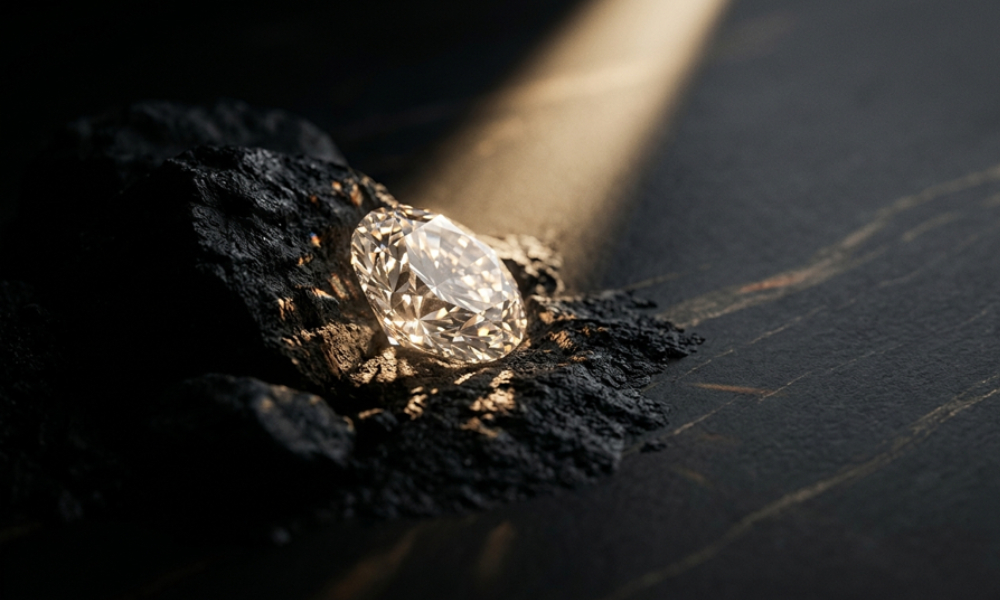
Diamond analyst Paul Zimnisky studies the natural diamond industry’s recovery, noting that its future lies in a smaller, more focused market built on luxury positioning, tighter supply and renewed consumer demand.
I recently got asked if I thought there would be a “hard landing” in the diamond industry? I intuitively shot back almost immediately with a dry laugh: “I think the hard landing has already hit.”
Over the last five years, diamond prices have retreated 50%; the book value of the industry’s steward De Beers has been written down by 70%; almost every independent diamond miner has been pressured to the brink of insolvency; and, just about every major media publication in the world has gleefully written about the “fall of the diamond industry.”
That carnage aside, I estimate that global natural diamond jewellery sales will still be about $65 billion this year, a figure that rivals the global luxury watch market. I think this is a sustainable figure longer-term even if natural diamond is permanently relegated to exclusively a higher-end luxury product.
The world’s largest sellers of fine jewellery serve as a base: Cartier, Tiffany & Co., Van Cleef & Arpels, Bulgari, Chow Tai Fook and Tanishq only sell natural diamonds.
However, the lower and mid segments of the market catering to consumers buying lower-priced engagement rings and more fashion-forward diamond merchandise will be difficult to win back given the ubiquitous presence of large, top-quality lab-grown diamonds marketed towards the price-conscious consumer.
Losing this segment of the market has, without a doubt, beaten and bruised many in the legacy supply chain, especially those with only mediocre economics to begin with. The consequence has been a catharsis of sorts that has filtered out all but the strongest players in the industry. This process has effectively taken the industry back a half century, where a much smaller number of players catered to only top-quality goods.

It’s almost hard to imagine today, but there was a time when the industry would not merchandise below VS-clarity, near-colourless goods as jewellery – especially in bridal. The mainstream distribution of lower-quality stones began around the time the Argyle mine in Australia commenced production in the mid-1980’s. Diamonds were further commoditised in the following decades with the entrance of the online “grid” retail model, e.g. Blue Nile, where consumers were presented with a shopping experience akin to that of a wholesaler.
LGDs have taken a lot of the “commoditised” segment of the diamond jewellery market over the last half decade. Perhaps this unintentionally elevates the natural diamond product back to what it once was, a true luxury item.
The natural diamond industry was already strategically aligning this way to reframe the exclusive perception of its product – for example, with origin tracking initiatives and luxury “mark” concepts. Losing the bulk of the lower-tier segment of the market inherently makes this easier.
If successful, upward price momentum in the upper-end of the diamond market will in part offset the pinch of losing the lower-end, especially for market participants like miners that rely on the full run-of-mine.
So, where are we now following the proverbial “hard landing”?
I think we are in the early recovery stage, but It’s more important to acknowledge that a typically cyclical convalescence is unlikely. There is a broader-based industry restructuring happening, one that likely results in a smaller but more deliberate industry marked by lower unit volume, but higher per unit value – which importantly is more akin to what a proper luxury industry looks like.
Near term catalysts include the sale of De Beers to a buyer that aligns with the aforementioned strategy, as well as, a gradual execution of the freshly repositioned Diamond Collective (formerly the Natural Diamond Council) – which now importantly is backed by a broader segment of the supply chain, i.e. not just a small handful of mining companies.
Personally, I am watching for retailers, especially in the Western world, to halt the selling of natural and LGDs side-by-side in a way that conflates the two products. I see this as the single most important development needed for the industry to get back on track. I think this will happen once the outsized profitability of selling LGDs normalises and/or when the downstream starts thinking more strategically longer-term.
In summary, here are some of my more categorical thoughts on the industry at the moment:
- There are essentially only three diamond miners left: De Beers and its government partners Botswana and Namibia; Russia vis-à-vis ALROSA; and Angola vis-à-vis ENDIAMA. All have a substantial vested interest in succeeding, e.g. the Botswana economy hinges on diamonds. All have sovereign capital backing.
- We have a “goldilocks” supply situation. Current supply levels are tight enough to support prices, but at the same time there is enough production capacity to keep natural diamonds a mainstream product.
- There is relative resiliency in the high-end diamond market. Effectively all the high jewellers only sell natural diamonds. This segment serves as a firm basis of demand support for the supply chain.
4. Given the nature of the product i.e. diamonds are an emotionally driven discretionary item, the future of demand ultimately lies in the industry’s hands. Proper investment will theoretically drive consumer demand back to underperforming segments of the market. If mid-market consumers start desiring “real” diamonds again, the downstream will revert to prioritising the category. For the most part, retailers go where the money is, and that has been LGDs over the last half-decade-plus. If relative profitability and ease-of-sale returns to natural diamonds, downstream results will follow: “Show me the incentive and I’ll show you the outcome.”
Paul Zimnisky, CFA is a leading independent diamond industry analyst and consultant based in the New York metro area. For regular in-depth analysis and forecasts of the global diamond industry please consider subscribing to his flagship product, State of the Diamond Market, a leading monthly industry report; an index of previous editions can be found here. Also, listen to the Paul Zimnisky Diamond Analytics Podcast on Spotify or Apple Podcasts for exclusive soliloquies and full-length conversations with top guests from the gem and jewelry industry. Paul is a graduate of the University of Maryland’s Robert H. Smith School of Business with a B.S. in finance and he is a CFA charterholder. He can be followed on X @paulzimnisky and on YouTube @paulzimnisky. Disclosure: At the time of writing Paul Zimnisky held a long equity position in Brilliant Earth Group.
