
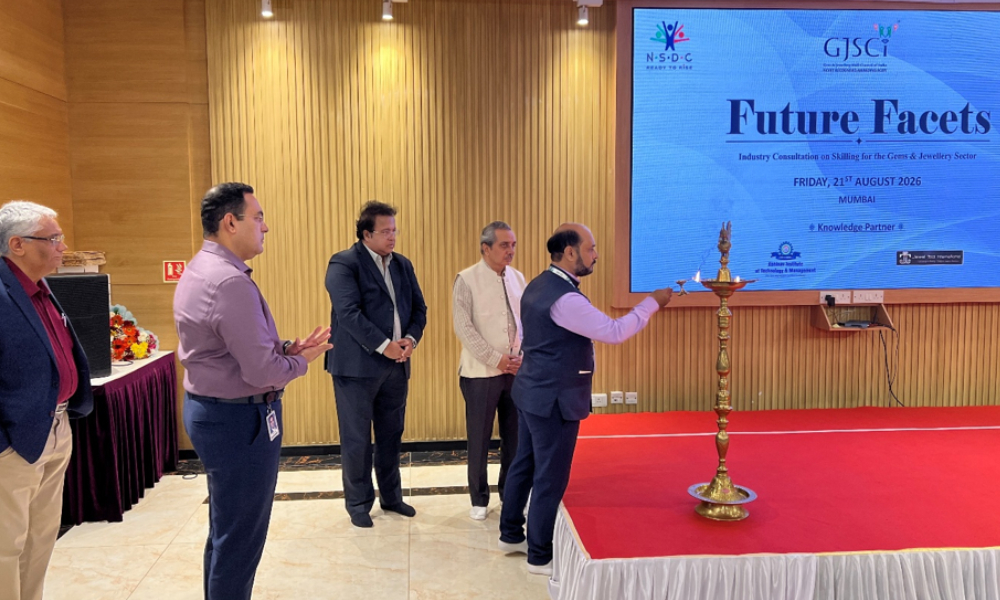
The Gem & Jewellery Skill Council of India (GJSCI) opened its industry consultation workshop, “Future Facets,” in Mumbai on 21st August, bringing together industry professionals, academics and skill-development stakeholders to examine the skills and technologies that will shape the future of the gems and jewellery sector.
The workshop, held at the Bharat Ratnam Mega CFC in SEEPZ, Mumbai, was inaugurated by Prof. M.S. Ramachandra Rao, Head, India Centre for Lab Grown Diamond (InCent-LGD), IIT Madras; Ajay Nayak, Skills Head, IGI; Kedar Raul, Director, GIA; Debasish Biswas, Director, GJSCI; and Rajeev Garg, ED & CEO, GJSCI.
In his opening address, Garg said the workshop was designed to look beyond the industry’s immediate skilling requirements and examine how the sector is likely to evolve. Referring to the recent Chintan Shivir held by Department of Commerce, in association with the GJEPC, and its roadmap for taking the industry towards US$100 billion by 2040, he said the focus now needs to be on removing roadblocks and preparing for the next phase of growth.
He identified lab-grown diamonds and technology as two developments already changing the industry, with technological advances spanning manufacturing, design and retail. The workshop, he said, would help identify the skill gaps emerging from these changes and determine where the skilling ecosystem needs to respond.
The first session, “Future Trends & Emerging Skills,” featured Prof. M.S. Ramachandra Rao on “Lab-Grown Diamonds: Opportunities and Challenges”, followed by AI and technology insights from Dhirendra Srivastava, Senior Data Scientist and AI Technical Lead.
Rao urged the industry to look at diamond beyond jewellery, highlighting applications in electronics, thermal management, optoelectronics, communications, space and quantum technologies. He also outlined IIT Madras’ work on indigenous diamond-growing technologies and equipment, including CVD and HPHT systems.
Srivastava focused on practical applications of AI across design, sampling, pricing and customer engagement. He explained how AI could help retailers search digital inventories, generate preliminary design options, automate quotation calculations and structure customer data for targeted engagement. He stressed that AI should be used to remove operational friction while domain expertise remains central to decision-making.
The second session, “Government Initiatives for MSME Growth & Skill Development,” covered government schemes supporting apprenticeships, training, international mobility and skill development for the sector.
The third session, “Open Discussion on Skill Gaps across Sub-sectors and Regions,” focused on identifying industry-specific gaps and opportunities for upskilling, reskilling and new training programs.
The final panel examined the impact of global trade policies and geopolitics, alongside the Indian gems and jewellery industry’s preparedness for ESG compliance and future requirements.