
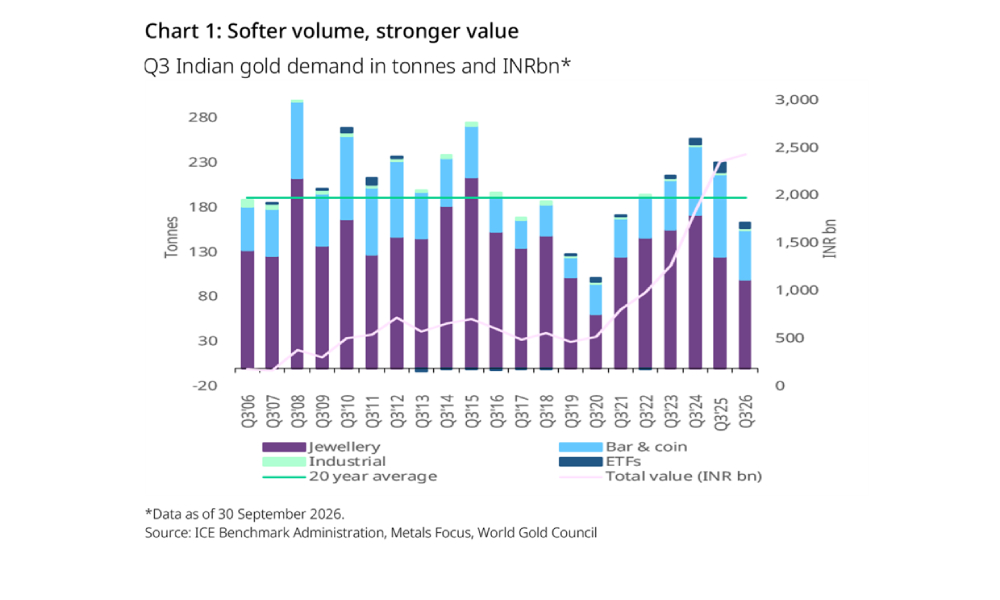
India’s gold demand declined 29% year-on-year to 162.5 tonnes in the July-September quarter of 2026, compared with 229.8 tonnes in the corresponding period last year, as elevated gold prices continued to weigh on consumer purchases. However, in value terms, demand increased 3% to ₹2,41,900 crore from ₹2,35,090 crore in Q3 2025, reflecting the impact of higher gold prices.
According to the World Gold Council’s (WGC) Gold Demand Trends: India Focus, Q3 2026, demand recovered from the subdued second quarter, rising 24% sequentially from 130.9 tonnes. The improvement was led by jewellery buying, supported by seasonal demand and a pullback in gold prices towards the end of the quarter.
Domestic gold prices averaged ₹1,48,891 per 10 grams during Q3, up 45% year-on-year, while the international gold price averaged US$4,262 per ounce, an increase of 23%.
Jewellery demand declined 20% year-on-year to 99.9 tonnes from 125 tonnes in Q3 2025. In value terms, however, it increased 16% to ₹1,48,700 crore (US$15.6 billion). On a quarter-on-quarter basis, jewellery demand rose 33%, supported by wedding and festive purchases, particularly in South India, where Onam and Varalakshmi festivities fell in August. Softer gold prices towards the end of the quarter also encouraged some consumers to proceed with purchases they had deferred.
India retained its position as the world’s largest jewellery market, accounting for 32% of global jewellery consumption in Q3 2026. During the first nine months of the year, jewellery demand fell 18% year-on-year to 241.1 tonnes, while its value increased 29% to ₹3,61,830 crore, indicating that consumers continued to spend more despite purchasing lower quantities of gold.
Investment demand also moderated from the exceptionally strong levels recorded in the previous year. Bar and coin demand fell 40% year-on-year to 55 tonnes, compared with 91.6 tonnes in Q3 2025, although it improved 9% sequentially. The WGC attributed the decline partly to a high comparative base, easing price momentum and the increase in gold import duty in May 2026. India remained the world’s second-largest bar and coin market after China, accounting for around 21% of global demand in the segment.
Gold ETF demand stood at 5.3 tonnes, down 50% year-on-year from 10.7 tonnes, but higher than the 3.6 tonnes recorded in Q2. ETF inflows strengthened towards the end of the quarter, reaching a seven-month high in September. Holdings increased to approximately 124 tonnes, reflecting continued investor interest in gold as a portfolio diversification asset.
Digital gold purchases continued to expand, with gross demand estimated at 4.9 tonnes in Q3, up 44% from 3.4 tonnes a year earlier. For January-September 2026, purchases increased 76% to 16.3 tonnes from 9.2 tonnes in the corresponding period last year.
India’s total gold supply was estimated at 136 tonnes during Q3, down 43% year-on-year. Net bullion imports, including official and unofficial inflows, amounted to 114 tonnes. Official bullion imports, including doré, fell sharply by 70% to 64 tonnes, reflecting softer physical demand, inventory adjustments, higher import duties and the possibility of imports being deferred ahead of the October festive season.
The report estimated unofficial gold inflows at around 50 tonnes in Q3, compared with just 3 tonnes in the corresponding quarter last year. The WGC noted that the increase in import duty to 15% in May had raised the cost of official imports and increased the incentive for unofficial inflows.
Recycled gold supply declined 12% year-on-year to 19.2 tonnes, despite domestic prices remaining around 45% higher than a year earlier. The relatively muted response suggested that gold holders remained reluctant to sell their holdings. The Reserve Bank of India did not purchase gold during the quarter, compared with 0.2 tonnes in Q3 2025. Its gold reserves remained broadly unchanged at around 880.5 tonnes at the end of September.
A consumer survey conducted by the WGC in association with Kantar indicated improving jewellery buying intentions ahead of the festive and wedding season. The survey covered 1,957 consumers across 12 metropolitan and Tier I cities between 4 and 18 September 2026. The proportion of respondents expecting to increase their gold jewellery purchases over the following three months rose from 20% to 29%, while those expecting to reduce purchases declined from 51% to 40%.
Weddings accounted for 25% of respondents’ expected next jewellery purchases, up from 22% in the previous survey. Purchases linked to festivals and auspicious occasions also increased from 16% to 21%. Consumers are increasingly adapting to higher prices by considering lower purity or carat options, with 77% indicating a willingness to trade down. Interest in exchanging old jewellery to fund new purchases rose from 70% to 76%.
Sachin Jain, Regional CEO, India, World Gold Council, “The July-September quarter 2026 reflected the continued resilience of gold demand in India, even as elevated prices influenced consumer purchasing behaviour… consumers continue to prioritise gold while adapting their purchases to balance affordability with long-term value… Jewellery demand was supported by a pullback in gold prices late in Q3, which encouraged some deferred purchases. Wedding and festive buying also supported demand, particularly in South India, where key festivals fell in August. Consumers are increasingly opting for more considered purchases and exchange programmes to navigate higher prices, while retaining their preference for gold jewellery.”
Looking ahead, the WGC expects the festive and wedding season to provide support to demand in Q4. Dhanteras and Diwali are expected to encourage purchases for investment, gifting and jewellery, although elevated prices and weakness in the rural economy following a poor monsoon could temper volumes. Consumers are expected to adapt through lighter-weight jewellery and exchange-led purchases.
The World Gold Council has projected India’s full-year gold demand for 2026 at 625-675 tonnes, with the country’s cultural affinity for gold and its role as a store of value expected to support purchases through the final quarter of the year.