
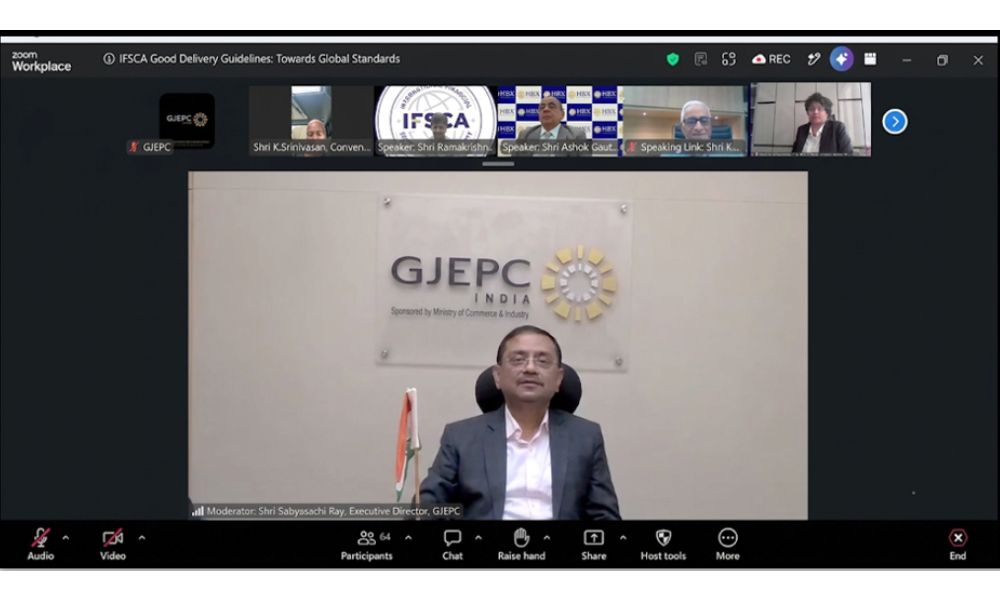
The International Financial Services Centres Authority’s (IFSCA) Good Delivery Guidelines for gold could strengthen India’s position in the global bullion trade by improving the international acceptability of Indian-refined gold, promoting responsible sourcing, and establishing greater supply chain transparency.
These priorities were discussed at a webinar titled “IFSCA Good Delivery Guidelines: Towards Global Standards”, organised by GJEPC on 22 October 2026. The session was moderated by Sabyasachi Ray, Executive Director, GJEPC, and featured K. Srinivasan, Convener – Gold Jewellery & Other Precious Metal Jewellery Panel Committee, GJEPC; Ramakrishnan Padmanabhan, Chief General Manager, IFSCA; Ashok Gautam, MD & CEO, IIBX; and Krishna Gangopadhyay, MD & CEO, India International Depository IFSC Ltd. (IIDI).
The guidelines have been developed over two years through consultations with industry stakeholders, including GJEPC, drawing on international benchmarks and the Organisation for Economic Co-operation and Development’s (OECD) due diligence guidance. The framework covers refiner accreditation, responsible sourcing, supply chain traceability, risk assessment and independent audits.
Ramakrishnan explained that global acceptance of Indian-refined gold will be essential if India is to emerge as an international bullion trading hub and exert greater influence on gold pricing. He highlighted the importance of transparent sourcing and robust due diligence in establishing confidence in Indian gold among international market participants.
Gautam outlined IIBX’s proposed implementation framework, which will include a board-level subcommittee and an advisory committee involving refiners, auditors and other stakeholders. The exchange will have responsibilities relating to refiner certification, compliance monitoring, auditor empanelment and the management of non-compliance.
The guidelines also establish a risk-based compliance process covering supplier identification, supply chain risk assessment, preventive measures, documentation, independent audits and annual reporting. Discussions highlighted the potential to develop domestic auditing capabilities in collaboration with international institutions, helping Indian refiners meet global expectations.
Gangopadhyay explained the role of IIDI in maintaining the integrity of the bullion value chain and supporting the issuance of bullion depository receipts. The framework is expected to improve transparency and traceability while strengthening confidence in gold refined within India’s international financial services ecosystem.
The discussion also examined the possibility of incorporating the guidelines into existing and future free trade agreements (FTAs), which could help widen international recognition of Indian-refined bullion. Participants considered extending the framework to silver in the future, although the current guidelines focus on gold.
Further stakeholder consultations are planned as the implementation framework takes shape. The initiative aims to strengthen the credibility of Indian refiners, improve access to international bullion markets and support India’s ambition to become a more influential participant in global gold trading.