
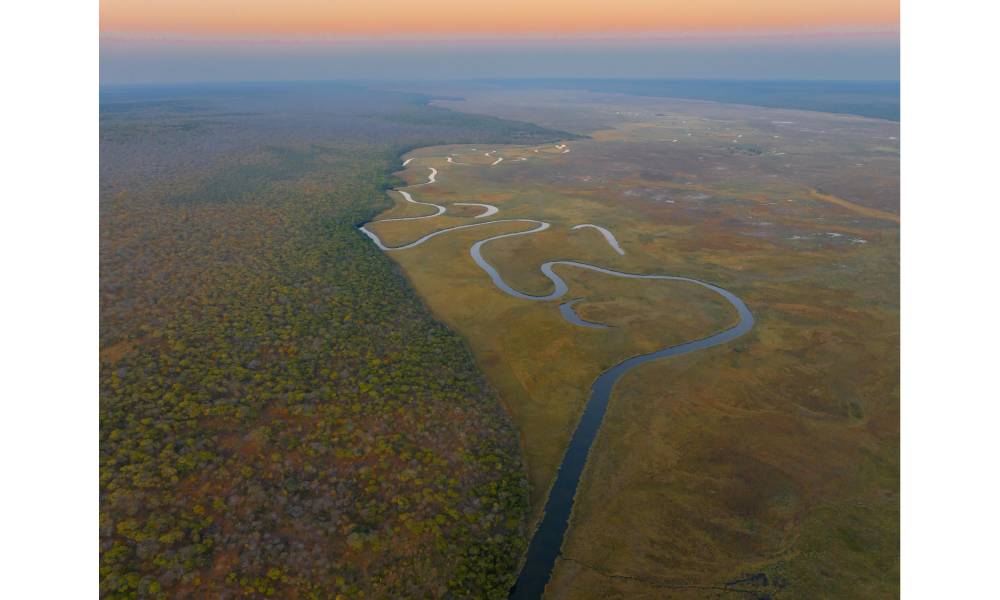
The National Geographic Society and De Beers Group have extended their Okavango Eternal partnership for another five years, renewing their commitment to protecting the Okavango River Basin and supporting conservation-linked livelihoods across Botswana, Angola and Namibia.
The next phase will focus on securing formal protection for approximately 5.4 million hectares at the Basin’s source in Angola, alongside stronger community-led stewardship across the region. More than 95% of the water sustaining Botswana’s Okavango Delta originates in the Angolan Highlands before flowing through Namibia into Botswana, making cooperation across the three countries central to the Basin’s long-term protection.
The partnership, launched in 2021, has already supported 19 research expeditions, mapped 230 carbon-storing peatland sites, trained 82 community members through the Watchers programme and supported 2,118 conservation-linked livelihood opportunities across the three countries. Infrastructure improvements have also benefited 18,500 people in Angola.
A key milestone was Angola’s designation of Lisima Lya Mwono (“Source of Life”) as the country’s first Ramsar Wetland of International Importance. The designation was supported by scientific research, traditional knowledge and community engagement developed through the partnership.
The renewed programme will centre on three areas: advancing conservation through science and traditional knowledge; expanding livelihood opportunities through financial and business training, mentoring and access to ethical markets; and using storytelling to encourage conservation action.
The announcement was made during an event co-hosted by the two organisations in New York during New York Climate Week. The event also highlighted an emerging Okavango Eternal Alliance between the governments of Botswana, Angola and Namibia, aimed at strengthening coordination across the Basin.